BookmarkBookmark
テキスト表示モード
ELT CATALOGUE KINSEIDO 2027
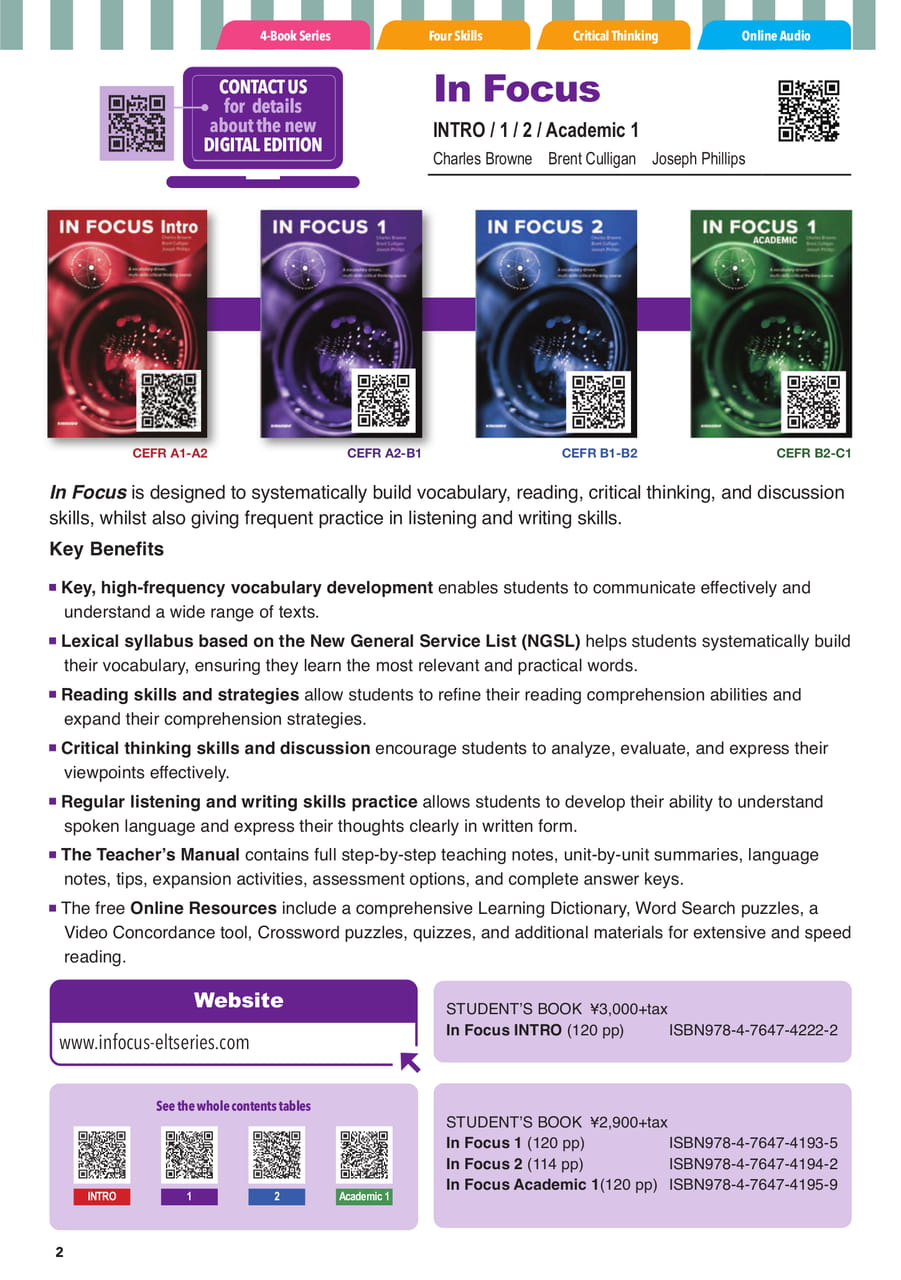
In Focus
4-Book Series Four Skills
Critical Thinking Online Audio
CONTACT US for details about the new DIGITAL EDITION
In Focus
INTRO / 1 / 2 / Academic 1
Charles Browne Brent Culligan Joseph Phillips
CEFR A1-A2 CEFR A2-B1 CEFR B1-B2 CEFR B2-C1
In Focus is designed to systematically build vocabulary, reading, critical thinking, and discussion skills, whilst also giving frequent practice in listening and writing skills. Key Benefits
Key, high-frequency vocabulary development enables students to communicate effectively and understand a wide range of texts. Lexical syllabus based on the New General Service List (NGSL) helps students systematically build their vocabulary, ensuring they learn the most relevant and practical words. Reading skills and strategies allow students to refine their reading comprehension abilities and expand their comprehension strategies. Critical thinking skills and discussion encourage students to analyze, evaluate, and express their viewpoints effectively. Regular listening and writing skills practice allows students to develop their ability to understand spoken language and express their thoughts clearly in written form. The Teacher’s Manual contains full step-by-step teaching notes, unit-by-unit summaries, language notes, tips, expansion activities, assessment options, and complete answer keys. The free Online Resources include a comprehensive Learning Dictionary, Word Search puzzles, a Video Concordance tool, Crossword puzzles, quizzes, and additional materials for extensive and speed reading.
Website www.infocus-eltseries.com
STUDENT’S BOOK ¥3,000+tax In Focus INTRO (120 pp) ISBN978-4-7647-4222-2
INTRO
See the whole contents tables
1 2
Academic 1
STUDENT’S BOOK ¥2,900+tax In Focus 1 (120 pp)
ISBN978-4-7647-4193-5
In Focus 2 (114 pp)
ISBN978-4-7647-4194-2 In Focus Academic 1(120 pp) ISBN978-4-7647-4195-9
2
In Focus Sample Pages
1
Sample pages (In Focus 2, Unit 1)
UNIT
A World of English
1 2 Core vocabulary A Skimming and scanning 1 Find and underline the keywords in the passage. Try to guess their meanings.
Keywords acquire equivalent estimate exposure multiple per regional researcher retain struggle
The Wonder of Language
B Words in context: collocations 1 Look at the text on page 2. Find the keywords that form collocations with the words below.
1 researchers ________________
3 ________________ day 2 roughly ________________ 4 ________________ accent
2 Match the four keywords with the words below to make new collocations. 1 ________________ costs
5 average ________________ 2 ________________ amount 6 cash ________________ 3 ________________ government 7 ________________ director 4 ________________ month
8 ________________ year collocations Collocations are common word combinations. For example, the verb express is often found with the noun opinion, as in express your opinion.
4 Unit 1
1
Critical cartoons A Warm up
English is spoken as a fi rst language in …
In this unit, you will: • read an article about language development. • read an article about the English-speaking world. • discuss the pros and cons of English as a world language.
Work with a partner or in a small group. Look at the information on this page and the cartoon. Discuss the questions below.
I guess some English speakers think …
1 How many countries can you name where English is spoken as a first or second language?
2 Have you ever met an English speaker who expects others to be able One way the use of to speak English? Why do you think they might have that attitude? English has changed is …
3 Think about the use of English among your grandparent’s generation, your parent’s generation, and your own. How has it changed?
Maybe the message
4 What is the message of the cartoon? of the cartoon is …
What is the connection to the unit topic? MEDIA Fry’s Planet Word (2011) is a five-part documentary series written by actor and link writer Stephen Fry. It explores language and its role in human history. Episode 4,
“Spreading the Word,” examines the influence of English as a world language. It looks at how technology influences language evolution and spread.
For additional media links, go to infocus-eltseries.com
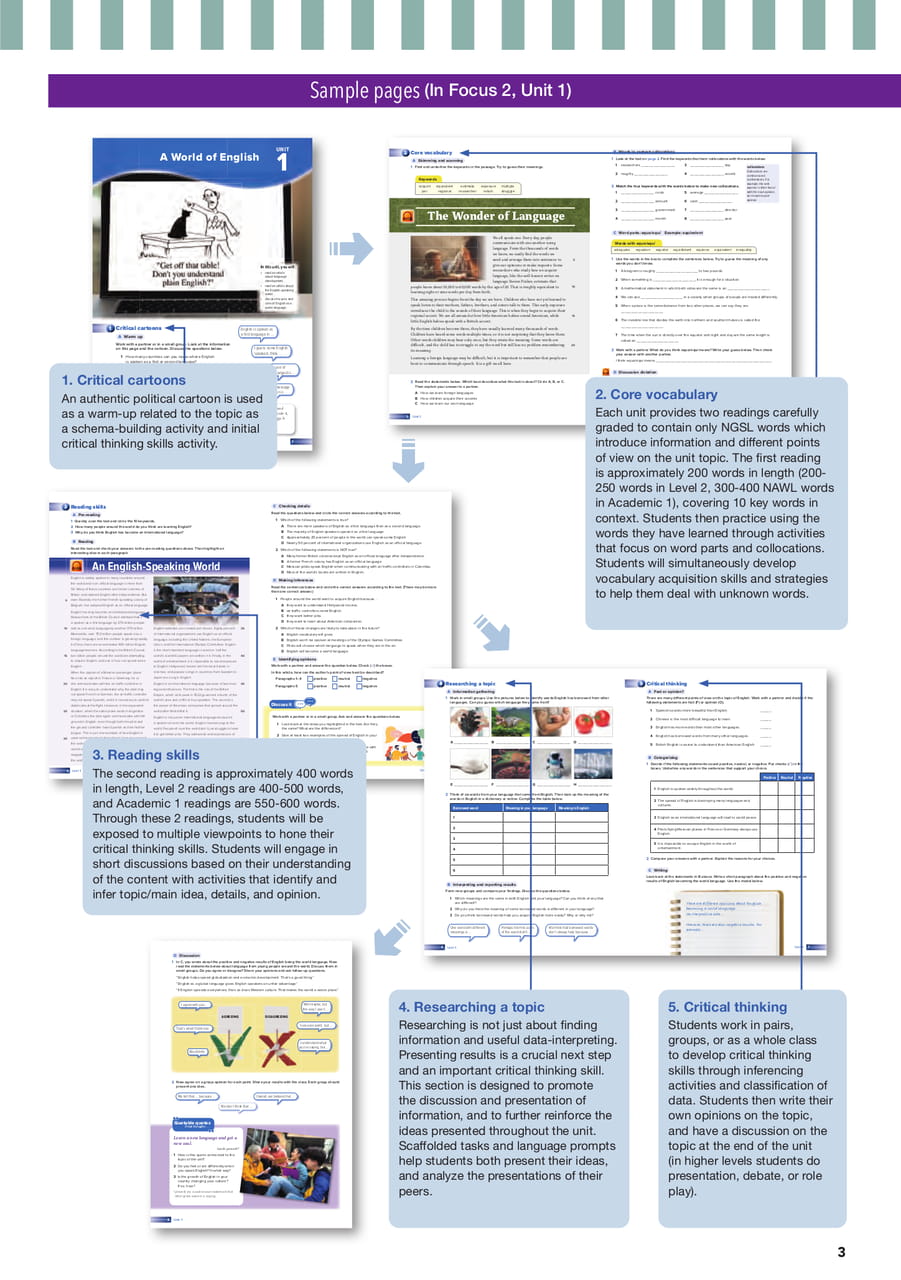
1. Critical cartoons An authentic political cartoon is used as a warm-up related to the topic as a schema-building activity and initial critical thinking skills activity. 3 Reading skills A Pre-reading 1 Quickly scan the text and circle the 10 keywords. 2 How many people around the world do you think are learning English? 3 Why do you think English has become an international language?
B Reading
Read the text and check your answers to the pre-reading questions above. Then highlight an interesting idea in each paragraph.
An English-Speaking World
English is widely spoken in many countries around the world and is an offi cial language in more than 50. Many of these countries are former colonies of Britain and retained English after independence. But 5 even Rwanda, the former French-speaking colony of Belgium, has adopted English as an offi cial language.
English has truly become an international language. Researchers at the British Council estimate that it is spoken as a fi rst language by 375 million people
10 and as a second language by another 375 million. English websites are created per minute. Eighty percent 35 Meanwhile, over 750 million people speak it as a of international organizations use English as an offi cial foreign language, and this number is growing rapidly. language, including the United Nations, the European In China, there are an estimated 400 million English Union, and the International Olympic Committee. English language learners. According to the British Council, is the most important language in science: half the
15 two billion people around the world are attempting world’s scientifi c papers are written in it. Finally, in the 40 to acquire English, and one in four can speak some world of entertainment, it is impossible to avoid exposure English. to English. Hollywood movies sell the most tickets in When the captain of a Mexican passenger plane cinemas, and popular songs in countries from Sweden to fl ies into an airport in France or Germany, he or Japan are sung in English.
20 she communicates with the air traffi c controller in English is an international language because of two main 45 English. It is easy to understand why: the pilot may regional infl uences. The fi rst is the rule of the British not speak French or German, the air traffi c controller Empire, which at its peak in 1922 governed a fourth of the may not speak Spanish, and it is necessary to confi rm world’s area and a fi fth of its population. The second is details about the fl ight. However, in the equivalent the power of American companies that spread around the 25 situation, when the same plane lands in Argentina world after World War II.
50 or Colombia, the pilot again communicates with the English is not just an international language because it ground in English, even though both the pilot and is spoken all over the world. English now belongs to the the ground controller have Spanish as their mother world. People all over the world don’t just struggle to learn tongue. This is just one example of how English is it to get better jobs. They add words and expressions of
30 used as the standard international language around their own, and they are changing the language in multiple 55 the world. Today, three-quarters of the world’s mail, ways. This helps to make English a true world language. most books, and many of the world’s newspapers and English as a world language allows all countries to be part magazines are written in English. More than half of of the world community, and this benefi ts us all. the world’s websites are in English, and over 100 new
3. Reading skills
We all speak one. Every day, people communicate with one another using language. From the thousands of words we know, we easily find the words we need and arrange them into sentences to give our opinions or make requests. Some researchers who study how we acquire language, like the well-known writer on language Steven Pinker, estimate that people know about 50,000 to 60,000 words by the age of 20. That is roughly equivalent to learning eight or nine words per day from birth.
This amazing process begins from the day we are born. Children who have not yet learned to speak listen to their mothers, fathers, brothers, and sisters talk to them. This early exposure introduces the child to the sounds of their language. This is when they begin to acquire their regional accent. We are all amazed at how little American babies sound American, while little English babies speak with a British accent.
By the time children become three, they have usually learned many thousands of words. Children have heard some words multiple times, so it is not surprising that they know them. Other words children may hear only once, but they retain the meaning. Some words are difficult, and the child has to struggle to say the word but still has no problem remembering its meaning.
Learning a foreign language may be difficult, but it is important to remember that people are born to communicate through speech. It is a gift we all have.
2 Read the statements below. Which best describes what this text is about? Circle A, B, or C. Then explain your answer to a partner.
A How we learn foreign languages B How children acquire their accents C How we learn our own language
2 Unit 1
C Checking details Read the questions below and circle the correct answers according to the text.
1 Which of the following statements is true? A There are more speakers of English as a first language than as a second language. B The majority of English speakers speak it as a first language. C Approximately 25 percent of people in the world can speak some English. D Nearly 50 percent of international organizations use English as an official language.
2 Which of the following statements is NOT true? A Many former British colonies kept English as an official language after independence. B A former French colony has English as an official language. C Mexican pilots speak English when communicating with air traffic controllers in Colombia. D Most of the world’s books are written in English.
D Making inferences
Read the sentences below and circle the correct answers according to the text. (There may be more than one correct answer.)
1 People around the world want to acquire English because … A they want to understand Hollywood movies. B air traffic controllers need English. C they want better jobs. D they want to learn about American companies.
2 Which of these changes are likely to take place in the future? A English vocabulary will grow. B English won’t be spoken at meetings of the Olympic Games Committee. C Pilots will choose which language to speak when they are in the air. D English will become a world language.
E Identifying opinions Work with a partner and answer the question below. Check (✓) the boxes. In this article, how can the author’s point of view best be described? Paragraphs 1–4 positive neutral negative 4 Researching a topic
Paragraphs 5 positive neutral negative A Information gathering
1 Work in small groups. Use the pictures below to identify words English has borrowed from other languages. Can you guess which language they came from? Discuss it
Work with a partner or in a small group. Ask and answer the questions below.
1 Look back at the ideas you highlighted in the text. Are they the same? What are the differences?
2 Give at least two examples of the spread of English in your country.
3 Are there any languages that could one day compete with English? Explain which language and why or why not.
The second reading is approximately 400 words in length, Level 2 readings are 400-500 words, and Academic 1 readings are 550-600 words. Through these 2 readings, students will be exposed to multiple viewpoints to hone their critical thinking skills. Students will engage in short discussions based on their understanding of the content with activities that identify and infer topic/main idea, details, and opinion.
Unit 1 5
A ________________ B ________________ C ________________ D ________________
E ________________ F ________________ G ________________ H ________________
2 Think of six words from your language that came from English. Then look up the meaning of the words in English in a dictionary or online. Complete the table below.
Borrowed word Meaning in your language Meaning in English 1
2
3
4
5
6
B Interpreting and reporting results Form new groups and compare your findings. Discuss the questions below.
1 Which meanings are the same in both English and your language? Can you think of any that are different?
2 Why do you think the meaning of some borrowed words is different in your language? 3 Do you think borrowed words help you acquire English more easily? Why or why not?
5
10
15
20
C Word parts: equa/equi Example: equivalent
Words with equa/equi adequate equation equator equidistant equinox equivalent inequality
1 Use the words in the box to complete the sentences below. Try to guess the meaning of any words you don’t know.
1 A kilogram is roughly ____________________ to two pounds. 2 When something is ____________________, it is enough for a situation. 3 A mathematical statement in which both sides are the same is an ____________________. 4 We can see ____________________ in a society when groups of people are treated differently.
5 When a place is the same distance from two other places, we can say they are ____________________.
6 The invisible line that divides the earth into northern and southern halves is called the ____________________.
7 The time when the sun is directly over the equator and night and day are the same length is called an ____________________.
2 Work with a partner. What do you think equa/equi means? Write your guess below. Then check your answer with another partner.
I think equa/equi means _______________________________________________________
D Discussion dictation
1 Listen and write down the questions. Then discuss them in small groups. 1 How ________________________________________________________________________ ? 2 How ________________________________________________________________________ ?
2. Core vocabulary
3 What _____________________________________________________________________?
2 Form new groups and compare your answers.
Each unit provides two readings Unit 1 3carefully graded to contain only NGSL words which introduce information and different points of view on the unit topic. The first reading is approximately 200 words in length (200- 250 words in Level 2, 300-400 NAWL words in Academic 1), covering 10 key words in context. Students then practice using the words they have learned through activities that focus on word parts and collocations. Students will simultaneously develop vocabulary acquisition skills and strategies to help them deal with unknown words. 5 Critical thinking A Fact or opinion?
There are many different points of view on the topic of English. Work with a partner and decide if the following statements are fact (F) or opinion (O).
1 Spanish sounds more beautiful than English. _____ 2 Chinese is the most difficult language to learn. _____ 3 English has more words than most other languages. _____ 4 English has borrowed words from many other languages. _____ 5 British English is easier to understand than American English. _____
B Categorizing
1 Decide if the following statements sound positive, neutral, or negative. Put checks (✓) in the boxes. Underline any words in the sentences that support your choice.
Positive Neutral Negative
1 English is spoken widely throughout the world.
2 The spread of English is destroying many languages and cultures.
3 English as an international language will lead to world peace.
4 Pilots flying Mexican planes in France or Germany always use English.
5 It is impossible to escape English in the world of entertainment.
2 Compare your answers with a partner. Explain the reasons for your choices.
C Writing
Look back at the statements in B above. Write a short paragraph about the positive and negative results of English becoming the world language. Use the model below.
There are different opinions about English becoming a world language. On the positive side …
One word with different meanings is …
Perhaps the fi rst users of the word didn’t ...
We think that borrowed words don’t always help because …
However, there are also negative results. For example …
6 Unit 1 Unit 1
7
D Discussion
1 In C, you wrote about the positive and negative results of English being the world language. Now read the statements below about language from young people around the world. Discuss them in small groups. Do you agree or disagree? Share your opinions and ask follow-up questions.
“English helps speed globalization and economic development. That’s a good thing.”“English as a global language gives English speakers an unfair advantage.”“If English spreads everywhere, then so does Western culture. That makes the world a worse place.”
I agree with you.
That’s what I think too.
Absolutely.
AGREEING DISAGREEING
Well maybe, but the way I see it …
I see your point, but …
I understand what you’re saying, but …
2 Now agree on a group opinion for each point. Share your results with the class. Each group should present one idea.
We felt that … because … Overall, we believe that …
We don’t think that …
Quotable quotes Final thoughts . . .
Learn a new language and get a new soul.
Czech proverb*
1 How is this quote connected to the topic of the unit?
2 Do you feel or act differently when you speak English? In what way?
3 Is the growth of English in your country changing your culture? If so, how?
*proverb (n): a well-known statement that often gives advice; a saying
4. Researching a topic Researching is not just about finding information and useful data-interpreting. Presenting results is a crucial next step and an important critical thinking skill. This section is designed to promote the discussion and presentation of information, and to further reinforce the ideas presented throughout the unit. Scaffolded tasks and language prompts help students both present their ideas, and analyze the presentations of their peers.
5. Critical thinking Students work in pairs, groups, or as a whole class to develop critical thinking skills through inferencing activities and classification of data. Students then write their own opinions on the topic, and have a discussion on the topic at the end of the unit (in higher levels students do presentation, debate, or role play).
8 Unit 1
3
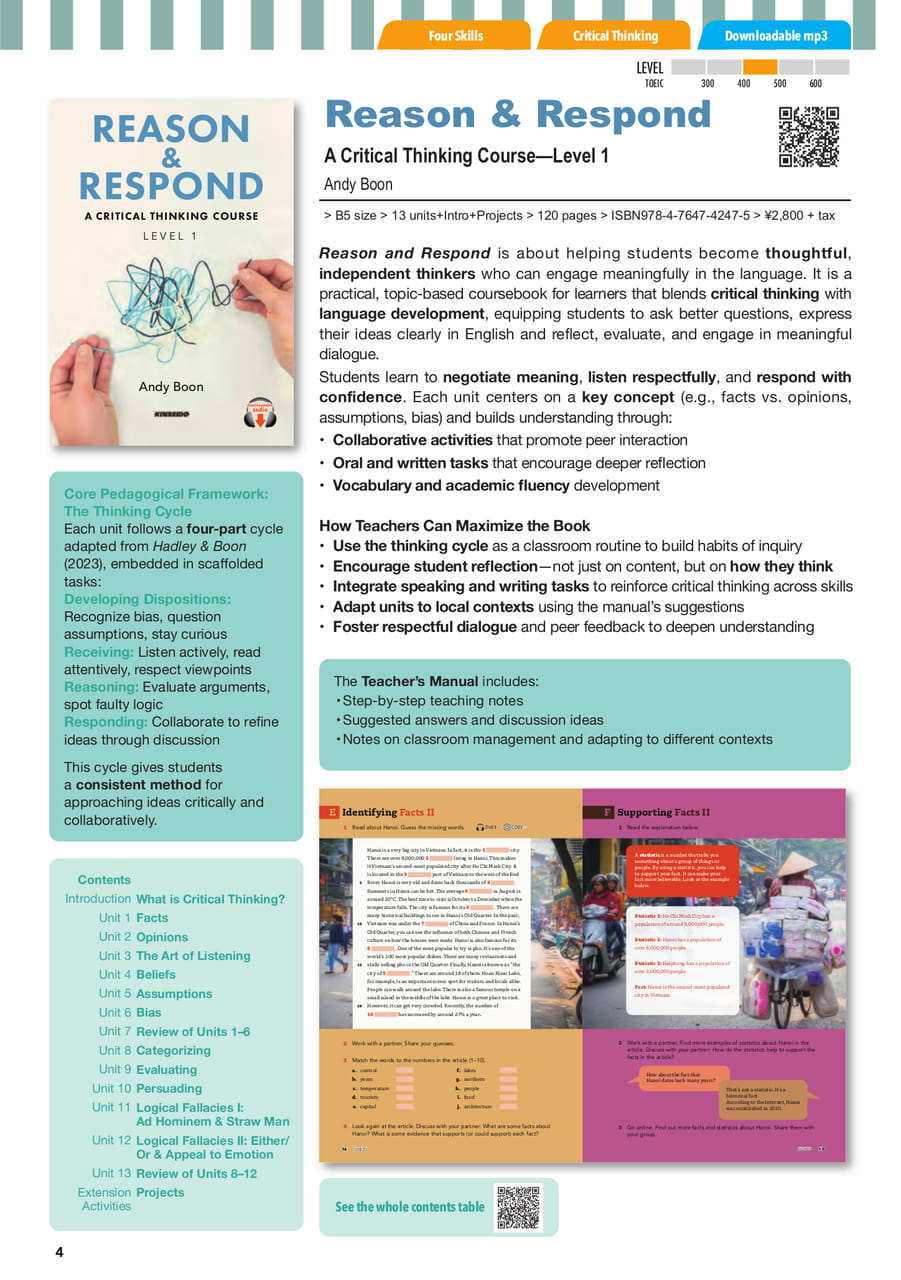
Reason & Respond
1 Read about Hanoi. Guess the missing words.
Four Skills Critical Thinking Downloadable mp3
REASON & RESPOND
A CRITICAL THINKING COURSE LEVEL 1
Andy Boon
Core Pedagogical Framework: The Thinking Cycle Each unit follows a four-part cycle adapted from Hadley & Boon (2023), embedded in scaffolded tasks: Developing Dispositions: Recognize bias, question assumptions, stay curious Receiving: Listen actively, read attentively, respect viewpoints Reasoning: Evaluate arguments, spot faulty logic Responding: Collaborate to refine ideas through discussion
This cycle gives students a consistent method for approaching ideas critically and collaboratively.
Reason & Respond
A Critical Thinking Course—Level 1
Andy Boon
Reason and Respond is about helping students become thoughtful, independent thinkers who can engage meaningfully in the language. It is a practical, topic-based coursebook for learners that blends critical thinking with language development, equipping students to ask better questions, express their ideas clearly in English and reflect, evaluate, and engage in meaningful dialogue. Students learn to negotiate meaning, listen respectfully, and respond with confidence. Each unit centers on a key concept (e.g., facts vs. opinions, assumptions, bias) and builds understanding through: • Collaborative activities that promote peer interaction • Oral and written tasks that encourage deeper reflection • Vocabulary and academic fluency development
How Teachers Can Maximize the Book • Use the thinking cycle as a classroom routine to build habits of inquiry • Encourage student reflection—not just on content, but on how they think • Integrate speaking and writing tasks to reinforce critical thinking across skills • Adapt units to local contexts using the manual’s suggestions • Foster respectful dialogue and peer feedback to deepen understanding
The Teacher’s Manual includes: • Step-by-step teaching notes • Suggested answers and discussion ideas • Notes on classroom management and adapting to different contexts
E Identifying Facts II
DL03 CD03
LEVEL
TOEIC 300 400 500 600
> B5 size > 13 units+Intro+Projects > 120 pages > ISBN978-4-7647-4247-5 > ¥2,800 + tax
F Supporting Facts II 1 Read the explanation below.
Contents
Introduction What is Critical Thinking? Unit 1 Facts Unit 2 Opinions Unit 3 The Art of Listening Unit 4 Beliefs Unit 5 Assumptions Unit 6 Bias Unit 7 Review of Units 1–6 Unit 8 Categorizing Unit 9 Evaluating Unit 10 Persuading
Unit 11 Logical Fallacies I: Ad Hominem & Straw Man
Unit 12 Logical Fallacies II: Either/ Or & Appeal to Emotion
Unit 13 Review of Units 8–12
Extension Projects Activities
Hanoi is a very big city in Vietnam. In fact, it is the 1 city.
A statistic is a number that tells you There are over 8,000,000 2 living in Hanoi. This makes something about a group of things or it Vietnam’s second-most populated city after Ho Chi Minh City. It people. By using a statistic, you can help is located in the 3 part of Vietnam to the west of the Red to support your fact. It can make your fact more believable. Look at the example 5 River. Hanoi is very old and dates back thousands of 4 . below.
Summers in Hanoi can be hot. The average 5 in August is around 30°C. The best time to visit is October to December when the temperature falls. The city is famous for its 6
. There are many historical buildings to see in Hanoi’s Old Quarter. In the past,
Statistic 1: Ho Chi Minh City has a 10 Vietnam was under the 7 of China and France. In Hanoi’s population of around 9,000,000 people.
Old Quarter, you can see the influence of both Chinese and French culture on how the houses were made. Hanoi is also famous for its
Statistic 2: Hanoi has a population of
8 . One of the most popular to try is pho. It’s one of the over 8,000,000 people. world’s 100 most popular dishes. There are many restaurants and 15 stalls selling pho in the Old Quarter. Finally, Hanoi is known as “the Statistic 3: Haiphong has a population of city of 9 .” There are around 18 of them. Hoan Kiem Lake, over 2,000,000 people. for example, is an important scenic spot for visitors and locals alike. People can walk around the lake. There is also a famous temple on a
Fact: Hanoi is the second-most populated small island in the middle of the lake. Hanoi is a great place to visit. city in Vietnam. 20 However, it can get very crowded. Recently, the number of 10 has increased by around 27% a year.
2 Work with a partner. Share your guesses.
2 Work with a partner. Find more examples of statistics about Hanoi in the article. Discuss with your partner: How do the statistics help to support the facts in the article?
3 Match the words to the numbers in the article (1–10). a. control f. lakes How about the fact that b. years g. northern
Hanoi dates back many years? c. temperature h. people
That’s not a statistic. It’s a d. tourists i. food historical fact. According to the Internet, Hanoi e. capital j. architecture was established in 1010.
4 Look again at the article. Discuss with your partner: What are some facts about 3 Go online. Find out more facts and statistics about Hanoi. Share them with
Hanoi? What is some evidence that supports (or could support) each fact? your group.
16 UNIT 1 FACTS
17
See the whole contents table
4
Reason & Respond Sample Pages
In this unit, you will learn: • Academic discussion skills: Asking for and sharing opinions • Note-taking skills: Organizing ideas—outlining, mapping, and charting • Research skills: Choosing a topic
1 How important is family to you? Give reasons. 2 How important is family in your culture? Explain. 3 What different types of family structures are there? Give examples.
1 Match the vocabulary items on the left side with the synonyms and definitions on the right. 1. adopt (v) a. the legal ending of a marriage 2. constant (adj) b. a way of trying to solve a situation 3. divorce (n) c. main; most important 4. extended family (n) d. to legally become the parent of someone else’s child 5. household (n) e. a family consisting of only the parents and their children 6. measure (n) f. point of view 7. nuclear family (n) g. happening without change for a period of time 8. perspective (n) h. to be very important (for someone) 9. primary (adj) i. something that is more important than other things 10. priority (n) j. fixed or safe
2 Use the vocabulary from Exercise 1 to complete the sentences.
a. Julian lives with his _____________________, including his grandparents on his mother’s side.
b. Tom lives with his father and three brothers, so they are a male-only _____________________.
c. After 10 years of marriage, my parents decided to get a(n) _____________________ and now live separately.
d. One _____________________ that will be taken to keep the campus safe is increasing the number of security cameras.
e. Poverty is a(n) _____________________ concern for many countries. f. My parents decided to _____________________ me when I was around two years old. g. Sophia’s main _____________________ after college is to get a good job. h. He was in an accident, but his condition is now _____________________. i. Jin always thinks about problems from a political _____________________. j. It’s just me and my parents, so we are a modern _____________________. k. The _____________________ noise of the city at night prevents me from sleeping well. l. I really _____________________ this necklace that used to belong to my grandmother.
3 Use your vocabulary: Discuss these questions with a partner or a group.
a. Including you, how many people belong to your household? b. What are your top priorities at the moment? c. What kinds of objects do you value? d. Is it possible for people from other countries to adopt children in your country? e. What is your primary goal for the future?
11. stable (adj) k. a family or a group of people who live together in a house
12. value (v) l. a family consisting of parents, children, and other relatives in the same household
12 UNIT 1 FAMILIES
13 a. Nuclear families are common in my culture.
b. Parents are expected to be married in my culture.
DL02
Family is usually regarded as a primary institution, fundamental to society, but what is a family? Sociologists agree that there are various types of families, including nuclear families, extended 5 families, and single-parent families. Families may not be connected by blood––for instance, couples may choose to get a divorce and remarry, building blended families, or to adopt children. In the U.S., research by the PEW Research Center (2021) showed that 10 the number of childless families could continue to increase as the percentage of non-parents who say they will probably not have children increased from 37% in 2018 to 44% in 2021. Similarly, in Japan, the government estimated that up to 42% of women 15 born in 2005 might not have children (Nikkei, 2023), a trend also present in various other East Asian countries.
CD02
1 Consider the passage about family. To what extent do you agree with the following statements?
Completely Somewhat Somewhat Completely agree agree disagree disagree
Asking for and sharing opinions is fundamental to any discussion and should be supported by reasons and evidence whenever possible. The language we use to ask for and share our opinions will vary depending on the context of the discussion and on the participating members.
1 Consider the expressions below, used for asking for and sharing opinions. Which of the following expressions are used in more formal (F) or informal (IF) contexts?
Asking for opinions Sharing opinions
Do you have any views on …? If you ask me, ...
How do you feel about …? I tend to think that ...
Your thoughts? It seems to me that ...
Have you got any comments on …? I’d say that ...
Do you believe that …? For me, ...
What do you think about …? Personally, I feel that ...
What’s your opinion on …?
Well, if you ask me ...
2 What other expressions to ask for and share opinions can you think of? Make a note as to whether they are used in formal (F) or informal (IF) contexts.
Asking for opinions Sharing opinions c. Close friends can be considered family despite not being related by blood.
3 Intercultural discussion: Consider the questions from an intercultural perspective, prepare notes, and discuss your ideas with your partner or group. d. In the country where I live, it is common for people to adopt children. a. What kinds of families are more common in your country? Why do you think that is? Consider various social, economic, and political factors. e. In the country where I live, more and more young people would rather not b. Have there been any big changes to family structures in your country in the past 50 years? have children.
Give examples. c. Research one other country or culture that you are interested in. What kinds of families
2 Discuss your answers to the table above with a partner or a group. Provide reasons and are popular? How is it similar to and/or different from your own country or culture? Give concrete examples whenever possible. reasons and examples.
14 UNIT 1 FAMILIES
15
DL03~ DL07
CD03 ~
Outlining Topic
When listening to a talk, lecture, or presentation, organize
1. Main idea 1 a. Example 1 your notes into main ideas, details, and examples. You b. Example 2 2. Main idea 2 can do this by outlining, mapping, or charting. You should a. Example 1 b. Example 2 choose the style that works the best for helping you to 3. Main idea 3 remember the content of the lectures. a. Example 1 b. Example 2
Mapping Charting
Example 1
Main idea 1
Topic
Example 2
Main
Main Example 1 Example 1 idea 2 idea 3
Example 2 Example 2
Main idea 1
Main idea 2
Main idea 3
Description Pros Cons
CD07
1 Before listening to the talk, discuss with a partner or a group: What is a single-parent family? What are some of the challenges these families may face?
2 Listen to the talk about being a single-parent and take notes. What are the main topics of the talk? Select all that apply.
Statistics about single-parent households Factors contributing to single-parent households Challenges faced by single-parent households Effects of single-parent households on children Measures that can help to provide support for single parents
3 Listen to the talk one more time and complete the sentences with information from your notes. a. _______________ % of children worldwide live in single-parent households. b. The _______________ has the second largest number of single-parent households in the world. c. One challenge is to balance home and parenting responsibilities with _______________. d. In Japan, 56% of _______________ households live below the poverty line. e. Many single mothers take on _______________, which is less stable financially. f. One way to help single parents is by providing _______________ work conditions. g. Single parents would also benefit from _______________ childcare. h. Finally, it is important to ensure that all children can receive _______________ education. aware of? Which of those challenges are less known or discussed? Can you think of others? Prepare notes, and discuss your ideas with your partner or group.
5 Apply your knowledge: Reflect on the talk you heard about single-parent families and complete the table with your notes. What trends do you notice in your country?
a. Number or percentage of single mothers in my country
b. Number or percentage of single fathers in my country
c. Poverty rate among single parents in my country
d. Challenges faced by single parents in my country
e. Support measures for singleparent families in my country
Summary of single-parenting trends in my country:
Analysis of single-parenting trends in my country:
16 UNIT 1 FAMILIES
17
When choosing a research topic, consider the following Venn diagram: • What are you interested in? Being interested in a topic will help you stay motivated when conducting research. • What is the broad theme or topic you are expected to research? Make sure to stay focused. • How much time and resources do you have at your disposal? Narrow your ideas to a manageable topic. available
Step 1: Choose an issue related to family that is important in your country or culture. Remember to balance the broad topic (family) with your personal interests, and the time and resources you have available.
Step 3:
Research topic:
Step 2: Research and make notes about the following points: a. Key data/statistics about this issue in your country or culture b. Causes and effects of the issue in your country or culture c. Other countries or cultures facing a similar issue d. Key data/statistics about this issue in other countries or cultures e. Causes and effects of the issue in other countries or cultures
Share your research with a partner or a group.
Completely Somewhat Somewhat Completely agree agree disagree disagree a. I can understand and use the vocabulary introduced in this unit.
b. I can ask for and share opinions in formal and informal contexts.
c. I can organize notes visually into main ideas, details, and examples.
d. I can choose an appropriate research topic based on the assignment, my interests, and the resources available.
e. I can think critically about social issues related to families.
18 UNIT 1 FAMILIES
19
Four Skills EAP
Downloadable mp3
INTERCULTURAL
PERSPECTIVES
Intercultural Perspectives
An EAP Course for Global Competence
Ana Sofia Hofmeyr
LEVEL
TOEIC 300 400 500 600
> B5 size > 12 units > 112 pages > ISBN978-4-7647-4248-2 > ¥2,800 + tax
UNIT
1 FAMILIES
MAIN SKILLS
A Think about the topic
B Vocabulary building
C Reading
AN EAP COURSE FOR GLOBAL COMPETENCE
What is a family?
Ana Sofia Hofmeyr
D Academic discussion skills
Asking for and sharing opinions
Intercultural Perspectives provides a culture-integrated approach to developing English skills for academic purposes. Students can build on their overall academic vocabulary, reading, listening, and speaking skills while increasing their awareness and understanding of cultural diversity.
There is a total of 12 units. Each unit: • is divided into seven sections as below, all of which provide students with the opportunity to think critically about social and global issues, and to share their opinions and views using the target language; • focuses on social topics including Families, Education, Migration, Privacy, and Artificial Intelligence, encouraging students to examine their own experiences and perspectives first, and then look outside their circle to find similarities and differences with others from around the globe; • is designed to expand students’ language skills by providing them with vocabulary, discussion, and presentation language they may need in academic, social, and professional contexts. • Reading and listening passages allow students to explore perspectives on the topic and help to strengthen their note-taking and critical thinking skills. In addition, as exposure to both information and disinformation increases, students apply research skills to help them navigate and be more critical of the information they come across.
Section A: Think about the topic Students consider the topic based on their personal experiences and points of view, activating the vocabulary and knowledge they have.
E Listening Talk: Being a single parent 4 Critical thinking: Which of the challenges from the talk about single parents were you
Note-taking skills: Organizing ideas —outlining, mapping, and charting
F Research skills
Choosing a topic
Your interests
Research Project 1
Time and resources
Broad theme
G Reflect on your progress
See the whole contents table
Section B: Vocabulary building Students begin by matching the vocabulary with definitions and synonyms and can then practice the vocabulary items in context.
Section C: Reading Students read a short introductory passage related to the main unit theme.
Section D: Academic discussion / presentation skills Students think about the contexts and ways in which discussion and presentation language are used, for instance in terms of formality, confidence level, politeness, and appropriateness.
Section E: Listening Students are introduced to a specific note-taking skill before they listen to a talk, presentation, lecture, or discussion on the topic.
Section F: Research skills The research skills section aims to prepare students to research, analyze, connect, and present information related to the main topic of each unit.
Section G: Reflect on your progress Students can reflect on how much they learned through the activities in each unit.
Assessment Each unit comes with a set of assessments: Two speaking rubrics for summative assessment, a rubric to assess the end-of-unit research projects, and a listening quiz related to the overall theme of each unit are provided, to test students’ listening comprehension of main topics, ideas, and details.
5
Think Smart
5
10
15
20
25
30
DL 08
CD1-20
1 2 3 4 5
1 2 3 4 5
1 2 3 4 5
~ CD1-23
DL 09 CD1-24
Shinji
UNIT 4 The Social Safety Net
UNIT 4
The Social Safety Net
UNIT 4 The Social Safety Net
Linda
Discussion Downloadable mp3
Perennial Favorite
Think Smart
Critical Thinking in Critical Times
Michael Hood
LEVEL
TOEIC 300 400 500 600
> B5 size > 15 units > 104 pages > ISBN978-4-7647-4043-3 > ¥2,000 + tax Class CD, TM (Japanese Translations) UNIT 4 The Social Safety Net
Preview
The group of government programs that provides assistance to people when they need it most is called the social safety net. Among these programs are unemployment insurance, aid to poor families, healthcare, and old age pension, among others. The goal of the social safety net is to prevent people from falling into poverty. The question faced by many governments today is, how strong and wide should the social safety net be?
Warm-up Discussion A
Rate your level of agreement with the following statements from 1 (strongly disagree) to 5 (strongly agree). Discuss your answers in your group.
1. The government has a role to play in keeping people out of poverty.
2. Helping people in need should be left to charities and non-profits.
3. Giving aid to the poor only makes them more dependent on the government. B Do you think the social safety net in Japan should be stronger or weaker? Complete the following sentence.
I think the social safety net in Japan should be stronger/weaker because .
20
22
Main Reading: Editorial
Most newspapers publish an “editorial page,” which includes letters to the editor, opinion columns, and editorials. Editorials are written by the newspaper’s editorial staff. They express the opinion of the newspaper on matters of public policy and current events. Editorials offer perspective on important issues to help the public understand those issues.
Time to Repair the Social Safety Net
It is the opinion of the editorial board that the social safety net, the services provided by the government for people in need, is in urgent need of repair. Millions of citizens are not receiving the assistance they need, and the problem is getting worse as the economy struggles to provide enough high-quality jobs. A few important programs are severely under funded or in need of large-scale reform. We urge the government to act immediately to reform the following programs.
Unemployment insurance. Currently, unemployed people who are looking for a job are entitled to receive only $300 per week, for up to 26 weeks. That is insufficient. Rent in this city averages $1,200 per month. Current benefits may be enough to pay the rent, but not enough to pay for other necessities, like food, healthcare, and transportation. Moreover, the Bureau of Labor Statistics has found that unemployed workers need much more than 26 weeks to find a new job in the current employment environment. Workers are unemployed for an average of 38 weeks before they are able to find work. We urge the government to increase benefits to $500 per week, and extend eligibility to 42 weeks.
Social security. Our social security system was designed to provide a stable income for retired people. These people have paid into the system throughout their careers. When they retire, they deserve to receive benefits sufficient to ensure their economic well-being for the rest of their lives. But the current system is coming up short in two important ways. First, people are living longer than they did 70 years ago when the program began. At that time, a person was expected to live 10 to 15 years after they retire. But now, because of medical and technological improvements, most people can expect to live 20 to 25 years after they retire. The government needs to increase funding to the system to keep up with this change. Second, benefits have not kept up with the cost of living. The average retiree receives only $1,500 per month in cash benefits, but the Social Security Administration has found that most retirees cannot live on that amount. As a result, many retirees are forced to return to the workforce, often accepting lowwage jobs that are too physically demanding for people their age. We believe that the government should increase average monthly benefits to $2,000, ensuring a better quality of life for all retirees.
These solutions will be expensive, but we believe the benefits to society outweigh the costs.
A
Read the following positions, then choose the best reason in support of the position by circling A or B.
1. We should use solar power as the main source of energy. a. Solar power has a limitless supply. b. Solar power is natural.
2. Smoking should be banned in public spaces. a. I hate the smell of smoke. b. It can make non-smokers sick.
3. The speed limit should be reduced to 100 kilometers per hour on the highway. a. There will be fewer accidents. b. People shouldn’t be in such a hurry. 4. We should switch from a meat-based to a plant-based diet.
B
Critical Thinking Skill 4: Reasons and Evidence in Support of Positions
A position is your point of view or attitude toward an issue. For example, maybe you think that we need longer prison sentences for people who sell illegal drugs. A position is strong when it is supported by reasons and evidence. A reason is a basis or cause that supports the position. For example, one reason to support longer prison terms might be that such terms deter some people from selling illegal drugs. Evidence is needed to support the reason. Crime statistics, for example, might show that longer prison sentences correlate to lower illegal drug sales. The position/reason/evidence structure is one of the most basic features of critical thinking and forms the foundation of any strong argument.
Practice
a. Plants are more delicious. b. Raising plants is more efficient.
Read the following reasons in support of the positions in Practice A. Choose the best evidence for each of the following reasons.
1. Solar energy is cleaner than fossil fuels. a. Burning fossil fuels adds CO2 to the atmosphere. b. Solar energy is easier to find.
2. Public smoking creates a pollution problem. a. City workers must spend hundreds of hours picking up cigarette butts. b. Cigarette taxes aren’t used to clean up pollution.
3. Automobile fuel efficiency improves at lower speeds. a. The price of gasoline has dropped in recent years. b. Cars can travel 2 kilometers per liter farther at lower speeds.
4. A plant-based diet is healthier. a. Plant-based food is easier to chew. b. Fewer types of cancer are connected to plant-based foods.
Reading Comprehension Answer the following questions. 1. What evidence indicates that current unemployment benefits are insufficient? a. Benefits are limited to $300 per week for 26 weeks. b. Benefits are enough for monthly rent. c. Most necessities are not covered.
2. Which of the following is NOT a reason pension benefits should be increased? a. People are living longer. b. It costs more to live day to day than it used to. c. Technology has made medical care cheaper.
3. What assumption does the editorial board make about retirees? a. Retirees are spending money carelessly. b. Retirees want to return to the workforce. c. Retirees can no longer do physically demanding jobs.
4. Which of the following benefits is implied by strengthening the social safety net? a. Keeping people out of poverty is good for society. b. People should only receive benefits that they have earned. c. The financial costs may not be worth the social benefits.
Fill in the blanks in the sentences with the bold words from the main readings. 1. My brother is not good at math and to do his homework. 2. He’s not a perfect employee, but his strengths his weaknesses. 3. is necessary when an institution no longer achieves its goals. 4. When you are unemployed, you are to certain benefits. 5. If your income is , you won’t be able to pay your bills.
1. 2. 3.
Vocabulary Review A
B
Now write three sentences using the new words to express your positions about the social safety net in Japan. Compare and discuss with a partner.
23
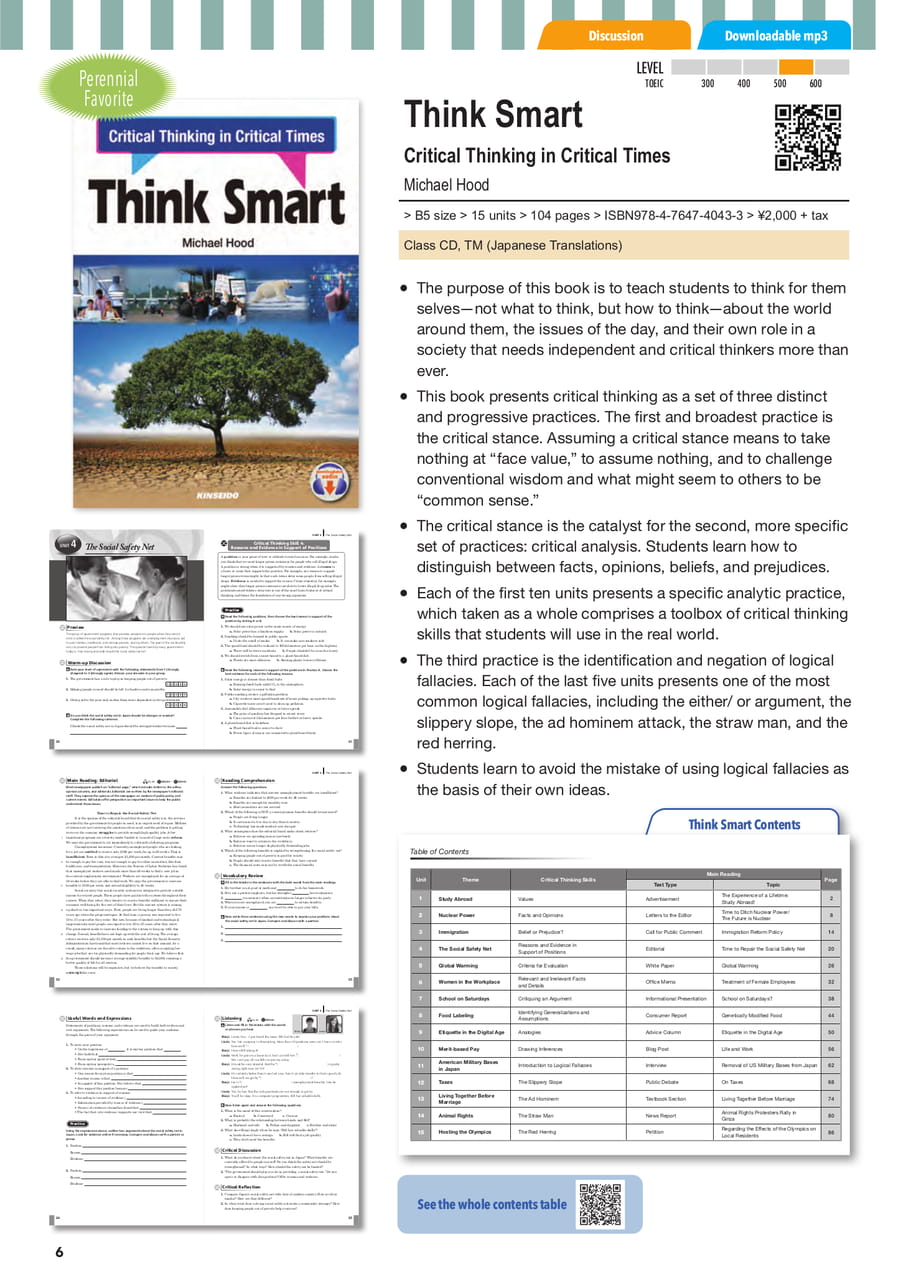
21 ● The purpose of this book is to teach students to think for them selves—not what to think, but how to think—about the world around them, the issues of the day, and their own role in a society that needs independent and critical thinkers more than ever. ● This book presents critical thinking as a set of three distinct and progressive practices. The first and broadest practice is the critical stance. Assuming a critical stance means to take nothing at “face value,” to assume nothing, and to challenge conventional wisdom and what might seem to others to be “common sense.”● The critical stance is the catalyst for the second, more specific set of practices: critical analysis. Students learn how to distinguish between facts, opinions, beliefs, and prejudices. ● Each of the first ten units presents a specific analytic practice, which taken as a whole comprises a toolbox of critical thinking skills that students will use in the real world. ● The third practice is the identification and negation of logical fallacies. Each of the last five units presents one of the most common logical fallacies, including the either/ or argument, the slippery slope, the ad hominem attack, the straw man, and the red herring. ● Students learn to avoid the mistake of using logical fallacies as the basis of their own ideas.
Table of Contents
Unit Theme Critical Thinking Skills
Text Type
1 Study Abroad Values Advertisement
2 Nuclear Power Facts and Opinions Letters to the Editor
Think Smart Contents
Main Reading Topic
The Experience of a Lifetime: Study Abroad!
Time to Ditch Nuclear Power/ The Future is Nuclear
3 Immigration Belief or Prejudice? Call for Public Comment Immigration Reform Policy 14 4 The Social Safety Net
Reasons and Evidence in Support of Positions
Editorial Time to Repair the Social Safety Net 20
5 Global Warming Criteria for Evaluation White Paper Global Warming 26 6 Women in the Workplace
Relevant and Irrelevant Facts and Details
Office Memo Treatment of Female Employees 32
7 School on Saturdays Critiquing an Argument Informational Presentation School on Saturdays? 38
Page
2
8
Useful Words and Expressions
Statements of positions, reasons, and evidence are used to build both written and oral arguments. The following expressions can be used to guide your audience through the parts of your argument.
1. To state your position: • On the topic/issue of , it is my/our position that . • I/we hold that . • From my/our point of view, . • From my/our perspective, .
2. To state reasons in support of a position: • One reason for my/our position is that . • Another reason is that . • In support of this position, I/we believe that . • I/we support this position because .
3. To refer to evidence in support of reasons: • According to (source of evidence), . • Information provided by (source of evidence), . • (Source of evidence) claims/has found that . • The fact that (cite evidence) supports our view that .
Practice
Using the expressions above, outline two arguments about the social safety net in Japan. Look for evidence online if necessary. Compare and discuss with a partner or group.
1. Position Reason Evidence
2. Position Reason
Listening A
Listen and fill in the blanks with the words or phrases you hear.
Shinji: Linda, hey…I just heard the news. Bill lost his job? Linda: Yes. His company is downsizing. More than 30 positions were cut. I have no idea how we’ll 1. ( ). Shinji: How’s Bill taking it? Linda: Well, he puts on a brave face, but I can tell he’s 2. ( ).
We can’t pay all our bills on just my salary. Shinji: It must be very stressful. But the 3. (
) is pretty strong right now, isn’t it? Linda: It’s certainly better than it was last year, but it can take months to find a good job.
How will we get by 4. ( )? Shinji: He is 5. (
) unemployment benefits. Has he applied yet? Linda: Yes, he has. But the cash payments are not enough to get by. Shinji: You’ll be okay. As a computer programmer, Bill has valuable skills.
B
Now listen again and answer the following questions. 1. What is the mood of this conversation? a. Excited b. Concerned c. Curious 2. What is probably the relationship between Linda and Bill? a. Husband and wife b. Father and daughter c. Brother and sister
3. What does Shinji imply when he says, “Bill has valuable skills”? a. Linda doesn’t have savings. b. Bill will find a job quickly. c. They don’t need the benefits.
Critical Discussion
1. What do you know about the social safety net in Japan? What benefits are currently offered to people in need? Do you think the safety net should be strengthened? In what ways? How should the safety net be funded?
2. “The government should play no role in providing a social safety net.” Do you agree or disagree with this position? Offer reasons and evidence.
Identifying Generalizations and
8 Food Labeling
Consumer Report Genetically Modified Food 44
Assumptions
9 Etiquette in the Digital Age Analogies Advice Column Etiquette in the Digital Age 50
10 Merit-based Pay Drawing Inferences Blog Post Life and Work 56
American Military Bases
11
Introduction to Logical Fallacies Interview Removal of US Military Bases from Japan 62 in Japan
12 Taxes The Slippery Slope Public Debate On Taxes 68
Living Together Before
13
The Ad Hominem Textbook Section Living Together Before Marriage 74
Marriage
Animal Rights Protesters Rally in
14 Animal Rights The Straw Man News Report
80
Ginza
Regarding the Effects of the Olympics on
15 Hosting the Olympics The Red Herring Petition
86
Local Residents
24
Evidence
Critical Reflection
1. Compare Japan’s social safety net with that of another country. How are they similar? How are they different?
2. In what ways does a strong social safety net make a community stronger? How does keeping people out of poverty help everyone?
25
See the whole contents table
6
Dynamic Presentations
A wedding reception.
DL 04
DL 06
CD 1-04
CD 1-06
DL 07
DL 08
CD 1-07
CD 1-08
DL 05
DL 02
online video DL 03 CD 1-03
CD 1-05
DL 09 CD 1-09
CD 1-02
Video
Online Video Presentation
Downloadable mp3
Perennial Favorite
Dynamic Presentations
Skills and Strategies for Public Speaking
Michael Hood
LEVEL
TOEIC 300 400 500 600
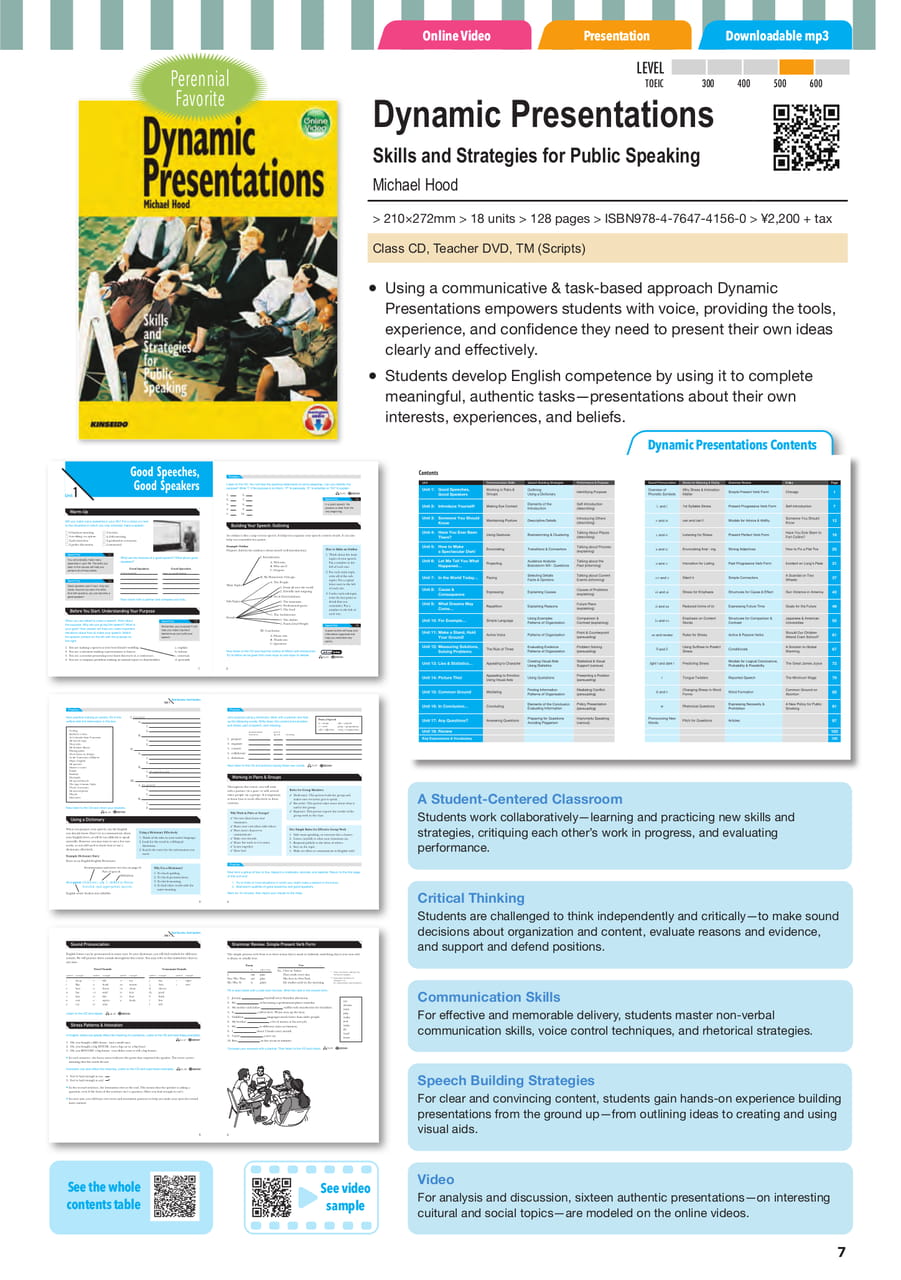
> 210×272mm > 18 units > 128 pages > ISBN978-4-7647-4156-0 > ¥2,200 + tax Class CD, Teacher DVD, TM (Scripts) ● Using a communicative & task-based approach Dynamic Presentations empowers students with voice, providing the tools, experience, and confidence they need to present their own ideas clearly and effectively. ● Students develop English competence by using it to complete meaningful, authentic tasks—presentations about their own interests, experiences, and beliefs.
Dynamic Presentations Contents
A Student-Centered Classroom Students work collaboratively—learning and practicing new skills and strategies, critiquing each other’s work in progress, and evaluating performance.
Critical Thinking Students are challenged to think independently and critically—to make sound decisions about organization and content, evaluate reasons and evidence, and support and defend positions.
Communication Skills For effective and memorable delivery, students master non-verbal communication skills, voice control techniques, and rhetorical strategies.
Speech Building Strategies For clear and convincing content, students gain hands-on experience building presentations from the ground up—from outlining ideas to creating and using visual aids.
See the whole contents table
See video sample
Video For analysis and discussion, sixteen authentic presentations—on interesting cuitural and social topics—are modeled on the online videos.
7
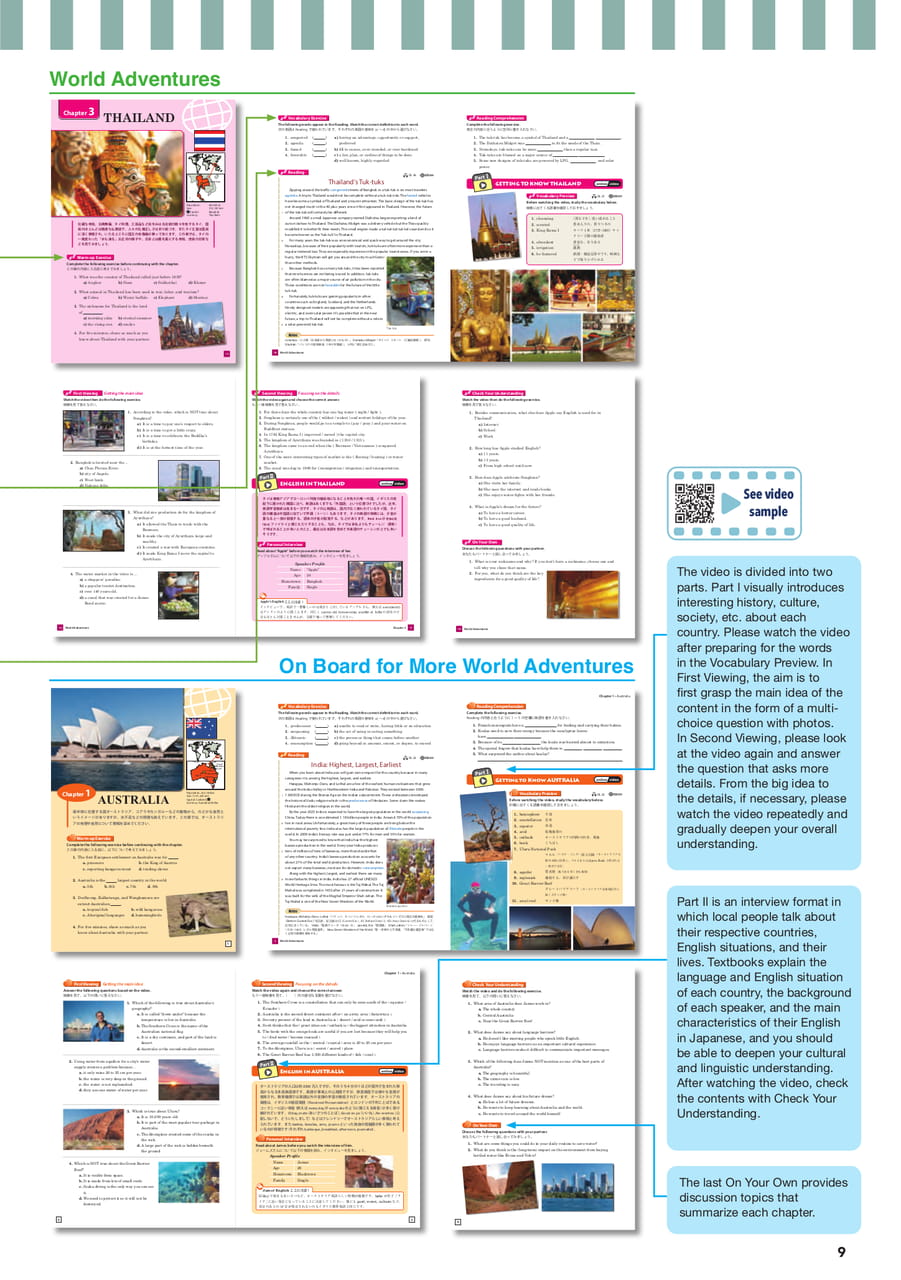
World Adventures Series
2-Book Series Online Video
Travel World Englishes
Downloadable mp3
Perennial Favorite
World Adventures Series
Scott Berlin Megumi Kobayashi
LEVEL
TOEIC 300 400 500 600
> B5 size > 15 units > 104 pages Class CD, Teacher DVD, TM (Scripts, Fill-in-the-blank Tests, etc.)
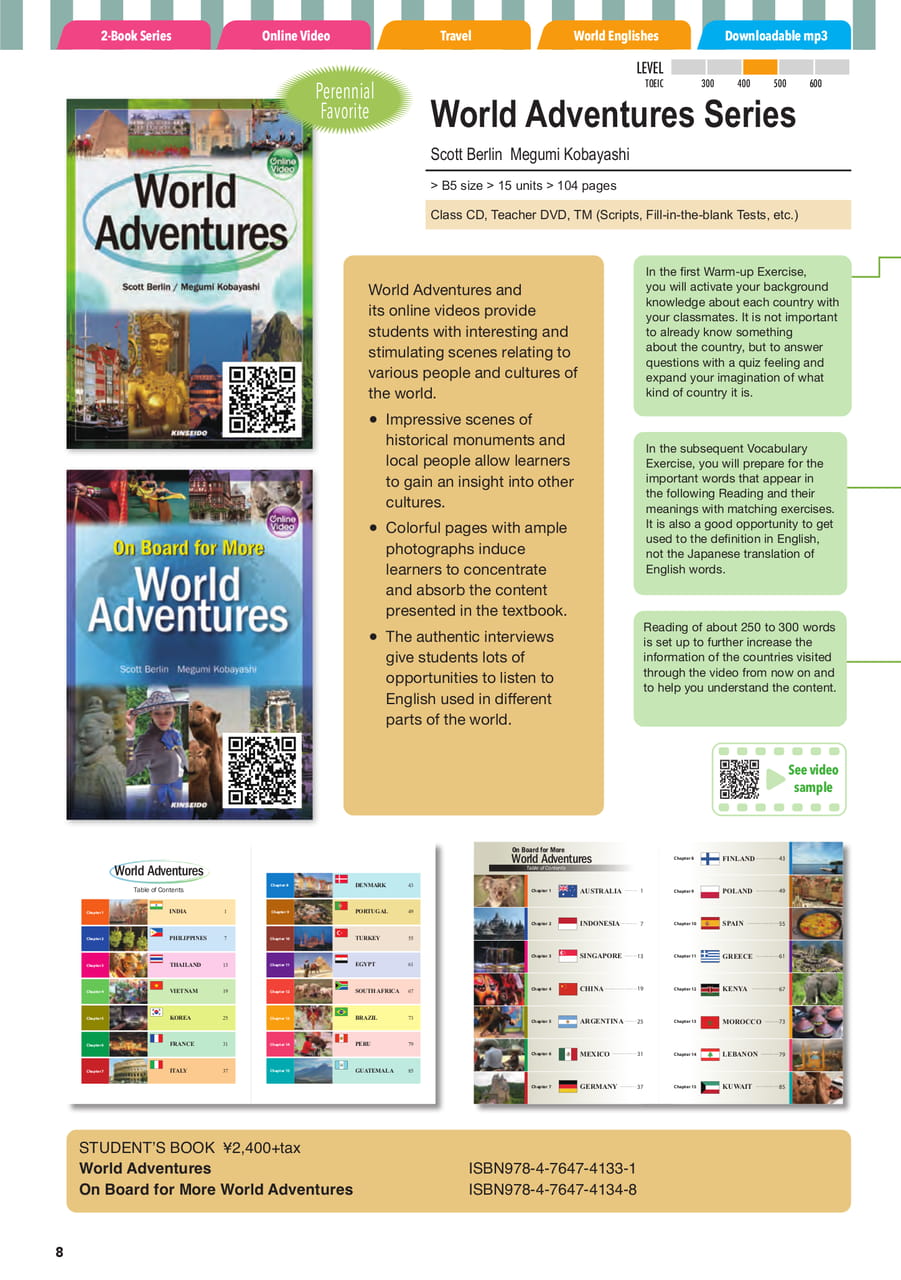
World Adventures and its online videos provide students with interesting and stimulating scenes relating to various people and cultures of the world. ● Impressive scenes of historical monuments and local people allow learners to gain an insight into other cultures. ● Colorful pages with ample photographs induce learners to concentrate and absorb the content presented in the textbook. ● The authentic interviews give students lots of opportunities to listen to English used in different parts of the world.
In the first Warm-up Exercise, you will activate your background knowledge about each country with your classmates. It is not important to already know something about the country, but to answer questions with a quiz feeling and expand your imagination of what kind of country it is.
In the subsequent Vocabulary Exercise, you will prepare for the important words that appear in the following Reading and their meanings with matching exercises. It is also a good opportunity to get used to the definition in English, not the Japanese translation of English words.
Reading of about 250 to 300 words is set up to further increase the information of the countries visited through the video from now on and to help you understand the content.
See video sample
World Adventures
On Board for More
World Adventures
Table of Contents
Chapter 8 FINLAND ……………43
Table of Contents
Chapter 8 DENMARK 43 Chapter 1 AUSTRALIA ……… 1
Chapter 9 POLAND ……………49
Chapter 1 INDIA 1 Chapter 9 PORTUGAL 49 Chapter 2 INDONESIA………… 7
Chapter 10 SPAIN …………………55
Chapter 2 PHILIPPINES 7 Chapter 10 TURKEY 55
Chapter 3 THAILAND 13 Chapter 11 EGYPT 61
Chapter 3 SINGAPORE ………13 Chapter 11 GREECE ……………61
Chapter 4 VIETNAM 19 Chapter 12
SOUTH AFRICA 67
Chapter 4 CHINA ……………………19 Chapter 12 KENYA ………………67
Chapter 5 KOREA 25 Chapter 13 BRAZIL 73 Chapter 5 ARGENTINA ………25 Chapter 13 MOROCCO ………73
Chapter 6 FRANCE 31 Chapter 14 PERU 79 Chapter 6 MEXICO ………………31 Chapter 14 LEBANON …………79
Chapter 7 ITALY 37 Chapter 15 GUATEMALA 85
Chapter 7 GERMANY …………37 Chapter 15 KUWAIT ……………85
STUDENT’S BOOK ¥2,400+tax World Adventures On Board for More World Adventures
ISBN978-4-7647-4133-1 ISBN978-4-7647-4134-8
8
World Adventures Chapter 3
16 World Adventures
4
Ayutthaya
Population: 66 million Size: 513,120 km 2
Bangkok Currency: Thai Baht
Great ■ Barrier Reef
Cairns ■ Brisbane ■ Uluru Sydney
■ Population: 22.5 million Size: 7,741,220 km 2
Currency: Australian Dollar
1
◆◆◆◆◆◆◆◆◆◆◆◆◆◆◆◆◆◆◆◆◆◆◆◆◆◆◆◆◆◆◆◆◆◆◆◆◆◆◆◆◆◆◆◆◆◆◆◆◆◆◆◆◆◆◆◆◆◆◆◆◆◆◆◆◆◆◆◆◆◆◆◆◆◆◆◆◆◆◆◆◆◆◆◆◆◆◆◆◆◆◆◆◆◆◆◆◆◆◆◆◆◆◆◆◆◆◆◆◆◆◆◆◆◆◆◆◆◆◆◆◆◆◆◆◆◆◆◆◆◆◆◆◆◆◆◆◆◆◆◆◆◆◆◆◆◆◆◆◆◆◆◆◆◆◆◆◆◆◆◆◆◆◆◆◆◆◆◆◆◆◆◆◆◆◆◆◆◆◆◆◆◆◆◆◆◆◆◆◆◆◆◆◆◆◆◆◆◆◆◆◆◆◆◆◆◆◆◆◆◆◆◆◆◆◆◆◆◆◆◆◆◆◆◆◆◆◆◆◆◆◆ 5
10
15
20
25
5
10
15
20 ◆◆◆◆◆◆◆◆◆近年広まっている」 Vedic 「聖典ヴェーダ(Veda)の」 poverty line 「貧困線」 Shah Jahan 「シャー・ジャハーン◆◆◆(1592–1666)ムガル帝国皇帝」 New Seven Wonders of the World 「新・世界の七不思議。“不思議な建造物”ではな◆◆◆く必見の景観を意味する」
5
6
陸中央部に位置し、ウルルまたは Ayers Rock と呼ばれる一枚岩で有名)
続く大サンゴ礁)
3
World Adventures Chapter 3
THAILAND
Vocabulary Exercise The following words appear in the Reading. Match the correct definition to each word.
Reading Comprehension Complete the following exercise.
次の単語は Reading で使われています。それぞれの単語の意味を a) 〜 d) の中から選びなさい。英文の内容に合うように空所に書き入れなさい。
壮麗な寺院、古典舞踊、タイ料理、工芸品など目をみはる伝統の数々を有するタイ。国民のほとんどは敬虔な仏教徒で、人々の礼儀正しさは折り紙つき。またタイ王室は国民に深く尊敬され、いたるところに国王の肖像画が飾ってあります。この章では、タイの一風変わった「水も滴る」お正月の様子や、日本とは趣を異にする寺院、庶民の日常などを見てみましょう。
Warm-up Exercise Complete the following exercise before continuing with the chapter. この章の内容に入る前に考えてみましょう。
1. What was the country of Thailand called just before 1939? a) Angkor b) Siam c) Sukhothai d) Khmer
2. What animal in Thailand has been used in war, labor, and tourism? a) Cobra b) Water buffalo c) Elephant d) Monkey
3. The nickname for Thailand is the land of . a) morning calm b) eternal summer c) the rising sun d) smiles
4. For five minutes, share as much as you know about Thailand with your partner.
★Capital:
★■ 1. congested ( ) a) having an advantage, opportunity or support, 2. agenda ( ) preferred 3. famed ( ) b) fill to excess, over-crowded, or over-burdened 4. favorable ( ) c) a list, plan, or outline of things to be done d) well known, highly regarded
Reading DL 06 CD 06
Thailand’s Tuk-tuks
Zipping around the traffic congested streets of Bangkok in a tuk-tuk is on most travelers agenda. A trip to Thailand would not be complete without a tuk-tuk ride. The famed vehicles have become a symbol of Thailand and a tourist attraction. The basic design of the tuk-tuk has not changed much in the 40 plus years since it first appeared in Thailand. However, the future of the tuk-tuk will certainly be different.
Around 1960 a small Japanese company named Daihatsu began exporting a kind of auto rickshaw to Thailand. The Daihatsu Midget was a delivery vehicle but the Thais quickly modified it to better fit their needs. The small engine made a tuk tuk tuk tuk tuk sound and so it became known as the “tuk-tuk” in Thailand.
For many years the tuk-tuk was an economical and quick way to get around the city. Nowadays, because of their popularity with tourists, tuk-tuks are often more expensive than a regular metered taxi. They are especially expensive in the popular tourist areas. If you are in a hurry, the BTS Skytrain will get you around the city much faster than other methods.
Because Bangkok has so many tuk-tuks, it has been reported that new licenses are not being issued. In addition, tuk-tuks are often blamed as a major source of air pollution in the city. These conditions are not favorable for the future of the little tuk-tuk.
Fortunately, tuk-tuks are gaining popularity in other countries such as England, Scotland, and the Netherlands. Newly designed models are appearing that run on LPG, electric, and even solar power. It’s possible that in the near future, a trip to Thailand will not be complete without a ride in a solar-powered tuk-tuk.
Tuk-tuk
rickshaw 「人力車(日本語から英語になったもの)」 Daihatsu Midget 「ダイハツミゼット(三輪自動車)」 BTS Skytrain 「バンコクの高架鉄道(1999 年開通)」 LPG 「液化石油ガス」
1. The tuk-tuk has become a symbol of Thailand and a . 2. The Daihatsu Midget was to fit the needs of the Thais. 3. Nowadays, tuk-tuks can be more than a regular taxi. 4. Tuk-tuks are blamed as a major source of . 5. Some new designs of tuk-tuks are powered by LPG, , and solar power.
GETTING TO KNOW THAILAND
Vocabulary Preview Before watching the video, study the vocabulary below. 映像に出てくる語彙を確認しておきましょう。
1. cleansing (罪などを)洗い清めること 2. scented 香水入りの、香りつきの 3. King Rama I ラーマ1世(1737‒1809)チャ
クリー王朝の創始者
4. abundant 豊富な、有り余る
かんがい 5. irrigation 灌漑
6. be featured 新聞・雑誌記事や TV 、映画などで取り上げられる
DL 07 CD 07
13 14 World Adventures
Chapter 3 15
First Viewing
Getting the main idea Watch the video then do the following exercise. 映像を見て答えなさい。
Second Viewing
Focusing on the details Watch the video again and choose the correct answer. もう一度映像を見て答えなさい。
Check Your Understanding Watch the video then do the following exercise. 映像を見て答えなさい。
2. Bangkok is located near the ... a) Chao Phraya River. b) city of Angels. c) West bank. d) Nakong delta.
4. The water market in the video is ... Chapter 1
a) a shoppers’ paradise. b) a popular tourist destination. c) over 140 years old.
1. According to the video, which is NOT true about
Songkran? a) It is a time to pay one’s respect to elders. b) It is a time to get a little crazy. c) It is a time to celebrate the Buddha’s birthday. d) It is at the hottest time of the year.
3. What did rice production do for the kingdom of Ayutthaya?
d) a canal that was created for a James Bond movie. a) It allowed the Thais to trade with the Burmese. b) It made the city of Ayutthaya large and wealthy.
Answer the following questions based on the video. 映像を見て、以下の問いに答えなさい。 c) It created a war with European countries. d) It made King Rama I move the capital to
Ayutthaya.
南半球に位置する国オーストラリア。コアラやカンガルーなどの動物から、のどかな自然というイメージがありますが、水不足などの問題も抱えています。この章では、オーストラリアの地理や自然について理解を深めてください。
Warm-up Exercise
1. Which of the following is true about Australia’s geography? a. It is called “down under” because the temperature is low in Australia. b. The Southern Cross is the name of the
Australian national flag. c. It is a dry continent, and part of the land is desert.
2. Using water from aquifers for a city’s water supply creates a problem because ... a. it only rains 20 to 25 cm per year. b. the water is very deep in the ground. c. the water is not replenished. d. they use one meter of water per year.
d. Australia is the second smallest continent.
3. Which is true about Uluru? a. It is 10,000 years old. b. It is part of the most popular tour package in
Australia. c. The Aborigines created some of the cracks in the rock.
4. Which is NOT true about the Great Barrier
Reef? a. It is visible from space. b. It is made from lots of small reefs.
d. A large part of the rock is hidden beneath the ground.
c. Scuba diving is the only way you can see it. d. We need to protect it so it will not be destroyed.
AUSTRALIA
Complete the following exercise before continuing with the chapter. この章の内容に入る前に、以下について考えてみましょう。
1. The first European settlement on Australia was for . a. prisoners b. the King of Austria c. exporting kangaroo meat d. trading slaves
2. Australia is the largest country in the world. a. 5th b. c. 7th d. 8th
6th
3. Doolboong, Kalkatungu, and Wangkumara are extinct Australian . a. tropical fish b. wild kangaroos c. Aboriginal languages d. hummingbirds
4. For five minutes, share as much as you know about Australia with your partner.
First Viewing Getting the main idea
Capital: Canberra★
★
1. For three days the whole country has one big water ( night / fight ). 2. Songkran is certainly one of the ( wildest / widest ) and wettest holidays of the year. 3. During Songkran, people would go to a temple to ( pay / pray ) and pour water on
Buddhist statues. 4. In 1782 King Rama I ( improved / moved ) the capital city. 5. The kingdom of Ayutthaya was founded in ( 1350 / 1315 ). 6. The kingdom came to an end when the ( Burmese / Vietnamese ) conquered
Ayutthaya. 7. One of the more interesting types of market is the ( floating / boating ) or water market. 8. The canal was dug in 1866 for ( immigration / irrigation ) and transportation.
タイは東南アジアでヨーロッパ列強の植民地になることを免れた唯一の国。イギリスの支配下に置かれた隣国に比べ、英語はあくまでも「外国語」という位置づけでしたが、近年、英語学習意欲は高まる一方です。タイの公用語は、国内で広く使われているタイ語。タイ語の構造は中国語に似ていて声調(トーン)もあります。タイの英語の特徴には、子音が重なると一部が脱落する、語末の子音が脱落する、などがあります。 fried rice が f(r)ie(d) li(ce) ファイライと聞こえたりすることも。なお、タイでは本名よりもチューレン(愛称)で呼ばれることが多いとのこと。最近は日本語を含めて外来語のチューレンがとても多いそうです。
ENGLISH IN THAILAND
Personal Interview Read about “Apple” before you watch the interview of her. アップルさんについて以下の情報を読み、インタビューを見ましょう。
Speaker Profile Name
Hometown
Age 24
Family
Apple’s English ここに注意!
“Apple”
Bangkok Single インタビューで、英語で一番難しいのは発音とこぼしているアップルさん。例えば assi(s)tan(t) はアシタンのように聞こえます。同じく year(s) old, hometow(n), sou(th) of, li(fe) の語末の子音もほとんど聞こえませんが、文脈で補って理解してください。
Second Viewing Focusing on the details Watch the video again and choose the correct answer. もう一度映像を見て、()内の適切な言葉を選びなさい。
Chapter 3 17 18 World Adventures
Chapter 1 • Australia
1. The Southern Cross is a constellation that can only be seen south of the ( equator / Ecuador ).
2 World Adventures
2. Australia is the second driest continent after ( an arctic area / Antarctica ). 3. Seventy percent of the land in Australia is ( desert / arid or semi-arid ). 4. Scott thinks that the ( great cities are / outback is ) the biggest attraction in Australia. 5. The birds with the orange beak are useful if you are lost because they will help you to ( find water / become rescued ). 6. The average rainfall in the ( central / coastal ) area is 20 to 25 cm per year. 7. To the Aborigines, Uluru is a ( secret / sacred ) place. 8. The Great Barrier Reef has 1,500 different kinds of ( fish / coral ).
オーストラリアの人口は約 2300 万人ですが、そのうち4分の1ほどが国外で生まれた移民からなる多民族国家です。英語が事実上の公用語ですが、移民家庭では様々な言語が使用され、教育機関では英語以外の言語の学習が推奨されています。オーストラリアの英語は、イギリスの容認英語(Received Pronunciation)とロンドンの下町ことばであるコックニーに近い発音(例えば every day が every die のように聞こえる発音)が多く受け継がれています。 G’day, mate(あいさつのことば)、 Good on ya(いいね)、 No worries(心配しないで、どういたしまして)などはフレンドリーでオーストラリアらしい表現と考えられています。また barbie, breakie, arvo, journo といった独自の短縮語が多く使われているのが特徴です(それぞれ barbeque, breakfast, afternoon, journalist)。
Personal Interview Read about James before you watch the interview of him. ジェームズさんについて以下の情報を読み、インタビューを見ましょう。
Speaker Profile Name Age 26 Hometown Family
Vocabulary Exercise The following words appear in the Reading. Match the correct definition to each word. 次の単語は Reading で使われています。それぞれの単語の意味を a) 〜 d) の中から選びなさい。
1. predecessor ( ) a) unable to read or write, having little or no education 2. surpassing ( ) b) the act of using or eating something 3. illiterate ( ) c) the person or thing that comes before another 4. consumption ( ) d) going beyond in amount, extent, or degree, to exceed
English in AUSTRALIA
James
Blacktown Single
James’ English ここに注意 !
Reading DL 02 CD 02
India: Highest, Largest, Earliest
When you learn about India you will gain some respect for the country because in many categories it is among the highest, largest, and earliest.
Harappa, Mohenjo-Daro, and Lothal are a few of the earliest human civilizations that grew around the Indus Valley in Northwestern India and Pakistan. They existed between 3300- 1300 BCE during the Bronze Age on the Indian subcontinent. These civilizations developed the historical Vedic religion which is the predecessor of Hinduism. Some claim this makes Hinduism the oldest religion in the world.
By the year 2025 India is expected to have the largest population in the world surpassing China. Today there is an estimated 1.18 billion people in India. Around 70% of the population live in rural areas. Unfortunately, a great many of these people are living below the international poverty line. India also has the largest population of illiterate people in the world. In 2009 India’s literacy rate was just under 77% for men and 55% for women.
You may be surprised to know that India has the highest banana production in the world. Every year India produces tens of millions of tons of bananas, more than double that of any other country. India’s banana production accounts for about 21% of the total world production. However, India does not export many bananas, most are for domestic consumption.
Along with the highest, largest, and earliest there are many more fantastic things in India. India has 27 official UNESCO World Heritage Sites. The most famous is the Taj Mahal. The Taj Mahal was completed in 1653 after 21 years of construction. It was built for the wife of the Mughal Emperor Shah Jahan. The Taj Mahal is one of the New Seven Wonders of the World.
Harappa, Mohenjo-Daro, Lothal 「ハラッパ、モヘンジョダロ、ロータルはいずれもインダス川周辺の遺跡地」 BCE (Before Current Era)「紀元前。紀元後は CE(Current Era)。 BC(Before Christ)と AD(Anno Domini)に代るものとして、
G’day で始まるあいさつなど、オーストラリア英語らしい特徴が満載です。 take が若干「タイク」に近い発音になっていることに注意してください。他にも part, worst, culture など、母音のあとの /r/ 音が発音されないのもイギリス標準英語と同じです。
1. Besides communication, what else does Apple say English is used for in
Thailand? a) Internet b) School c) Work
2. How long has Apple studied English? a) 11 years. b) 13 years. c) From high school until now.
3. How does Apple celebrate Songkran? a) She visits her family. b) She uses the internet and reads books. c) She enjoys water fights with her friends.
4. What is Apple’s dream for the future? a) To have a better career. b) To have a good husband. c) To have a good quality of life.
On Your Own Discuss the following questions with your partner. あなたもパートナーと話し合ってみましょう。
1. What is your nickname and why? If you don’t have a nickname, choose one and tell why you chose that name.
2. For you, what do you think are the key ingredients for a good quality of life?
On Board for More World Adventures
Banana auction
Reading Comprehension Complete the following exercise. Reading の内容と合うように 1 ~ 5 の空欄に英語を書き入れなさい。
Check Your Understanding Watch the video and do the following exercise. 映像を見て、以下の問いに答えなさい。
1. What area of Australia does James work in? a. The whole country b. Central Australia c. Near the Great Barrier Reef
2. What does James say about language barriers? a. He doesn’t like meeting people who speak little English. b. He enjoys language barriers as an important cultural experience. c. Language barriers make it difficult to communicate important messages.
3. Which of the following does James NOT mention as one of the best parts of
Australia? a. The geography is beautiful. b. The crime rate is low. c. The traveling is easy.
4. What does James say about his future dream? a. He has a lot of future dreams. b. He wants to keep learning about Australia and the world. c. He wants to travel around the world himself.
On Your Own Discuss the following questions with your partner. あなたもパートナーと話し合ってみましょう。
1. What are some things you could do in your daily routine to save water? 2. What do you think is the (long-term) impact on the environment from buying bottled water like Evian and Volvic?
Chapter 1 • Australia
1. Female marsupials have a for feeding and carrying their babies. 2. Koalas need to save their energy because the eucalyptus leaves have . 3. Because of its the koala was hunted almost to extinction. 4. The special fingers that koalas have help them to . 5. What surprised the author about koalas?
Getting to Know AUSTRALIA
Vocabulary Preview
DL 03 CD 03 Before watching the video, study the vocabulary below. 映像に出てくる語彙を確認しておきましょう。
1. hemisphere 半球 2. constellation 星座 3. equator 赤道 4. arid 乾燥地帯の 5. outback オーストラリアの内陸の田舎、奥地 6. beak くちばし 7. Uluru National Park
ウルル(=カタ・ジュタ)国立公園(オーストラリア大
8. aquifer 帯水層(地下水を多く含む地層) 9. replenish 補給する、再び満たす 10. Great Barrier Reef
11. coral reef サンゴ礁グレートバリアリーフ(オーストラリア北東部沿岸に
See video sample
The video is divided into two parts. Part I visually introduces interesting history, culture, society, etc. about each country. Please watch the video after preparing for the words in the Vocabulary Preview. In First Viewing, the aim is to first grasp the main idea of the content in the form of a multichoice question with photos. In Second Viewing, please look at the video again and answer the question that asks more details. From the big idea to the details, if necessary, please watch the video repeatedly and gradually deepen your overall understanding.
Part Il is an interview format in which local people talk about their respective countries, English situations, and their lives. Textbooks explain the language and English situation of each country, the background of each speaker, and the main characteristics of their English in Japanese, and you should be able to deepen your cultural and linguistic understanding. After watching the video, check the contents with Check Your Understanding.
The last On Your Own provides discussion topics that summarize each chapter.
9
World Travelers
5
10
15
20
25
1. logging [ℓ.6] a. dignified
Online Video Travel
Downloadable mp3
LEVEL
TOEIC 300 400 500 600
WORLD TRAVELERS A Learning Journey with Videos from BBC’s The Travel Show
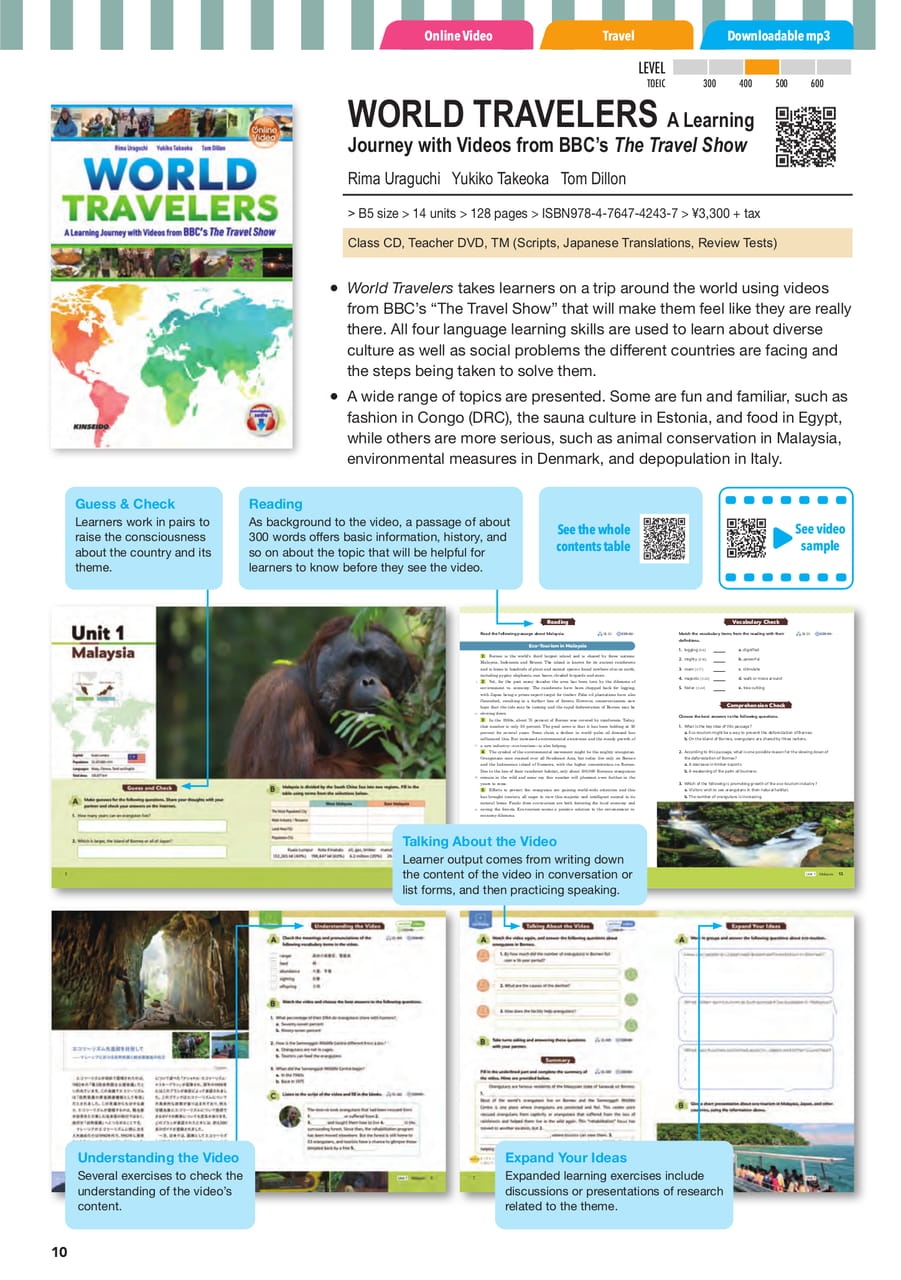
Rima Uraguchi Yukiko Takeoka Tom Dillon > B5 size > 14 units > 128 pages > ISBN978-4-7647-4243-7 > ¥3,300 + tax Class CD, Teacher DVD, TM (Scripts, Japanese Translations, Review Tests) ● World Travelers takes learners on a trip around the world using videos from BBC’s “The Travel Show” that will make them feel like they are really there. All four language learning skills are used to learn about diverse culture as well as social problems the different countries are facing and the steps being taken to solve them. ● A wide range of topics are presented. Some are fun and familiar, such as fashion in Congo (DRC), the sauna culture in Estonia, and food in Egypt, while others are more serious, such as animal conservation in Malaysia, environmental measures in Denmark, and depopulation in Italy.
Guess & Check Learners work in pairs to raise the consciousness about the country and its theme.
Reading As background to the video, a passage of about 300 words offers basic information, history, and so on about the topic that will be helpful for learners to know before they see the video.
See the whole contents table
See video sample
Reading
Read the following passage about Malaysia.
Eco-Tourism in Malaysia
DL 02 CD1-02 Match the vocabulary items from the reading with their DL 03 CD1-03 definitions.
Vocabulary Check
1 Borneo is the world’s third largest island and is shared by three nations: Malaysia, Indonesia and Brunei. The island is known for its ancient rainforests and is home to hundreds of plant and animal species found nowhere else on earth, including pygmy elephants, sun bears, clouded leopards and more. 2 Yet, for the past many decades the area has been torn by the dilemma of environment vs. economy. The rainforests have been chopped back for logging, with Japan being a prime export target for timber. Palm oil plantations have also flourished, resulting in a further loss of forests. However, conservationists now hope that the tide may be turning and the rapid deforestation of Borneo may be slowing down. 3 In the 1980s, about 75 percent of Borneo was covered by rainforests. Today, that number is only 50 percent. The good news is that it has been holding at 50 percent for several years. Some claim a decline in world palm oil demand has influenced this. But increased environmental awareness and the steady growth of a new industry—eco-tourism—is also helping. 4 The symbol of the environmental movement might be the mighty orangutan. Orangutans once roamed over all Southeast Asia, but today live only on Borneo and the Indonesian island of Sumatra, with the higher concentration on Borneo. Due to the loss of their rainforest habitat, only about 100,000 Bornean orangutans remain in the wild and some say this number will plummet even further in the years to come. 5 Efforts to protect the orangutan are gaining world-wide attention and this has brought tourists, all eager to view this majestic and intelligent animal in its natural home. Funds from eco-tourism are both fostering the local economy and saving the forests. Eco-tourism seems a positive solution to the environment vs. economy dilemma.
2. mighty [ℓ.16] b. powerful 3. roam [ℓ.17] c. stimulate 4. majestic [ℓ.23] d. walk or move around 5. foster [ℓ.24] e. tree cutting
Comprehension Check
Choose the best answers to the following questions.
1. What is the key idea of this passage? a. Eco-tourism might be a way to prevent the deforestation of Borneo. b. On the island of Borneo, orangutans are shared by three nations.
2. According to this passage, what is one possible reason for the slowing down of the deforestation of Borneo? a. A decrease in timber exports b. A weakening of the palm oil business
3. Which of the following is promoting growth of the eco-tourism industry? a. Visitors wish to see orangutans in their natural habitat. b. The number of orangutans is increasing.
Talking About the Video Learner output comes from writing down the content of the video in conversation or list forms, and then practicing speaking.
Notes eco-tourism 「エコツーリズム」自然環境や歴史文化について観光を通して学ぶことで、その保全へとつなげる仕組み Brunei 「ブルネイ」ボルネオ島北部に位置する立憲君主制の国家 pygmy elephant 「ボルネオゾウ」体が小さいことが特徴 sun bear 「マレーグマ」クマの中で最も体が小さい clouded leopard 「ウンピョウ」名前は雲のような形の斑紋に由来ℓ.6 chop back 「〜を切り倒す」 palm oil plantation 「パーム油を生産するための大規模農園」 turn the tide 「流れを一変させる」 plummet 「急落する」
12 Unit 1 Malaysia 13
Understanding the Video Several exercises to check the understanding of the video’s content.
Expand Your Ideas Expanded learning exercises include discussions or presentations of research related to the theme.
10
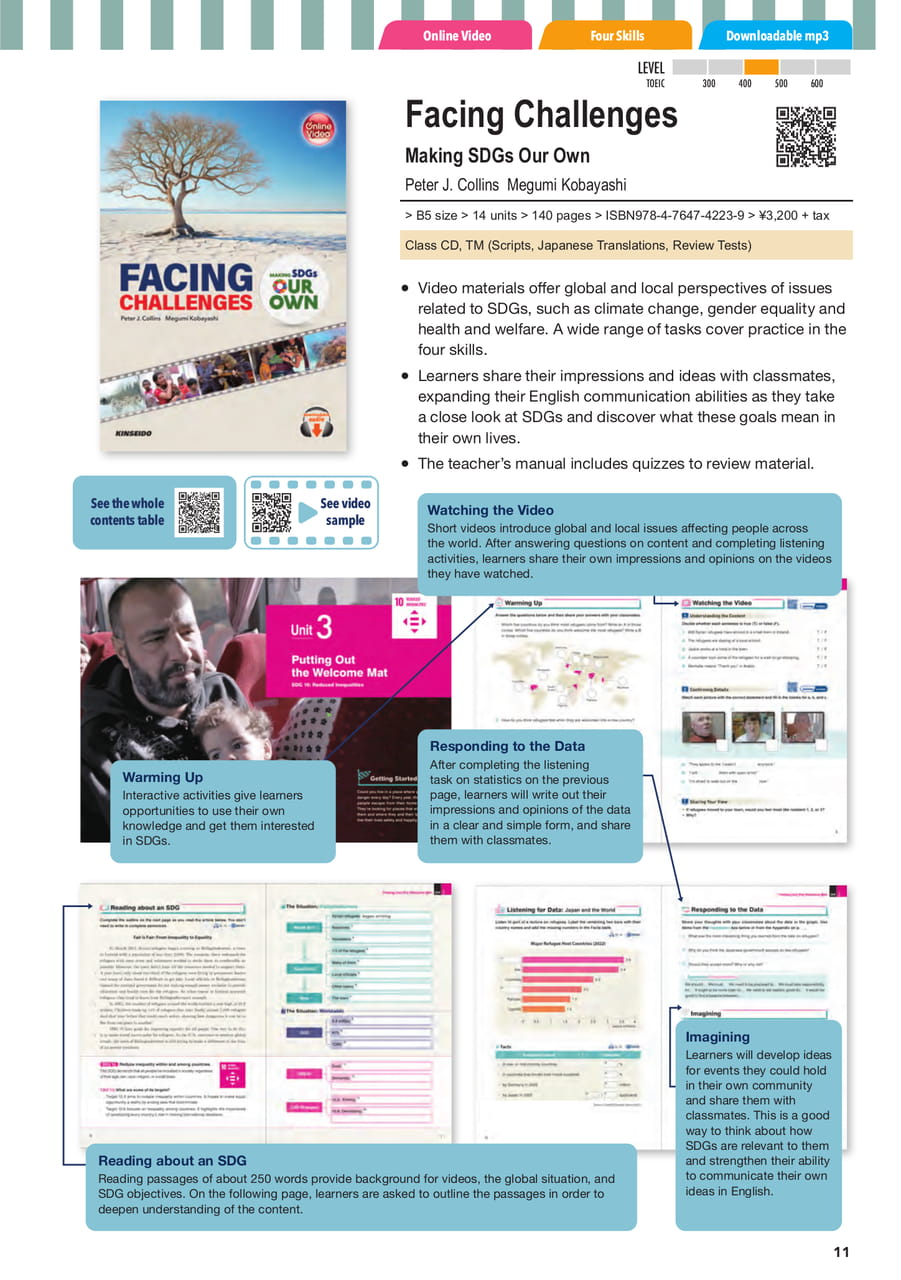
Facing Challenges
Online Video Four Skills
Downloadable mp3
Facing Challenges
Making SDGs Our Own
Peter J. Collins Megumi Kobayashi
LEVEL
TOEIC 300 400 500 600
> B5 size > 14 units > 140 pages > ISBN978-4-7647-4223-9 > ¥3,200 + tax Class CD, TM (Scripts, Japanese Translations, Review Tests) ● Video materials offer global and local perspectives of issues related to SDGs, such as climate change, gender equality and health and welfare. A wide range of tasks cover practice in the four skills. ● Learners share their impressions and ideas with classmates, expanding their English communication abilities as they take a close look at SDGs and discover what these goals mean in their own lives. ● The teacher’s manual includes quizzes to review material.
See the whole contents table
See video sample
Watching the Video Short videos introduce global and local issues affecting people across the world. After answering questions on content and completing listening activities, learners share their own impressions and opinions on the videos they have watched.
Warming Up Interactive activities give learners opportunities to use their own knowledge and get them interested in SDGs.
Responding to the Data After completing the listening task on statistics on the previous page, learners will write out their impressions and opinions of the data in a clear and simple form, and share them with classmates.
Reading about an SDG Reading passages of about 250 words provide background for videos, the global situation, and SDG objectives. On the following page, learners are asked to outline the passages in order to deepen understanding of the content.
Imagining Learners will develop ideas for events they could hold in their own community and share them with classmates. This is a good way to think about how SDGs are relevant to them and strengthen their ability to communicate their own ideas in English.
11
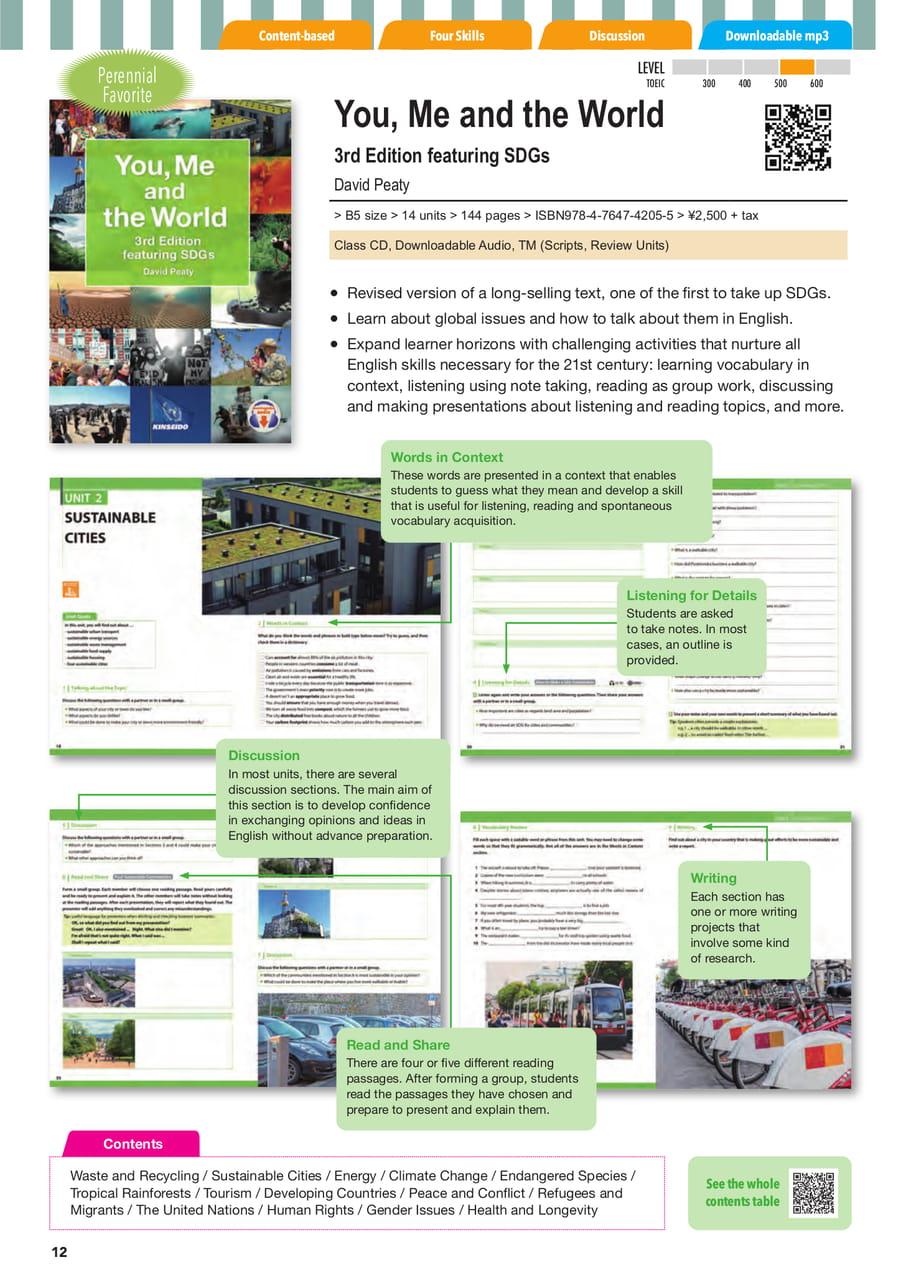
You, Me and the World
Content-based Four Skills
Discussion Downloadable mp3
Perennial Favorite
You, Me and the World
3rd Edition featuring SDGs
David Peaty
LEVEL
TOEIC 300 400 500 600
> B5 size > 14 units > 144 pages > ISBN978-4-7647-4205-5 > ¥2,500 + tax Class CD, Downloadable Audio, TM (Scripts, Review Units) ● Revised version of a long-selling text, one of the first to take up SDGs. ● Learn about global issues and how to talk about them in English. ● Expand learner horizons with challenging activities that nurture all English skills necessary for the 21st century: learning vocabulary in context, listening using note taking, reading as group work, discussing and making presentations about listening and reading topics, and more.
Words in Context These words are presented in a context that enables students to guess what they mean and develop a skill that is useful for listening, reading and spontaneous vocabulary acquisition.
Listening for Details Students are asked to take notes. In most cases, an outline is provided.
Discussion In most units, there are several discussion sections. The main aim of this section is to develop confidence in exchanging opinions and ideas in English without advance preparation.
Writing Each section has one or more writing projects that involve some kind of research.
Read and Share There are four or five different reading passages. After forming a group, students read the passages they have chosen and prepare to present and explain them.
Contents
Waste and Recycling / Sustainable Cities / Energy / Climate Change / Endangered Species / Tropical Rainforests / Tourism / Developing Countries / Peace and Conflict / Refugees and Migrants / The United Nations / Human Rights / Gender Issues / Health and Longevity
See the whole contents table
12
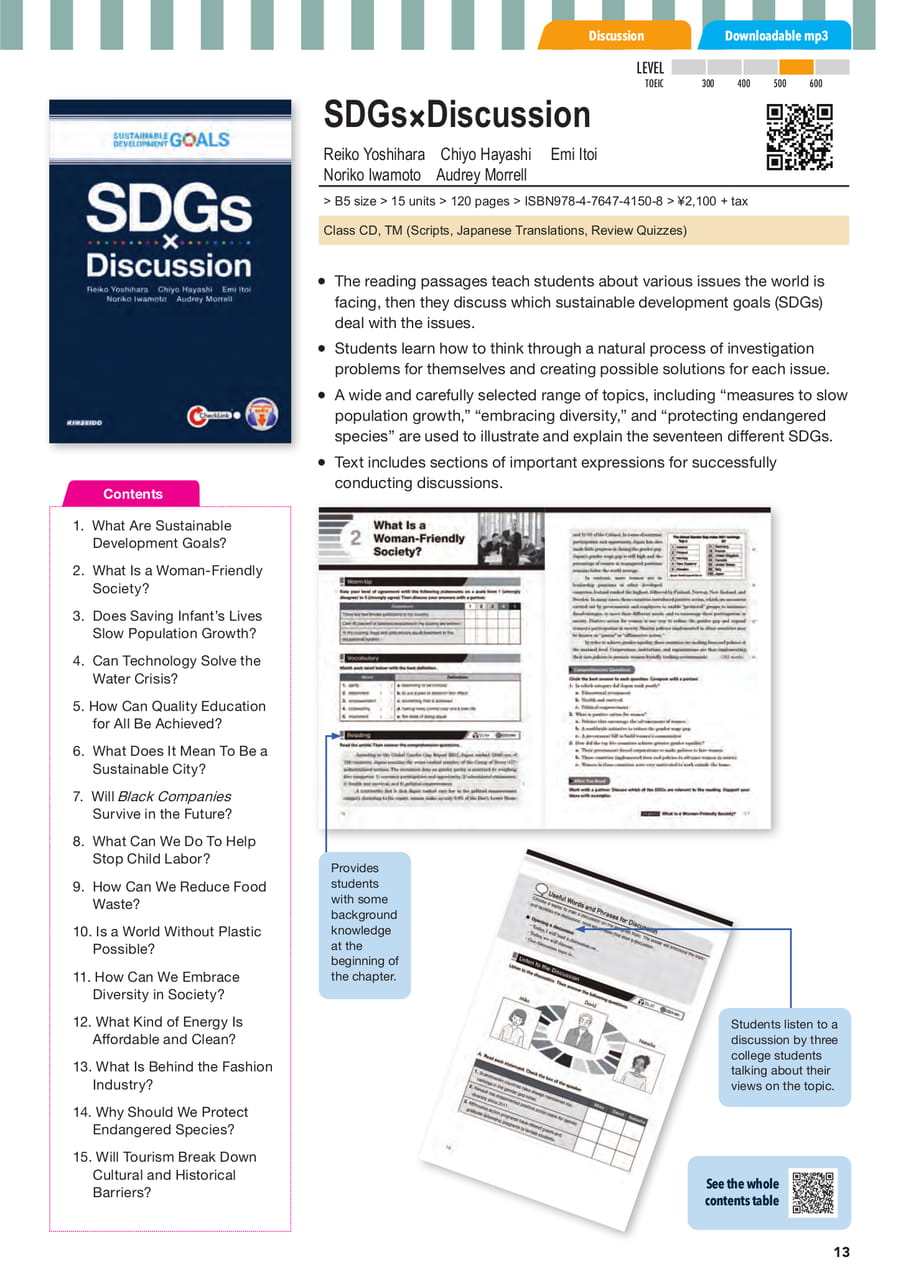
SDGs×Discussion
Discussion Downloadable mp3
SDGs×Discussion
Reiko Yoshihara Chiyo Hayashi Emi Itoi
Noriko Iwamoto Audrey Morrell
LEVEL
TOEIC 300 400 500 600
> B5 size > 15 units > 120 pages > ISBN978-4-7647-4150-8 > ¥2,100 + tax Class CD, TM (Scripts, Japanese Translations, Review Quizzes)
Contents ● The reading passages teach students about various issues the world is facing, then they discuss which sustainable development goals (SDGs) deal with the issues. ● Students learn how to think through a natural process of investigation problems for themselves and creating possible solutions for each issue. ● A wide and carefully selected range of topics, including “measures to slow population growth,”“embracing diversity,” and “protecting endangered species” are used to illustrate and explain the seventeen different SDGs. ● Text includes sections of important expressions for successfully conducting discussions.
1. What Are Sustainable Development Goals?
2. What Is a Woman-Friendly Society?
3. Does Saving Infant’s Lives Slow Population Growth?
4. Can Technology Solve the Water Crisis?
5. How Can Quality Education for All Be Achieved?
6. What Does It Mean To Be a Sustainable City?
7. Will Black Companies Survive in the Future?
8. What Can We Do To Help Stop Child Labor?
9. How Can We Reduce Food Waste?
10. Is a World Without Plastic Possible?
11. How Can We Embrace Diversity in Society?
12. What Kind of Energy Is Affordable and Clean?
13. What Is Behind the Fashion Industry?
14. Why Should We Protect Endangered Species?
15. Will Tourism Break Down Cultural and Historical Barriers?
Provides students with some background knowledge at the beginning of the chapter.
Students listen to a discussion by three college students talking about their views on the topic.
See the whole contents table
13
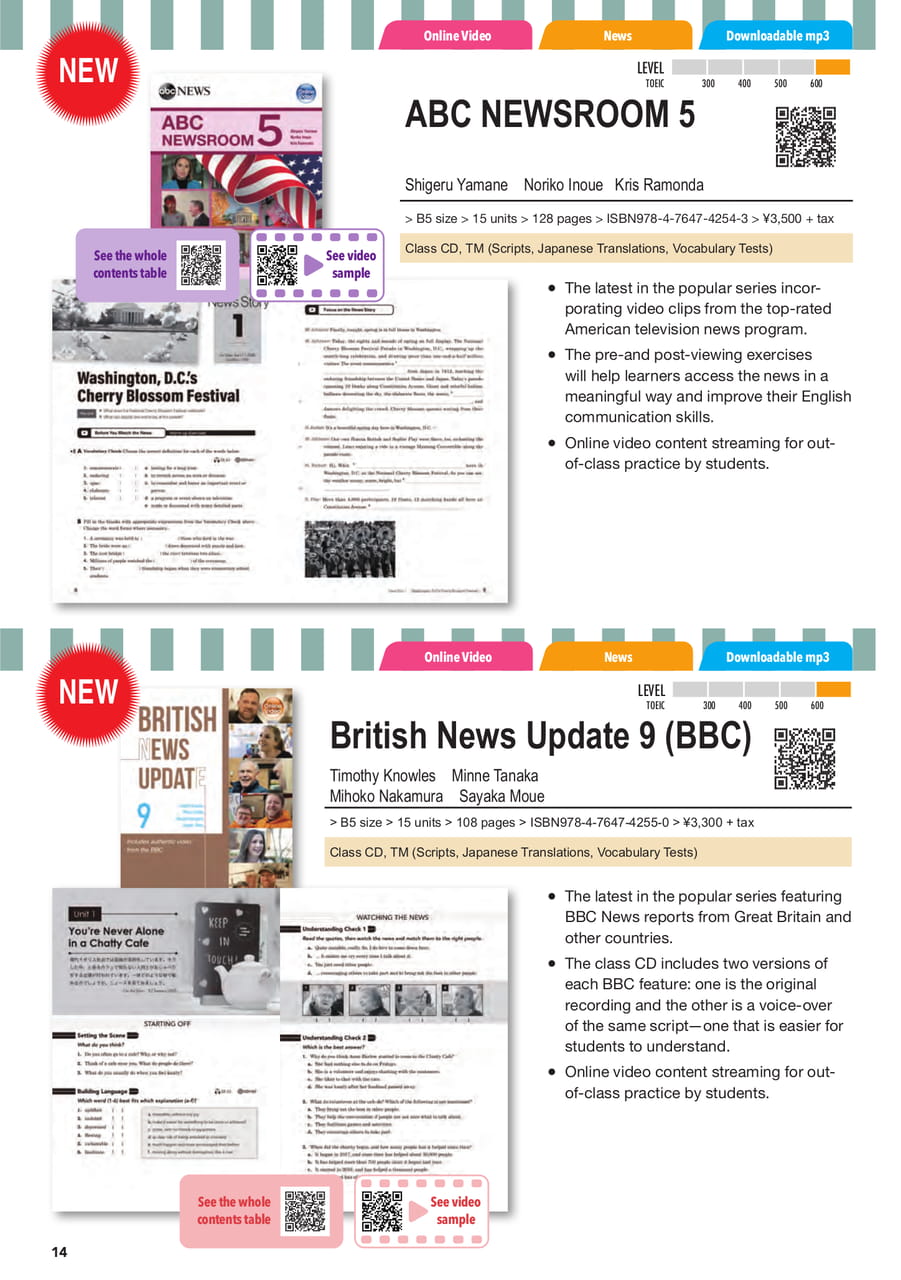
ABC NEWSROOM 5 / British News
NEW
Online Video
News
ABC NEWSROOM 5
Downloadable mp3
LEVEL
TOEIC 300 400 500 600
Shigeru Yamane Noriko Inoue Kris Ramonda
See the whole contents table
See video sample
> B5 size > 15 units > 128 pages > ISBN978-4-7647-4254-3 > ¥3,500 + tax Class CD, TM (Scripts, Japanese Translations, Vocabulary Tests) ● The latest in the popular series incorporating video clips from the top-rated American television news program. ● The pre-and post-viewing exercises will help learners access the news in a meaningful way and improve their English communication skills. ● Online video content streaming for outof-class practice by students.
NEW
Online Video News
Downloadable mp3
LEVEL
TOEIC 300 400 500 600
British News Update 9 (BBC)
Timothy Knowles Minne Tanaka
Mihoko Nakamura Sayaka Moue
> B5 size > 15 units > 108 pages > ISBN978-4-7647-4255-0 > ¥3,300 + tax Class CD, TM (Scripts, Japanese Translations, Vocabulary Tests) ● The latest in the popular series featuring BBC News reports from Great Britain and other countries. ● The class CD includes two versions of each BBC feature: one is the original recording and the other is a voice-over of the same script—one that is easier for students to understand. ● Online video content streaming for outof-class practice by students.
See the whole contents table
See video sample
14
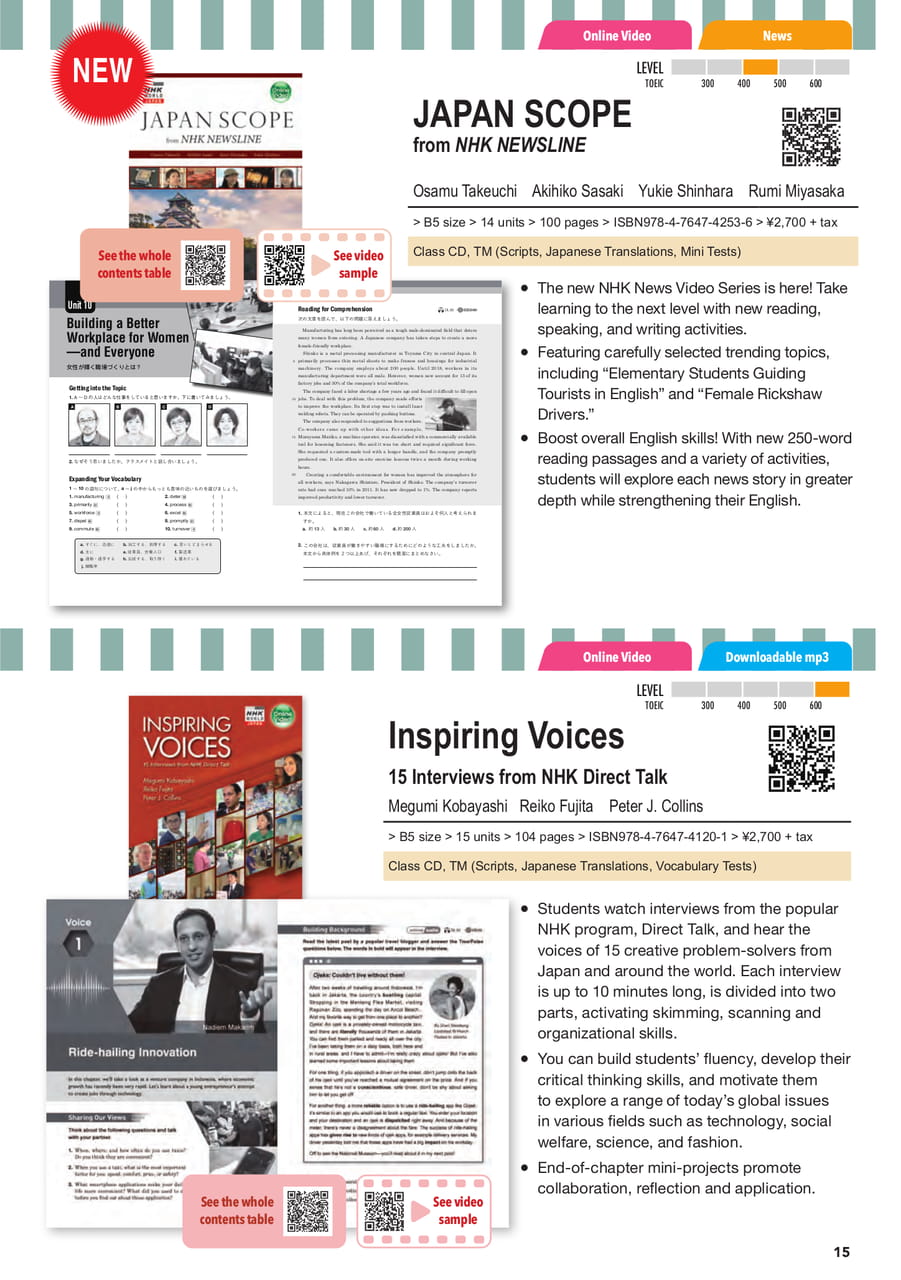
JAPAN SCOPE
NEW
Online Video
JAPAN SCOPE from NHK NEWSLINE
News
LEVEL
TOEIC 300 400 500 600
Osamu Takeuchi Akihiko Sasaki Yukie Shinhara Rumi Miyasaka
> B5 size > 14 units > 100 pages > ISBN978-4-7647-4253-6 > ¥2,700 + tax
Unit 10
Building a Better Workplace for Women —and Everyone
女性が輝く職場づくりとは?
Getting into the Topic 1. A 〜 D の人はどんな仕事をしていると思いますか。下に書いてみましょう。 A B C D
2. なぜそう思いましたか。クラスメイトと話し合いましょう。
Expanding Your Vocabulary 1 〜 10 の語句について、 a 〜 j の中からもっとも意味の近いものを選びましょう。 1. manufacturing ▢名 ( ) 2. deter ▢動 ( ) 3. primarily ▢副 ( ) 4. process ▢動 ( ) 5. workforce ▢名 ( ) 6. excel ▢動 ( ) 7. dispel ▢動 ( ) 8. promptly ▢副 ( ) 9. commute ▢動 ( ) 10. turnover ▢名 ( )
a. すぐに、迅速に b. 加工する、処理する c. 思いとどまらせる d. 主に e. 従業員、労働人口 f. 製造業 g. 通勤・通学する h. 払拭する、取り除く i. 優れている j. 離職率
See the whole contents table
See video sample
Reading for Comprehension 次の文章を読んで、以下の問題に答えましょう。
Manufacturing has long been perceived as a tough male-dominated field that deters many women from entering. A Japanese company has taken steps to create a more female-friendly workplace.
Shinko is a metal processing manufacturer in Toyama City in central Japan. It 5 primarily processes thin metal sheets to make frames and housings for industrial machinery. The company employs about 200 people. Until 2018, workers in its manufacturing department were all male. However, women now account for 13 of its factory jobs and 30% of the company’s total workforce.
The company faced a labor shortage a few years ago and found it difficult to fill open 10 jobs. To deal with this problem, the company made efforts to improve the workplace. Its first step was to install laser welding robots. They can be operated by pushing buttons.
The company also responded to suggestions from workers. Co-workers came up with other ideas. For example, 15 Murayama Mariko, a machine operator, was dissatisfied with a commercially available tool for loosening fasteners. She said it was too short and required significant force. She requested a custom-made tool with a longer handle, and the company promptly produced one. It also offers on-site exercise lessons twice a month during working hours. 20 Creating a comfortable environment for women has improved the atmosphere for all workers, says Nakagawa Shintaro, President of Shinko. The company’s turnover rate had once reached 10% in 2011. It has now dropped to 1%. The company reports improved productivity and lower turnover.
1. 本文によると、現在この会社で働いている全女性従業員はおよそ何人と考えられますか。 a. 約 13 人 b. 約 30 人 c. 約 60 人 d. 約 200 人
2. この会社は、従業員が働きやすい職場にするためにどのような工夫をしましたか。本文から具体例を 2 つ以上あげ、それぞれを簡潔にまとめなさい。
Class CD, TM (Scripts, Japanese Translations, Mini Tests)
DL 00 CD 2-00
Unit 10 Building a Better Workplace for Women—and Everyone ● The new NHK News Video Series is here! Take
1st Viewing online video
learning to the next level with new reading,
映像を見て、次の問題に答えましょう。
1. Why do many women avoid working in manufacturing? a. Because speaking, the salary is too low. and writing activities. b. Because people think it is a job for men. c. Because there are already enough workers. ● d. Because Featuring most work is done home. carefully selected trending topics,
2. Fill the blanks. Uematsu including Mayu says the company “Elementary offers lessons twice a Students month Guiding during working hours. She also likes that she can from her parents’ home.
Tourists in English” and “Female Rickshaw
3. After creating a comfortable workplace for women, what improved at the company? Select all that apply. a. Customer Drivers.”
satisfaction b. Number of machines c. Salaries ● d. Turnover Boost rate overall English skills! With new 250-word e. Working hours f. Work performance
reading passages and a variety of activities,
Tips for LISTENING 弱く発音される語の聞き取り DL 00 CD 2-00
w ではじまる英単語は、弱く発音されることがあります。次の英文を聞いて、下線部に入る w
students will explore each news story in greater
からはじまる単語を書きなさい。
1. Manufacturing has long been perceived as a tough male-dominated field deters depth many women from while entering. strengthening their English.
2. One Japanese company has taken steps to create a more female-friendly workplace unexpected results.
3. Metal processing has a strong image of being a field male craftsmen excel, and we wanted to dispel that image.
4. Co-workers came up other ideas. This worker was dissatisfied a commercially available tool for loosening fasteners.
5. I think it’s a wonderful company I can request new tools.
1 2
3
Online Video Downloadable mp3
Inspiring Voices
15 Interviews from NHK Direct Talk
Megumi Kobayashi Reiko Fujita Peter J. Collins
LEVEL
TOEIC 300 400 500 600
> B5 size > 15 units > 104 pages > ISBN978-4-7647-4120-1 > ¥2,700 + tax Class CD, TM (Scripts, Japanese Translations, Vocabulary Tests)
See the whole contents table
See video sample ● Students watch interviews from the popular NHK program, Direct Talk, and hear the voices of 15 creative problem-solvers from Japan and around the world. Each interview is up to 10 minutes long, is divided into two parts, activating skimming, scanning and organizational skills. ● You can build students’ fluency, develop their critical thinking skills, and motivate them to explore a range of today’s global issues in various fields such as technology, social welfare, science, and fashion. ● End-of-chapter mini-projects promote collaboration, reflection and application.
15
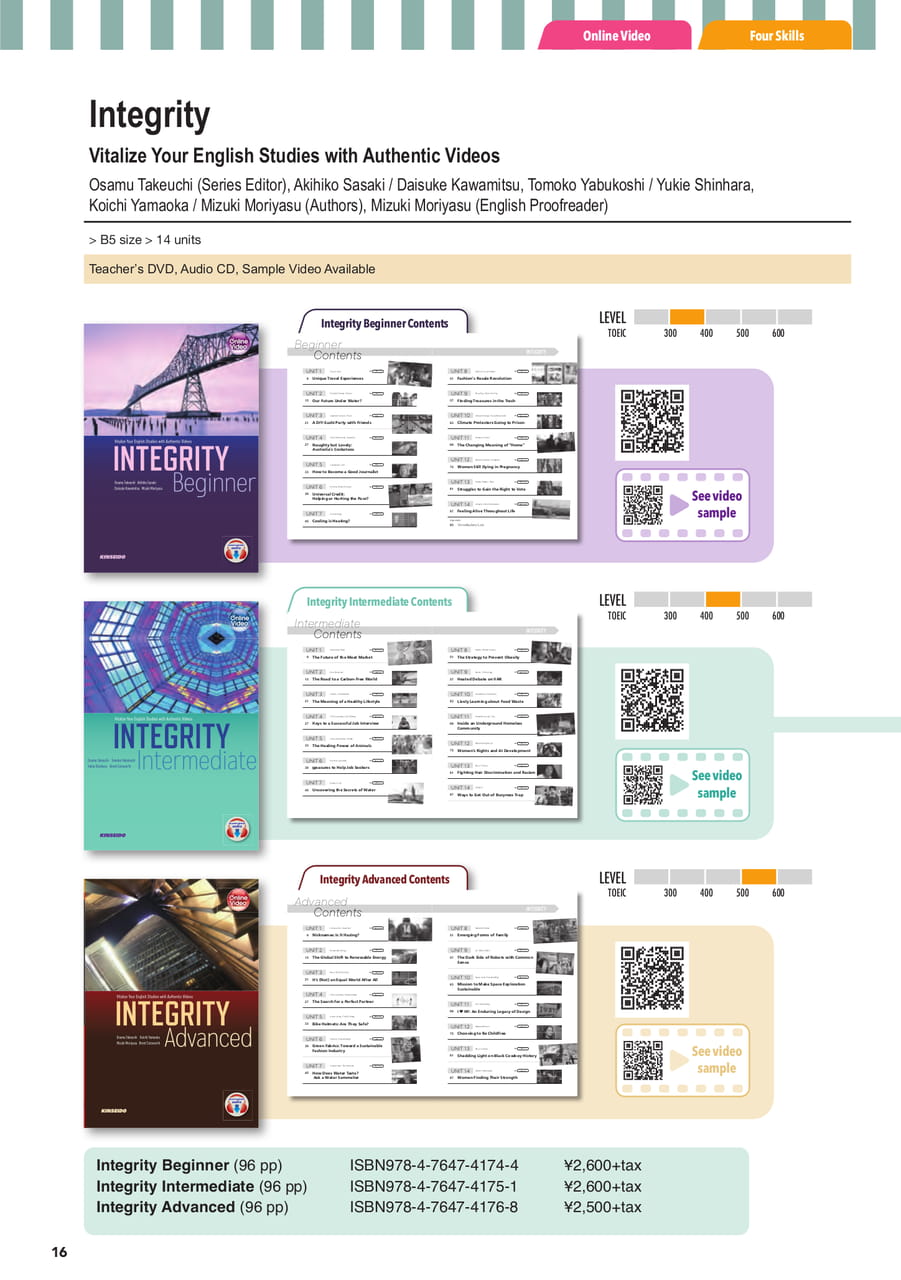
Integrity
Appendix
Online Video Four Skills
Integrity
Vitalize Your English Studies with Authentic Videos
Osamu Takeuchi (Series Editor), Akihiko Sasaki / Daisuke Kawamitsu, Tomoko Yabukoshi / Yukie Shinhara, Koichi Yamaoka / Mizuki Moriyasu (Authors), Mizuki Moriyasu (English Proofreader)
> B5 size > 14 units Teacher’s DVD, Audio CD, Sample Video Available
CMYK
Integrity Beginner Contents Beginner
Contents
LEVEL
TOEIC 300 400 500 600
UNIT 1 Travel / Asia TIME 1:46 9 Unique Travel Experiences
UNIT 8 Fashion / Social Media TIME 2:05 51 Fashion’s Resale Revolution
UNIT 2 Climate Change / Humor TIME 1:07 15 Our Future Under Water?
UNIT 9 Recycling / New York City TIME 2:25 57 Finding Treasures in the Trash
UNIT 3 Japanese Culture / Food TIME 3:17 21 A DIY-Sushi Party with Friends
UNIT 10 Climate Change / Social Movement TIME 2:08 63 Climate Protesters Going to Prison
UNIT 4 Life with Animals / Australia TIME 2:49 27 Naughty but Lovely: Australia’s Cockatoos
UNIT 11 Lifestyle / Home TIME 2:31 69 The Changing Meaning of “Home”
UNIT 12 Women’s Rights / Childbirth TIME 1:23
UNIT 5 Journalism / Job TIME 2:11 33 How to Become a Good Journalist 75 Women Still Dying in Pregnancy
UNIT 6 Poverty / British Society TIME 2:16 39 Universal Credit: Helping or Hurting the Poor?
UNIT 7 Clean Energy TIME 1:40 45 Cooling is Heating?
UNIT 13 Human Rights / Race TIME 2:02 81 Struggles to Gain the Right to Vote
UNIT 14 Lifestyle / After Retirement TIME 2:43 87 Feeling Alive Throughout Life 93 Vocabulary List
See video sample
CMYK
Integrity Intermediate Contents Intermediate
Contents
LEVEL
TOEIC 300 400 500 600
UNIT 1 Alternative Meat TIME 2:59 9 The Future of the Meat Market
UNIT 8 Health / British Society TIME 2:07 51 The Strategy to Prevent Obesity
UNIT 2 Zero Emissions TIME 3:07 15 The Road to a Carbon-Free World
UNIT 9 Sports / Technology TIME 2:43 57 Heated Debate on VAR
UNIT 3 Health / Social Media TIME 2:27 21 The Meaning of a Healthy Lifestyle
UNIT 10 Food Waste / Education TIME 2:31 63 Lively Learning about Food Waste
UNIT 4 Life Counseling / Job Hunting TIME 3:02 27 Keys to a Successful Job Interview
UNIT 11 Homeless Issues / City TIME 3:32 69 Inside an Underground Homeless Community
UNIT 5 Life with Animals / Health TIME 3:00 33 The Healing Power of Animals
UNIT 12 Women’s Rights / AI TIME 2:56 75 Women’s Rights and AI Development
UNIT 6 Poverty / Australia TIME 2:48 39 Measures to Help Job Seekers
UNIT 7 Nature / Life TIME 3:10 45 Uncovering the Secrets of Water
UNIT 13 Race / Culture TIME 3:05 81 Fighting Hair Discrimination and Racism
UNIT 14 Lifestyle TIME 3:33 87 Ways to Get Out of Busyness Trap
See video sample
7
CMYK
Integrity Advanced Contents Advanced
Contents
LEVEL
TOEIC 300 400 500 600
UNIT 1 Campus Life / Australia TIME 3:08 9 Nicknames: Is It Hazing?
UNIT 8 Modern Families TIME 2:45 51 Emerging Forms of Family
UNIT 2 Renewable Energy TIME 3:59 15 The Global Shift to Renewable Energy
UNIT 9 AI / Robot Ethics TIME 4:30 57 The Dark Side of Robots with Common Sense
UNIT 3 Race / British Society TIME 2:35 21 It’s (Not) an Equal World After All
UNIT 10 Space Junk / Sustainability TIME 5:06 63 Mission to Make Space Exploration Sustainable
UNIT 4 Life Counseling / Relationships TIME 3:22 27 The Search for a Perfect Partner
UNIT 11 Art / Advertising TIME 3:33 69 I NY: An Enduring Legacy of Design
UNIT 5 Active Living / Traffic Safety TIME 4:45 33 Bike Helmets: Are They Safe? UNIT 12 Modern Women TIME 3:47
UNIT 6 Fashion / Sustainability TIME 3:21 39 Green Fabrics: Toward a Sustainable Fashion Industry
UNIT 7 Unique Jobs / Environment TIME 4:43 45 How Does Water Taste? Ask a Water Sommelier 75 Choosing to Be Childfree
UNIT 13 Race / Culture TIME 5:14 81 Shedding Light on Black Cowboy History
UNIT 14 Gender Stereotypes TIME 4:57 87 Women Finding Their Strength
See video sample
6 7
Integrity Beginner (96 pp) ISBN978-4-7647-4174-4 ¥2,600+tax
Integrity Intermediate (96 pp) ISBN978-4-7647-4175-1 ¥2,600+tax
Integrity Advanced (96 pp) ISBN978-4-7647-4176-8 ¥2,500+tax
16
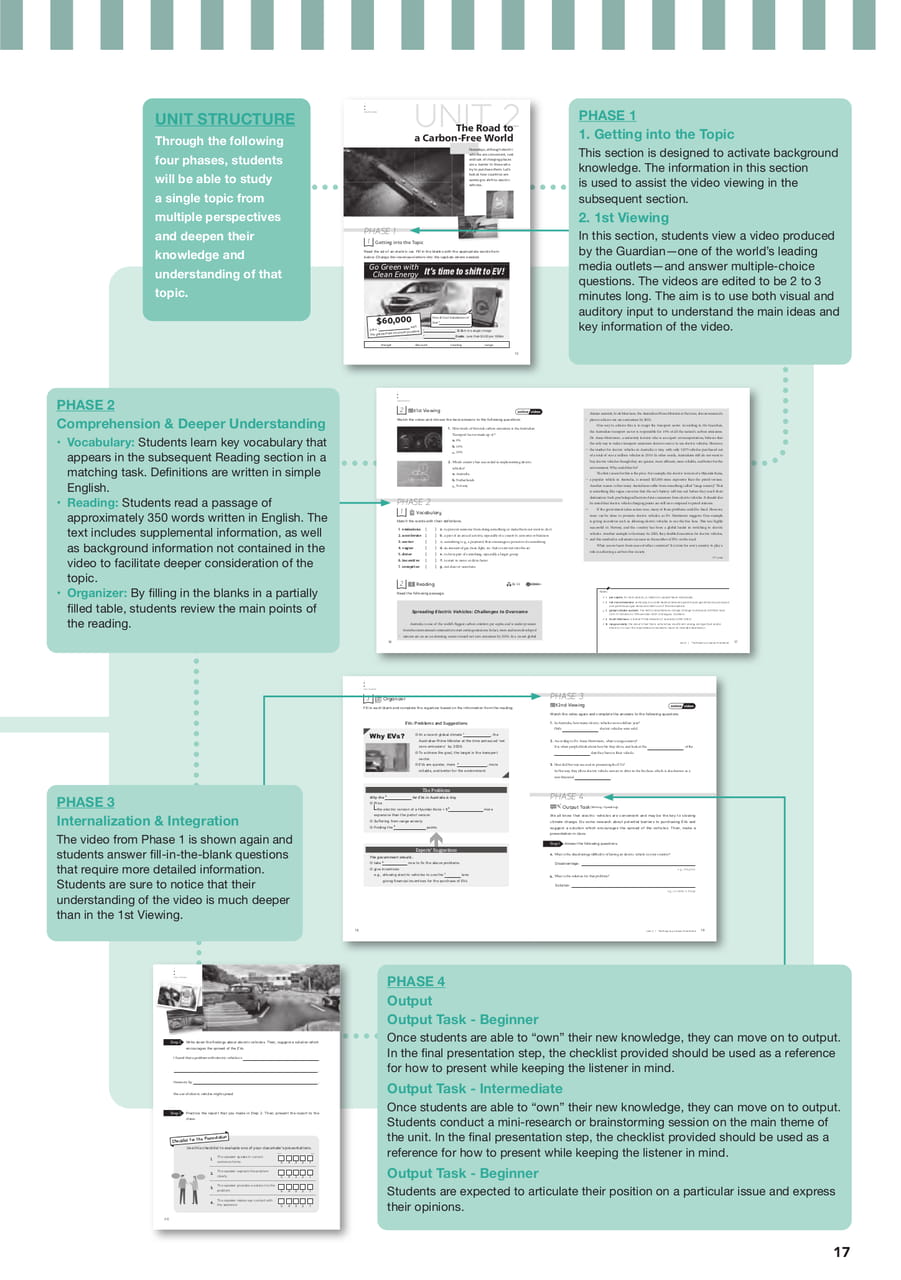
UNIT STRUCTURE
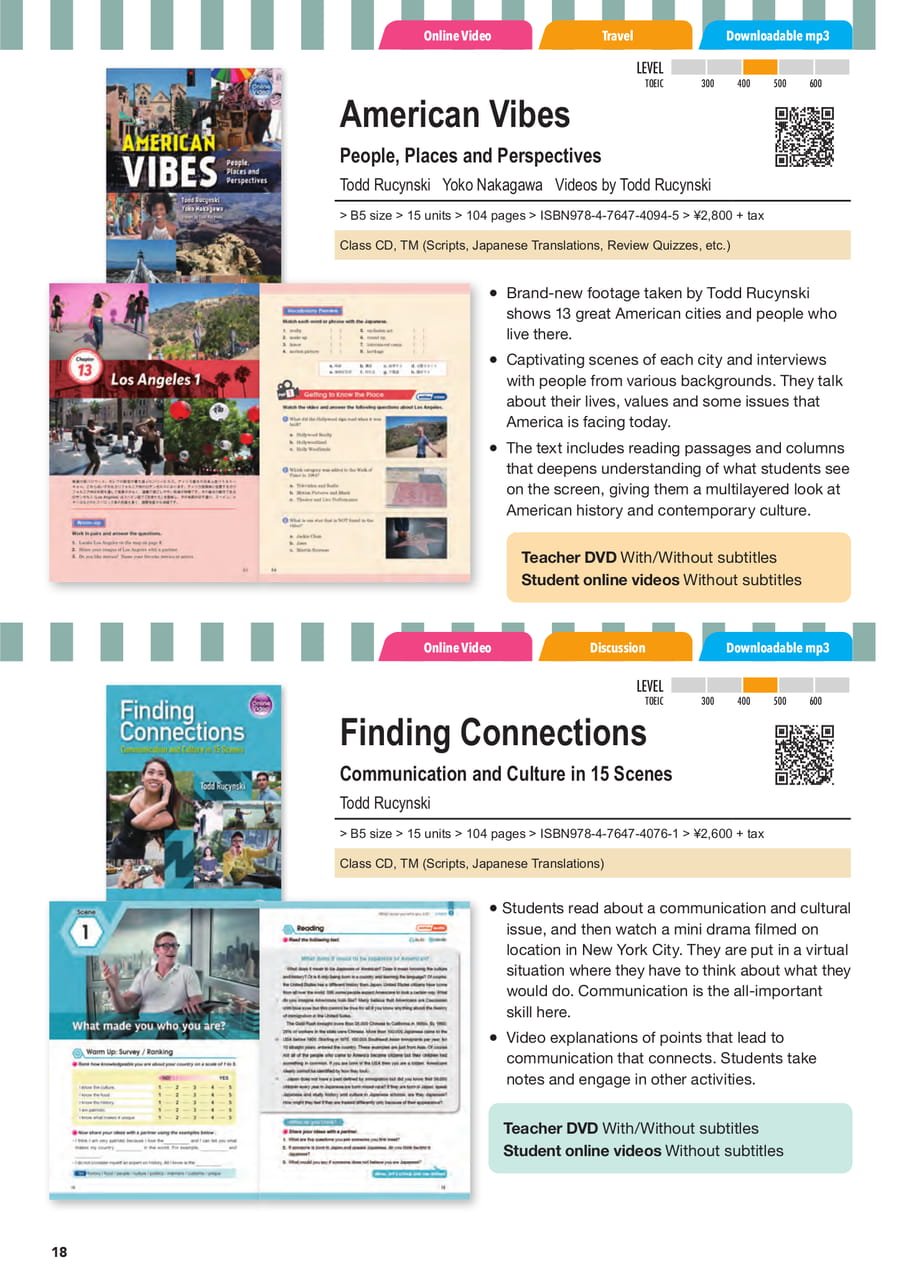
American Vibes
Online Video Travel
Downloadable mp3
American Vibes
People, Places and Perspectives
Todd Rucynski Yoko Nakagawa Videos by Todd Rucynski
> B5 size > 15 units > 104 pages > ISBN978-4-7647-4094-5 > ¥2,800 + tax Class CD, TM (Scripts, Japanese Translations, Review Quizzes, etc.)
LEVEL
TOEIC 300 400 500 600 ● Brand-new footage taken by Todd Rucynski shows 13 great American cities and people who live there. ● Captivating scenes of each city and interviews with people from various backgrounds. They talk about their lives, values and some issues that America is facing today. ● The text includes reading passages and columns that deepens understanding of what students see on the screen, giving them a multilayered look at American history and contemporary culture.
Teacher DVD With/Without subtitles Student online videos Without subtitles
Online Video Discussion
Downloadable mp3
Finding Connections
Communication and Culture in 15 Scenes
Todd Rucynski
> B5 size > 15 units > 104 pages > ISBN978-4-7647-4076-1 > ¥2,600 + tax Class CD, TM (Scripts, Japanese Translations)
LEVEL
TOEIC 300 400 500 600 ● Students read about a communication and cultural issue, and then watch a mini drama filmed on location in New York City. They are put in a virtual situation where they have to think about what they would do. Communication is the all-important skill here. ● Video explanations of points that lead to communication that connects. Students take notes and engage in other activities.
Teacher DVD With/Without subtitles Student online videos Without subtitles
18
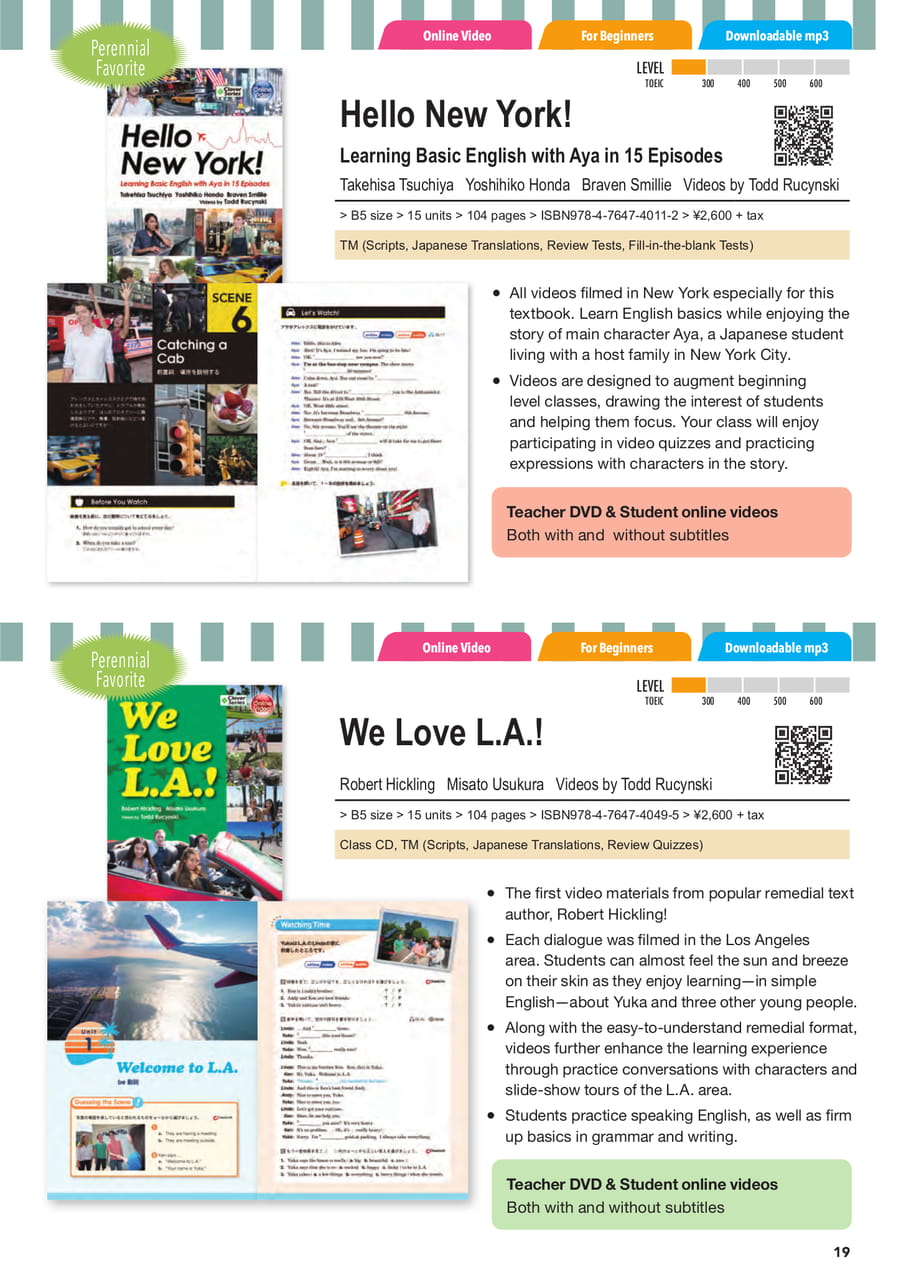
Hello New York!
Perennial Favorite
Online Video
Hello New York!
For Beginners Downloadable mp3
LEVEL
TOEIC 300 400 500 600
Learning Basic English with Aya in 15 Episodes
Takehisa Tsuchiya Yoshihiko Honda Braven Smillie Videos by Todd Rucynski
> B5 size > 15 units > 104 pages > ISBN978-4-7647-4011-2 > ¥2,600 + tax TM (Scripts, Japanese Translations, Review Tests, Fill-in-the-blank Tests) ● All videos filmed in New York especially for this textbook. Learn English basics while enjoying the story of main character Aya, a Japanese student living with a host family in New York City. ● Videos are designed to augment beginning level classes, drawing the interest of students and helping them focus. Your class will enjoy participating in video quizzes and practicing expressions with characters in the story.
Teacher DVD & Student online videos Both with and without subtitles
Perennial Favorite
Online Video
We Love L.A.!
For Beginners Downloadable mp3
LEVEL
TOEIC 300 400 500 600
Robert Hickling Misato Usukura Videos by Todd Rucynski
> B5 size > 15 units > 104 pages > ISBN978-4-7647-4049-5 > ¥2,600 + tax Class CD, TM (Scripts, Japanese Translations, Review Quizzes) ● The first video materials from popular remedial text author, Robert Hickling! ● Each dialogue was filmed in the Los Angeles area. Students can almost feel the sun and breeze on their skin as they enjoy learning—in simple English—about Yuka and three other young people. ● Along with the easy-to-understand remedial format, videos further enhance the learning experience through practice conversations with characters and slide-show tours of the L.A. area. ● Students practice speaking English, as well as firm up basics in grammar and writing.
Teacher DVD & Student online videos Both with and without subtitles
19
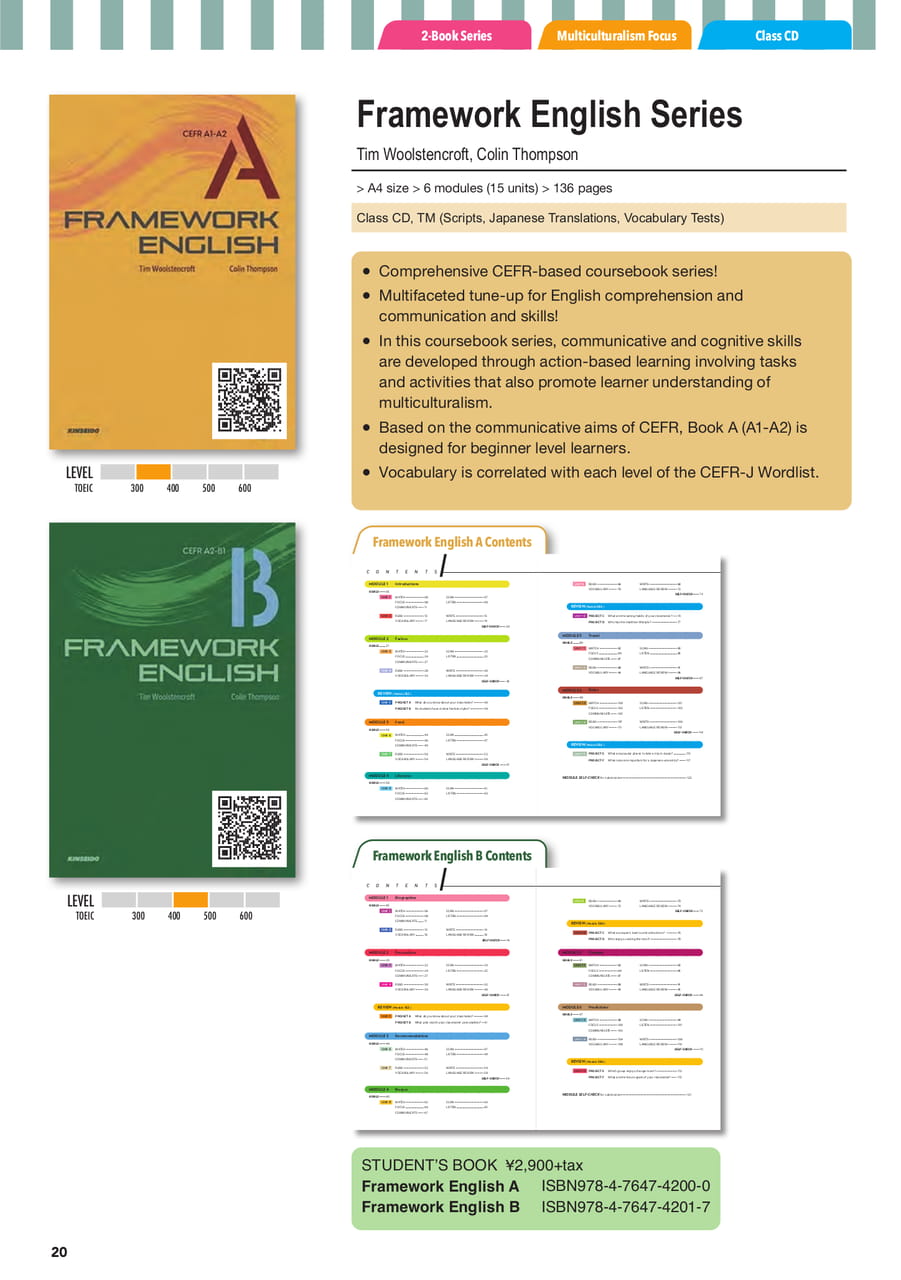
Framework English Series
2-Book Series Multiculturalism Focus
Class CD
Framework English Series
Tim Woolstencroft, Colin Thompson
> A4 size > 6 modules (15 units) > 136 pages Class CD, TM (Scripts, Japanese Translations, Vocabulary Tests)
LEVEL
TOEIC 300 400 500 600 ● Comprehensive CEFR-based coursebook series! ● Multifaceted tune-up for English comprehension and communication and skills! ● In this coursebook series, communicative and cognitive skills are developed through action-based learning involving tasks and activities that also promote learner understanding of multiculturalism. ● Based on the communicative aims of CEFR, Book A (A1-A2) is designed for beginner level learners. ● Vocabulary is correlated with each level of the CEFR-J Wordlist.
Framework English A Contents
C O N T E N T S
MODULE 1 GOALS 05
MODULE 2 GOALS 21
Introductions
Unit 1 MATCH 06 SCAN 07 FOCUS 08 LISTEN 09 COMMUNICATE 11
Unit 2 READ 13 WRITE 15 VOCABULARY 17 LANGUAGE REVIEW 19
Fashion
Unit 3 MATCH 22 SCAN 23 FOCUS 24 LISTEN 25 COMMUNICATE 27
Unit 4 READ 28 WRITE 30 VOCABULARY 32 LANGUAGE REVIEW 34 REVIEW ( Module 1&2 )
Unit 5 PROJECT A What do you know about your classmates? 36 PROJECT B Do students have similar fashion styles? 39
MODULE 3 GOALS 42
Food
Unit 6 MATCH 44 SCAN 45 FOCUS 46 LISTEN 47 COMMUNICATE 49
Unit 7 READ 50 WRITE 52 VOCABULARY 54 LANGUAGE REVIEW 56
SELF-CHECK 20
SELF-CHECK 35
SELF-CHECK 57
Unit 9 READ 66 WRITE 68 VOCABULARY 70 LANGUAGE REVIEW 72 REVIEW( Module 3&4 )
Unit 10 PROJECT C What are the eating habits of your classmates? 74 PROJECT D Who has the healthier lifestyle? 77
MODULE 5 GOALS 80
MODULE 6 GOALS 98
Travel
Unit 11 MATCH 82 SCAN 83 FOCUS 84 LISTEN 85 COMMUNICATE 87
Unit 12 READ 88 WRITE 91 VOCABULARY 94 LANGUAGE REVIEW 96
Rules
Unit 13 MATCH 100 SCAN 101 FOCUS 102 LISTEN 103 COMMUNICATE 105
Unit 14 READ 107 WRITE 109 VOCABULARY 111 LANGUAGE REVIEW 113
SELF-CHECK 73
SELF-CHECK 97
SELF-CHECK 114 REVIEW( Module 5&6 )
Unit 15 PROJECT E What are popular places to take a trip in Japan? 115 PROJECT F What rules are important for a Japanese university? 117
MODULE 4 GOALS 58
Lifestyles
Unit 8 MATCH 60 SCAN 61 FOCUS 62 LISTEN 63 COMMUNICATE 65
MODULE SELF-CHECK for submission 125
Framework English B Contents
LEVEL
TOEIC 300 400 500 600
C O N T E N T S
MODULE 1 GOALS 05
Biographies
Unit 1 MATCH 06 SCAN 07 FOCUS 08 LISTEN 09 COMMUNICATE 11
Unit 2 READ 12 WRITE 14 VOCABULARY 16 LANGUAGE REVIEW 18
SELF-CHECK 19
Unit 9 READ 69 WRITE 70 VOCABULARY 72 LANGUAGE REVIEW 74 REVIEW ( Module 3&4 )
Unit 10 PROJECT C What are Japan’s best tourist attractions? 76 PROJECT D Who enjoys cooking the most? 78
SELF-CHECK 75
MODULE 2 GOALS 20
Personalities
Unit 3 MATCH 22 SCAN 23 FOCUS 24 LISTEN 25 COMMUNICATE 27
MODULE 5 GOALS 81
Changes
Unit 11 MATCH 82 SCAN 83 FOCUS 84 LISTEN 85 COMMUNICATE 87
Unit 4 READ 30 WRITE 32 VOCABULARY 34 LANGUAGE REVIEW 36
SELF-CHECK 37
Unit 12 READ 89 WRITE 91 VOCABULARY 93 LANGUAGE REVIEW 95
SELF-CHECK 96 REVIEW ( Module 1&2 )
Unit 5 PROJECT A What do you know about your classmates? 38 PROJECT B What jobs match your classmates’ personalities? 41
MODULE 3 GOALS 44
Recommendations
Unit 6 MATCH 46 SCAN 47 FOCUS 48 LISTEN 49 COMMUNICATE 51
Unit 7 READ 52 WRITE 54 VOCABULARY 56 LANGUAGE REVIEW 58
SELF-CHECK 59
MODULE 6 GOALS 97
Predictions
Unit 13 MATCH 98 SCAN 99 FOCUS 100 LISTEN 101 COMMUNICATE 103
Unit 14 READ 104 WRITE 106 VOCABULARY 108 LANGUAGE REVIEW 110 REVIEW ( Module 5&6 )
Unit 15 PROJECT E Which group enjoys change more? 112 PROJECT F What are the future goals of your classmates? 115
SELF-CHECK 111
MODULE 4 GOALS 60
Recipes
Unit 8 MATCH 62 SCAN 63 FOCUS 64 LISTEN 65 COMMUNICATE 67
MODULE SELF-CHECK for submission 121
STUDENT’S BOOK ¥2,900+tax
Framework English A ISBN978-4-7647-4200-0
Framework English B ISBN978-4-7647-4201-7
20
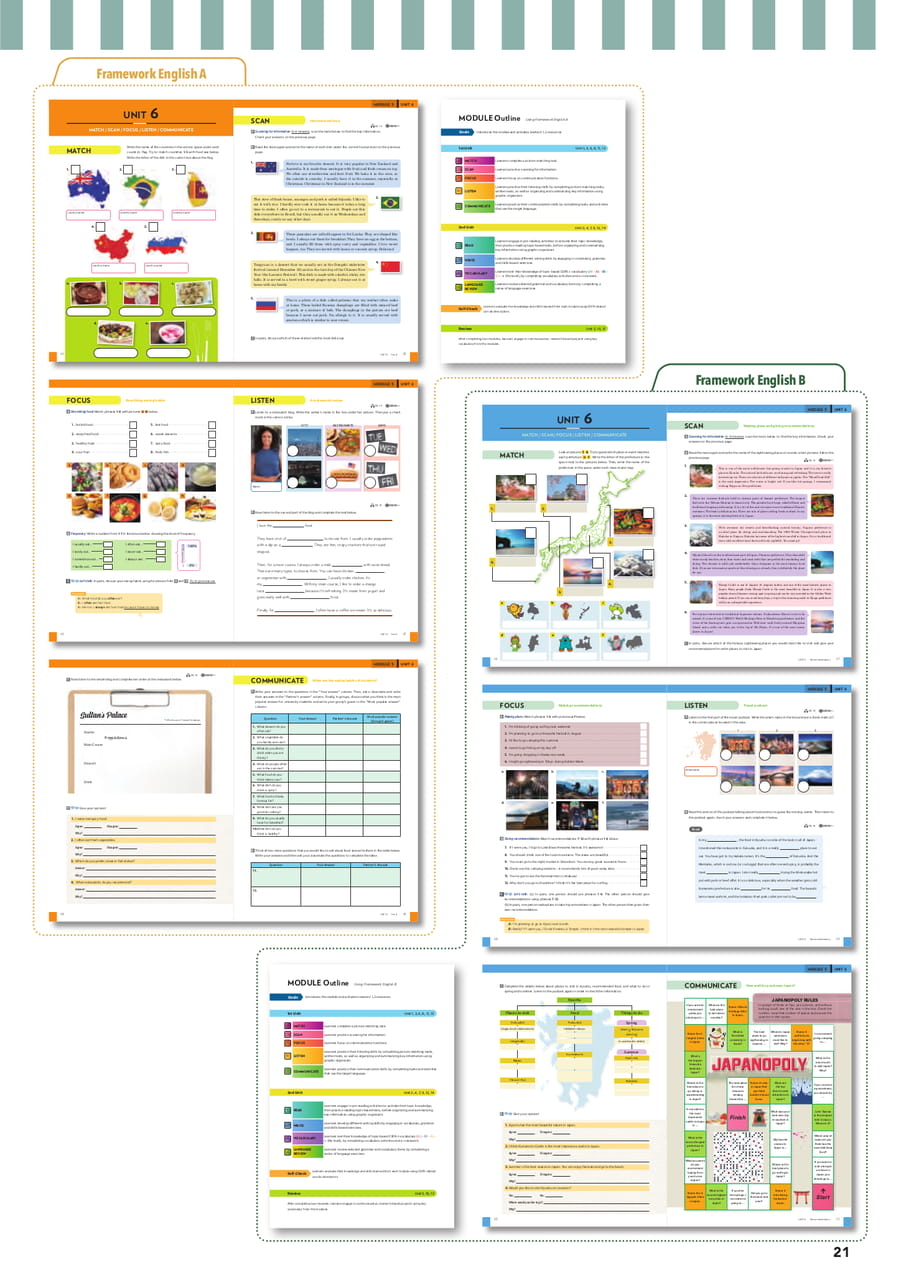
World Englishes: Japan
country name
For example: country name country name country name country name
*10% discount *closed Tuesdays
DL 15 CD 15
Name:
DL 12 CD 12
UNIT 6 Food
DL 13 CD 13
DL 14 CD 14
UNIT 6
UNIT 6
Food
Food
For example:
Area name:
DL 13 CD 13
This is one of the most well-known hot spring resorts in Japan and it is my favorite place in Kyushu. The natural hot baths are so relaxing and refreshing. The town is really interesting too. There are also lots of different hell pools or jigoku. The “Blood Pond Hell” is the most impressive. The water is bright red. If you like hot springs, I recommend visiting Beppu in Oita prefecture.
There are summer festivals held in various parts of Aomori prefecture. The largest festival is the Nebuta Matsuri in Aomori city. The parades have huge, colorful floats and traditional singing and dancing. It is a lot of fun and everyone wears traditional Haneto costumes. The food is delicious too. There are lots of places selling fresh seafood. In my opinion, it is the most exciting festival in Japan.
With awesome ski resorts and breathtaking natural beauty, Nagano prefecture is an ideal place for skiing and snowboarding. The 1998 Winter Olympics took place in Hakuba in Nagano. Hakuba has some of the highest snowfall in Japan. It is a traditional town with excellent local food and lively nightlife. You must go!
Miyako Island is in the southernmost part of Japan, Okinawa prefecture. It has beautiful white sandy beaches, clear, blue water and coral reefs that are perfect for snorkeling and diving. The climate is mild and comfortable. Goya chanpuru is the most famous local dish. If you are into marine sports or like relaxing on a beach, this is definitely the place for you.
For anyone interested in traditional Japanese culture, Itsukushima Shrine is not to be missed. It is one of two UNESCO World Heritage Sites in Hiroshima prefecture and the views of the floating torii gate are spectacular. Wild deer walk freely around Miyajima Island and a cable car takes you to the top of Mt. Misen. It is one of the most scenic places in Japan!
If you are into Where is the Name 3 World amusement best place Heritage Sites parks, you to eat ramen in Japan. should go to … noodles?
Name the 3 longest rivers in Japan.
What is the largest fireworks festival in Japan?
Where is the best place to go skiing or snowboarding in Japan?
In my opinion, the most impressive castle in Japan is …
What is the second largest prefecture in Japan?
What souvenirs do you recommend buying from your home region?
Himeji Castle is one of Japan’s 12 original castles and one of the most historic places in Japan. Many people think Himeji Castle is the most beautiful in Japan. It is also a very popular cherry blossom viewing spot in spring and can be very crowded in the Golden Week holiday period. If you can avoid busy days, a trip to this stunning castle in Hyogo prefecture will be an unforgettable experience.
What is the oldest university in Japan?
UNIT 6 Recommendations
DL 14 CD 14
DL 15 CD 15
UNIT 6 Recommendations
The best Where in Japan Name 4 I recommend place to go would you prefectures going camping sightseeing in most like to beginning with to …
Japan is … live? Why? the letter “S”.
The best place Name 4 rules What are for cherry in Japan that the top blossom you think three tourist viewing tourists should attractions in
(hanami) is … know. Japan?
What is the If you like Name the 5
Did you go to second highest hot springs, I biggest cities the beach last mountain in recommend in Japan. year? Japan? going to …
What was your best ever trip or vacation in Japan?
My favorite season in Japan is …
Where is the best place to go surfing in Japan?
Name 4 interesting festivals in Japan.
What is the best month to visit Japan? Why?
If you come to my hometown, you should try …
Lake Tazawa is the deepest lake in Japan. Where is it?
Which area of Japan do you think has the most delicious food?
If you want to visit a temple or shrine in Japan, you should go to …
UNIT 6 Recommendations
Framework English A UNIT 6
MATCH / SCAN / FOCUS / LISTEN / COMMUNICATE
SCAN
International food
A Scanning for information: In 4 minutes, scan the texts below to find the key information. Check your answers on the previous page.
MODULE 3 UNIT 6
MODULE Outline
Using Framework English A Goals Introduces the module and activates learners’ L2 resources.
MATCH
Write the name of the countries in the correct space under each country’s flag. Try to match countries 1-5 with food a-e below.
B Read the texts again and write the name of each dish under the correct food picture on the previous page.
1st Unit Unit 1, 3, 6, 8, 11, 13
1. 2.
Write the letter of the dish in the correct box above the flag. 1.
Pavlova is my favorite dessert. It is very popular in New Zealand and
3.
Australia. It is made from meringue with fruit and fresh cream on top. We often use strawberries and kiwi fruit. We bake it in the oven, so the outside is crunchy. I usually have it in the summer, especially at Christmas. Christmas in New Zealand is in the summer.
This stew of black beans, sausages and pork is called feijoada. I like to eat it with rice. I hardly ever cook it at home because it takes a long time to make. I often go out to a restaurant to eat it. People eat this dish everywhere in Brazil, but they usually eat it on Wednesdays and Saturdays, rarely on any other days.
MATCH Learners complete a picture matching task.
SCAN Learners practice scanning for information.
FOCUS
Learners focus on communicative functions.
Learners practice their listening skills by completing picture matching tasks,
LISTEN written texts, as well as organizing and summarizing key information using
2. graphic organizers.
Learners practice their communication skills by completing tasks and activities COMMUNICATE that use the target language.
4. 5.
2nd Unit Unit 2, 4, 7, 9, 12, 14
3.
These pancakes are called hoppers in Sri Lanka. They are shaped like bowls. I always eat them for breakfast. They have an egg at the bottom, and I usually fill them with spicy curry and vegetables. I love sweet
READ
Learners engage in pre-reading activities to activate their topic knowledge, then practice reading topic-based texts, before organizing and summarizing hoppers, too. They are served with honey or coconut syrup. Delicious! key information using graphic organizers.
Tangyuan is a dessert that we usually eat at the Dongzhi midwinter festival (around December 22) and on the last day of the Chinese New Year (the Lantern Festival). This dish is made with colorful, sticky rice a. b. c. balls. It is served in a bowl with sweet ginger syrup. I always eat it at
4.
WRITE
Learners develop different writing skills by engaging in vocabulary, grammar and skills-based exercises.
VOCABULARY
Learners test their knowledge of topic-based CEFR-J vocabulary (A1 - A2 - B1 - B2 - + (No level), by completing vocabulary activities and a crossword.. home with my family. LANGUAGE
Learners review selected grammar and vocabulary items by completing a
REVIEW series of language exercises.
5.
This is a photo of a dish called pelmeni that my mother often cooks at home. These boiled Russian dumplings are filled with minced beef or pork, or a mixture of both. The dumplings in the picture are beef because I never eat pork. I’m allergic to it. It is usually served with
Learners evaluate the knowledge and skills learned from each module using CEFR related Self-Check can-do descriptors. d. e. smetana which is similar to sour cream. Review
Unit 5, 10, 15
C In pairs, discuss which of these dishes look the most delicious.
After completing two modules, learners engage in communicative, research-based projects using key vocabulary from the modules.
44
45
MODULE 3 UNIT 6
Framework English B
FOCUS
Describing eating habits
LISTEN
A restaurant review
A Describing food: Match phrases 1-8 with pictures a - h below. 1. boiled food ····················· 5. fast food ······················· A Listen to a restaurant blog. Write the writer’s name in the box under her picture. Then put a check mark in the correct circles.
CITY RESTAURANTS DAYS UNIT 6
SCAN
Making plans and giving recommendations
MODULE 3 UNIT 6 2. deep fried food·················· 6. sweet desserts ·················· MATCH / SCAN / FOCUS / LISTEN / COMMUNICATE
A Scanning for information: In 4 minutes, scan the texts below to find the key information. Check your 3. healthy food ···················· 7. spicy food ······················ answers on the previous page. 4. sour fruit······················· 8. fresh fish······················· a. b. c. d.
MATCH
Look at pictures 1 - 6 . Try to guess which place or event matches each prefecture a - f . Write the letter of the prefecture in the space next to the pictures below. Then, write the name of the prefecture in the space under each mascot and map.
B Read the texts again and write the name of the sightseeing places or events under pictures 1-6 on the previous page.
1. e. f. g. h. 2.
B Now listen to the second part of the blog and complete the text below.
1. 2.
B Frequency: Write a number from 1-7 in the boxes below showing the level of frequency.
I usually eat… I often eat…
1
I rarely eat…
I never eat…
I sometimes eat… I hardly eat…
I always eat…
2
I love the food.
3.
100%
They have a lot of with a dip as a to choose from. I usually order poppadoms . They are thin, crispy crackers that are round
3. shaped. 4. 7 0% Then, for a main course, I always order a mild with naan bread. There are many types to choose from. You can have chicken, ,
6.
C
Let’s talk: In pairs, discuss your eating habits using the phrases from A and B . Try to give reasons.
A: What food do you often eat? B: I often eat fast food.
46
A: Me too. I always eat fast food because I have no money. or vegetarian with my
. I usually order chicken, it’s . With my main course, I like to order a mango
4.
5. lassi because it’s refreshing. It’s made from yogurt and
5. goes really well with food. a b c
Finally, for , I often have a coffee ice cream. It’s so delicious.
6.
47 d e f
C In pairs, discuss which of the famous sightseeing places you would most like to visit and give your recommendations for other places to visit in Japan.
MODULE 3 UNIT 6
46 47
C Now listen to the whole blog and complete her order at the restaurant below.
COMMUNICATE
What are the eating habits of students?
A Write your answers to the questions in the “Your answer” column. Then, ask a classmate and write
MODULE 3 UNIT 6 their answers in the “Partner’s answer” column. Finally, in groups, discuss what you think is the most popular answer for university students and write your group’s guess in the “Most popular answer” column.
FOCUS
Making recommendations
LISTEN
Travel podcast
Question Your Answer Partner’s Answer
Starter
Poppadoms
Main Course
Dessert
Drink
D Give your opinion!
1. What dessert do you
Most popular answer (Group’s guess) often eat?
2. What vegetable do you hardly ever eat?
3. What do you like to drink when you are thirsty?
4. What do people often eat in the summer?
5. What food do you think tastes sour?
6. What dish do you think is spicy?
7. What food is Osaka famous for?
A Making plans: Match phrases 1-6 with pictures a-f below.
A Listen to the first part of the travel podcast. Write the area’s name in the box and put a check mark (✓) in the correct places located in the area. 1. I’m thinking of going surfing next weekend. 2. I’m planning to go to a fireworks festival in August. 3. I’d like to go camping this summer. 4. I want to go hiking on my day off.
1 2 3 5. I’m going shopping in Osaka next week. 6. I might go sightseeing in Tokyo during Golden Week.
a. b. c.
d. e. f.
8. What dish are you good at cooking?
B Read the section of the podcast talking about food and try to guess the missing words. Then listen to 1. I never eat spicy food. Agree: Why?
9. What do you usually
Disagree: have for breakfast? the podcast again, check your answers and complete it below.
10. What dish do you Food think is healthy? 2. I often eat fresh vegetables. B Giving recommendations: Match recommendations 7-12 with phrases 1-6 above.
In my
, the food in Kyushu is some of the best in all of Japan.
Agree: Why?
Disagree: B Think of two more questions that you would like to ask about food and write them in the table below. 7. If I were you, I’d go to Lake Biwa fireworks festival. It’s awesome! I mentioned the restaurants in Fukuoka, and it is a really place to eat
Write your answers and then ask your classmate the questions to complete the table. 8. You should climb one of the local mountains. The views are beautiful. out. You have got to try Hakata ramen. It’s the of Fukuoka. And the 3. Which do you prefer, meat or fish dishes? Answer: Why?
11.
Question Your Answer Partner’s Answer 9. You must go to the night market in Dotonbori. You can buy great souvenirs there. 10. Check out this camping website – it recommends lots of good camp sites. 11. You’ve got to see the Kaminarimon in Asakusa! 4. What restaurants do you recommend? 12. Why don’t you go to Enoshima? I think it’s the best place for surfing.
Answer: 12.
Why?
C
Let’s talk: (a) In pairs, one person should use phrases 1-6. The other person should give recommendations using phrases 7-12. (b) In pairs, one person make plans to take trip somewhere in Japan. The other person then gives their
Mentaiko, which is cod roe (or cod eggs) that are often served spicy, is probably the most in Japan. I also really trying the Motsunabe hot pot with pork or beef offal. It is so delicious, especially when the weather gets cold. Kumamoto prefecture is also for its food. The basashi horse meat sashimi, and the tonkatsu fried pork cutlet are not to be .
48 49 own recommendations.
A: I’m planning to go to Kyoto next month. B: Really? If I were you, I’d visit Kinkaku-ji Temple. I think it’s the most beautiful temple in Japan.
48
49
MODULE 3 UNIT 6
MODULE Outline
Using Framework English B
C Complete the details below about places to visit in Kyushu, recommended food, and what to do in spring and summer. Listen to the podcast again in order to check the information.
COMMUNICATE
How well do you know Japan?
Goals Introduces the module and activates learners’ L2 resources.
Kyushu JAPANOPOLY RULES
1st Unit Unit 1, 3, 6, 8, 11, 13
Places to visit Food
Things to do
In groups of three or four, use a pencil, and without looking, touch one of the dice in the box. Check the number, move that number of spaces and answer the question in that square.
MATCH
SCAN
FOCUS
Learners complete a picture matching task.
Learners practice scanning for information.
Learners focus on communicative functions.
Fukuoka shops and restaurants
Nagasaki
Fukuoka Hakata ramen
Spring
Cherry blossom viewing
Kumamoto castle
Learners practice their listening skills by completing picture matching tasks,
LISTEN written texts, as well as organizing and summarizing key information using graphic organizers.
Learners practice their communication skills by completing tasks and activities COMMUNICATE that use the target language.
Beppu
Kumamoto
Summer Festivals
JAPANOPOLY
2nd Unit Unit 2, 4, 7, 9, 12, 14
Mount Aso Beaches
READ
WRITE
Learners engage in pre-reading activities to activate their topic knowledge, then practice reading topic-based texts, before organizing and summarizing key information using graphic organizers.
Learners develop different writing skills by engaging in vocabulary, grammar and skills-based exercises.
D Give your opinion! 1. Kyushu has the most beautiful nature in Japan.
Finish
Agree:
Disagree:
VOCABULARY
LANGUAGE REVIEW
Learners test their knowledge of topic-based CEFR-J vocabulary (A2 - B1 - B2 - + (No level), by completing vocabulary activities and a crossword..
Learners review selected grammar and vocabulary items by completing a series of language exercises.
Why? 2. I think Kumamoto Castle is the most impressive castle in Japan. Agree:
Disagree:
Self-Check
Learners evaluate their knowledge and skills learned from each module using CEFR related can-do descriptors.
Why? 3. Summer is the best season in Japan. You can enjoy festivals and go to the beach. Agree: Why?
Disagree:
Review
Unit 5, 10, 15
After completing two modules, learners engage in communicative, research-based projects using key vocabulary from the modules. 4. Would you like to visit Kyushu on vacation? Yes:
No: Where would you like to go?
Start
Why?
50
51
21
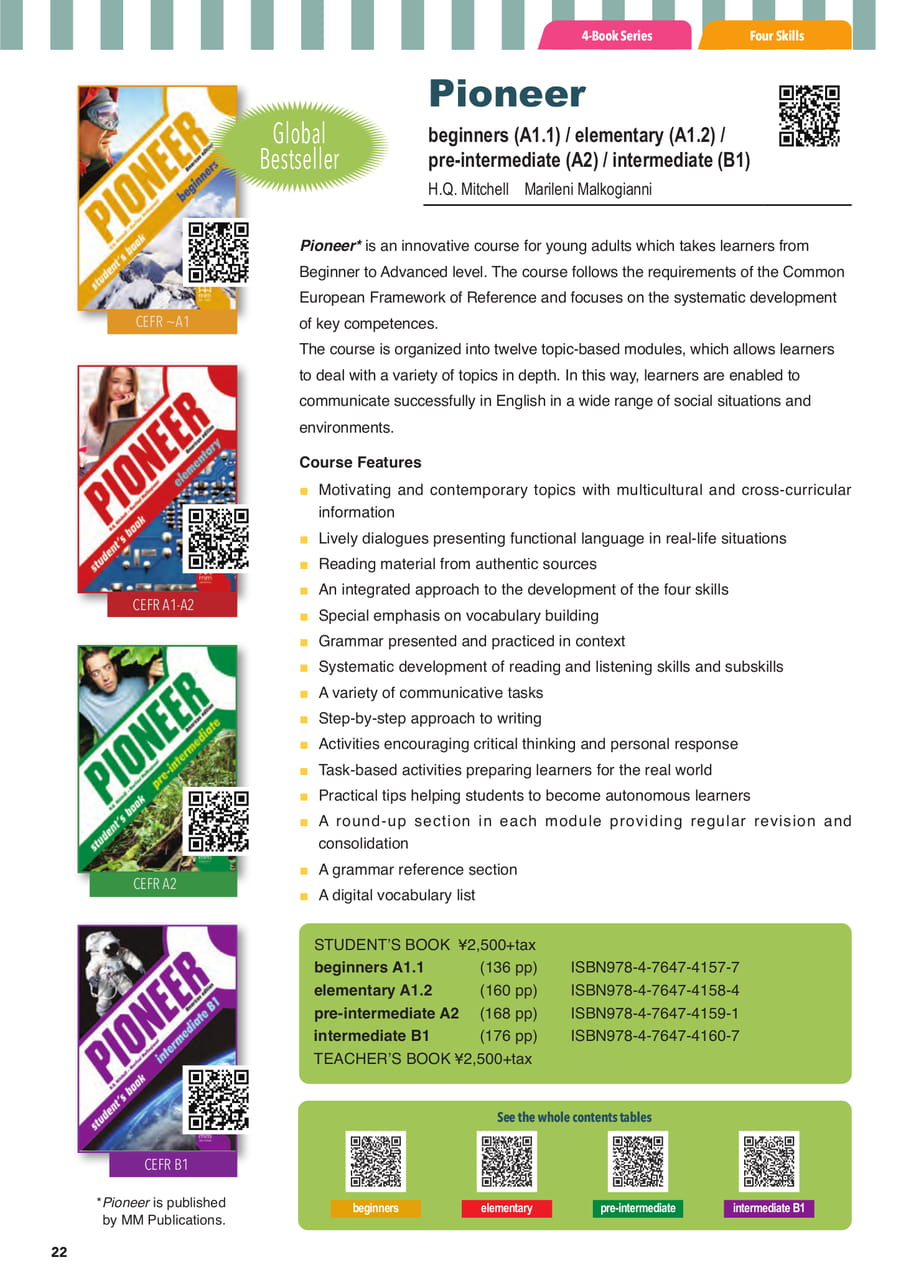
Pioneer
4-Book Series Four Skills
Global Bestseller
Pioneer
beginners (A1.1) / elementary (A1.2) / pre-intermediate (A2) / intermediate (B1)
H.Q. Mitchell Marileni Malkogianni
Pioneer* is an innovative course for young adults which takes learners from Beginner to Advanced level. The course follows the requirements of the Common
CEFR ~A1
European Framework of Reference and focuses on the systematic development of key competences. The course is organized into twelve topic-based modules, which allows learners to deal with a variety of topics in depth. In this way, learners are enabled to communicate successfully in English in a wide range of social situations and environments.
Course Features
CEFR A1-A2
CEFR A2 ■ Motivating and contemporary topics with multicultural and cross-curricular information ■ Lively dialogues presenting functional language in real-life situations ■ Reading material from authentic sources ■ An integrated approach to the development of the four skills ■ Special emphasis on vocabulary building ■ Grammar presented and practiced in context ■ Systematic development of reading and listening skills and subskills ■ A variety of communicative tasks ■ Step-by-step approach to writing ■ Activities encouraging critical thinking and personal response ■ Task-based activities preparing learners for the real world ■ Practical tips helping students to become autonomous learners ■ A round-up section in each module providing regular revision and consolidation ■ A grammar reference section ■ A digital vocabulary list
STUDENT’S BOOK ¥2,500+tax beginners A1.1 (136 pp) ISBN978-4-7647-4157-7 elementary A1.2 (160 pp) ISBN978-4-7647-4158-4 pre-intermediate A2 (168 pp) ISBN978-4-7647-4159-1 intermediate B1 (176 pp) ISBN978-4-7647-4160-7
TEACHER’S BOOK ¥2,500+tax
See the whole contents tables
CEFR B1
*Pioneer is published by MM Publications. beginners elementary pre-intermediate intermediate B1
22
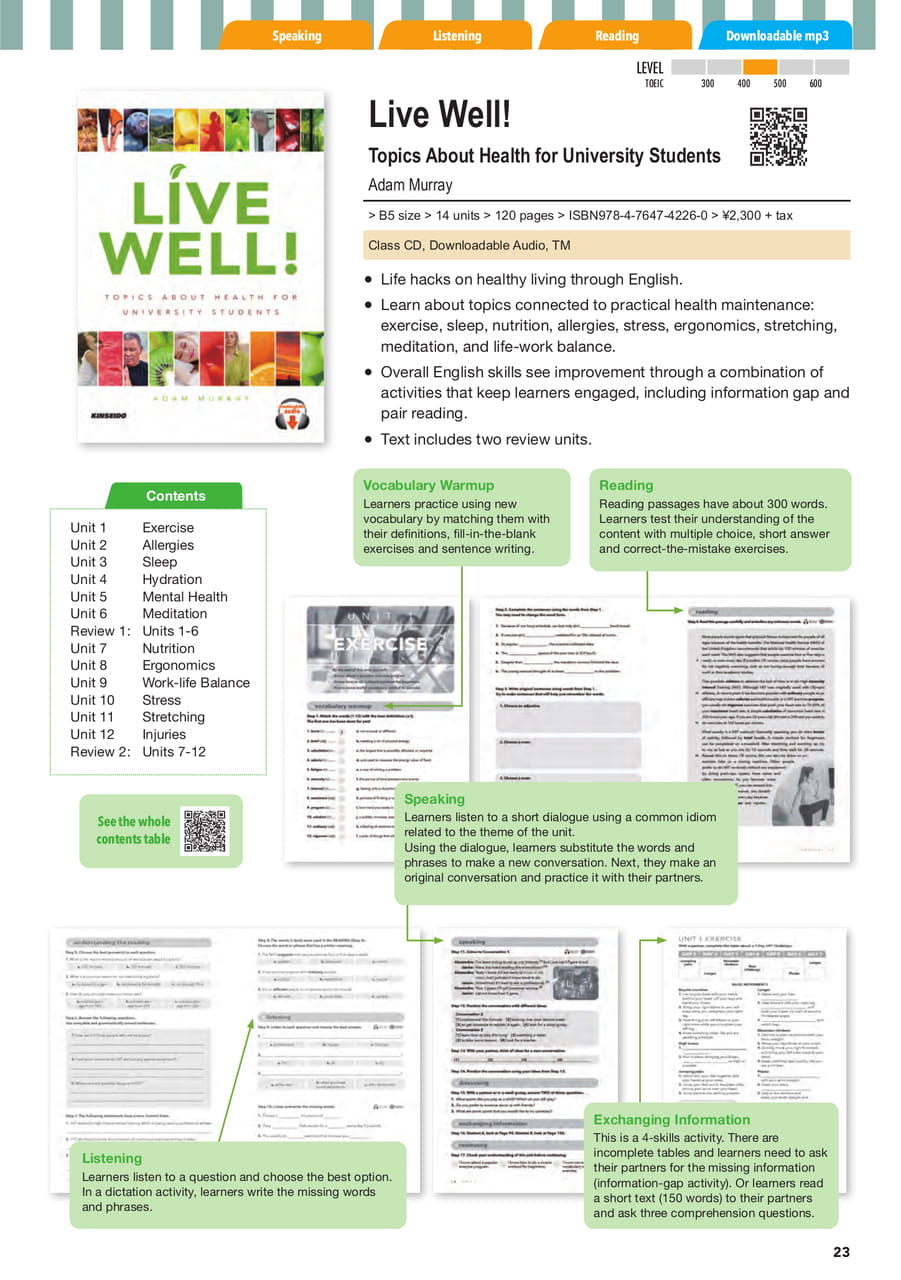
Live Well!
Speaking Listening
Reading Downloadable mp3
Live Well!
Topics About Health for University Students
Adam Murray
> B5 size > 14 units > 120 pages > ISBN978-4-7647-4226-0 > ¥2,300 + tax Class CD, Downloadable Audio, TM ● Life hacks on healthy living through English.
LEVEL
TOEIC 300 400 500 600 ● Learn about topics connected to practical health maintenance: exercise, sleep, nutrition, allergies, stress, ergonomics, stretching, meditation, and life-work balance. ● Overall English skills see improvement through a combination of activities that keep learners engaged, including information gap and pair reading. ● Text includes two review units.
Contents
Unit 1 Exercise
Unit 2 Allergies
Unit 3 Sleep
Unit 4 Hydration
Unit 5 Mental Health
Unit 6 Meditation
Review 1: Units 1-6
Unit 7 Nutrition
Unit 8 Ergonomics
Unit 9 Work-life Balance
Unit 10 Stress
Unit 11 Stretching
Unit 12 Injuries
Review 2: Units 7-12
Vocabulary Warmup Learners practice using new vocabulary by matching them with their definitions, fill-in-the-blank exercises and sentence writing.
Reading Reading passages have about 300 words. Learners test their understanding of the content with multiple choice, short answer and correct-the-mistake exercises.
See the whole contents table
Speaking Learners listen to a short dialogue using a common idiom related to the theme of the unit. Using the dialogue, learners substitute the words and phrases to make a new conversation. Next, they make an original conversation and practice it with their partners.
Listening Learners listen to a question and choose the best option. In a dictation activity, learners write the missing words and phrases.
Exchanging Information This is a 4-skills activity. There are incomplete tables and learners need to ask their partners for the missing information (information-gap activity). Or learners read a short text (150 words) to their partners and ask three comprehension questions.
23
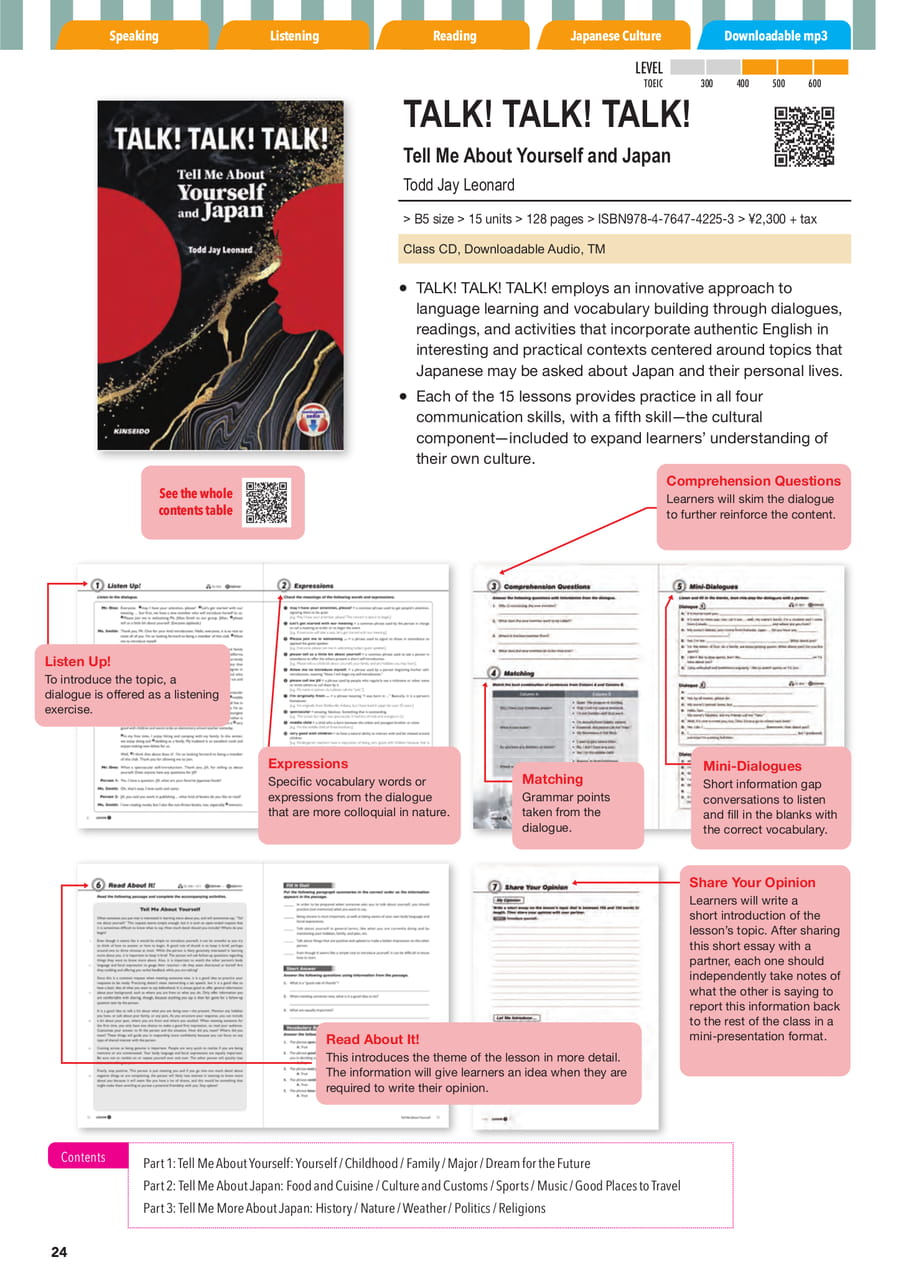
TALK! TALK! TALK!
Speaking Listening
Reading
Japanese Culture Downloadable mp3
TALK! TALK! TALK!
Tell Me About Yourself and Japan
Todd Jay Leonard
> B5 size > 15 units > 128 pages > ISBN978-4-7647-4225-3 > ¥2,300 + tax Class CD, Downloadable Audio, TM
LEVEL
TOEIC 300 400 500 600
See the whole contents table ● TALK! TALK! TALK! employs an innovative approach to language learning and vocabulary building through dialogues, readings, and activities that incorporate authentic English in interesting and practical contexts centered around topics that Japanese may be asked about Japan and their personal lives. ● Each of the 15 lessons provides practice in all four communication skills, with a fifth skill—the cultural component—included to expand learners’ understanding of their own culture.
Comprehension Questions Learners will skim the dialogue to further reinforce the content.
Listen Up! To introduce the topic, a dialogue is offered as a listening exercise.
Expressions Specific vocabulary words or expressions from the dialogue that are more colloquial in nature.
Matching Grammar points taken from the dialogue.
Mini-Dialogues Short information gap conversations to listen and fill in the blanks with the correct vocabulary.
Read About It! This introduces the theme of the lesson in more detail. The information will give learners an idea when they are required to write their opinion.
Share Your Opinion Learners will write a short introduction of the lesson’s topic. After sharing this short essay with a partner, each one should independently take notes of what the other is saying to report this information back to the rest of the class in a mini-presentation format.
Contents
Part 1: Tell Me About Yourself: Yourself / Childhood / Family / Major / Dream for the Future Part 2: Tell Me About Japan: Food and Cuisine / Culture and Customs / Sports / Music / Good Places to Travel Part 3: Tell Me More About Japan: History / Nature / Weather / Politics / Religions
24
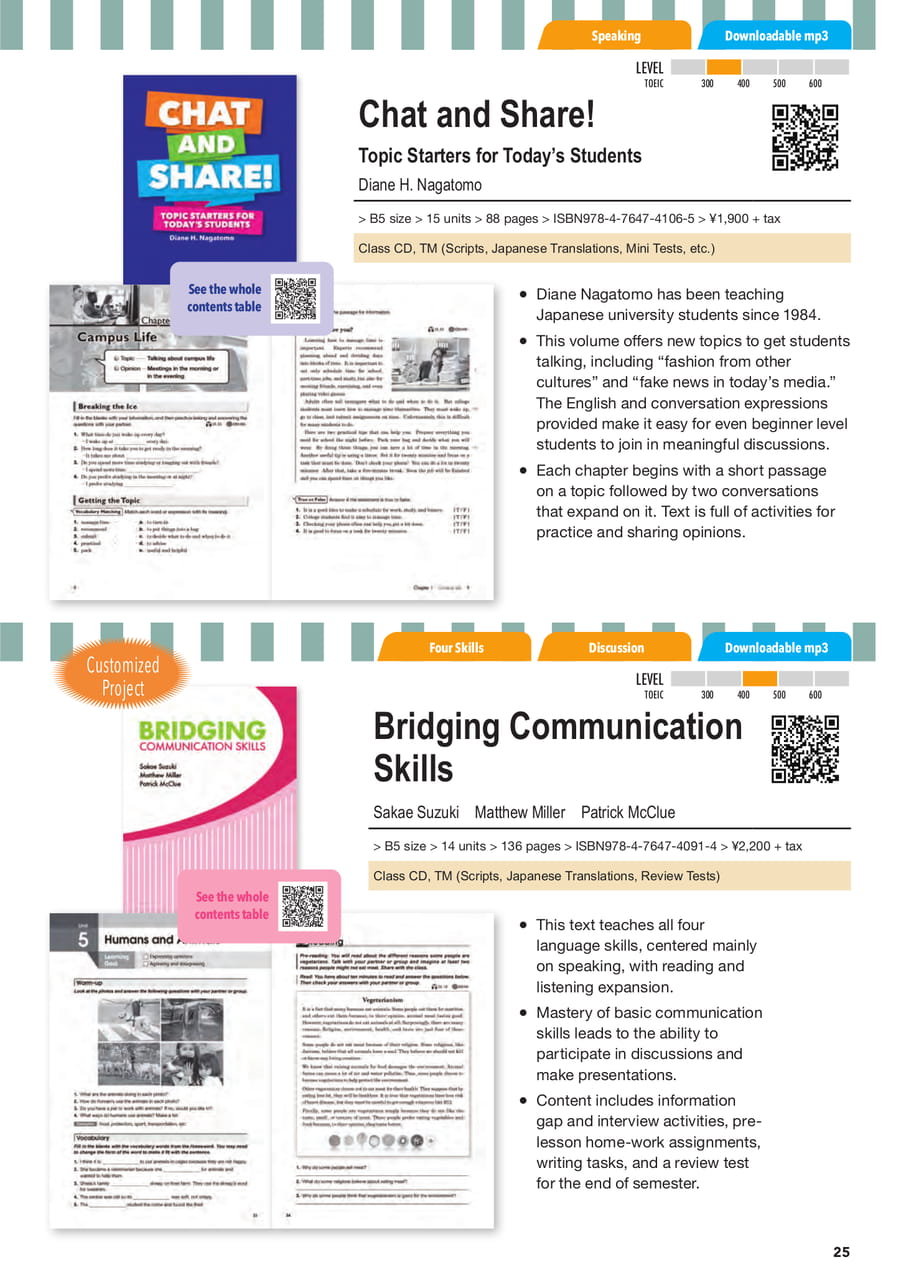
Chat and Share!
Speaking Downloadable mp3
Chat and Share!
Topic Starters for Today’s Students
Diane H. Nagatomo
LEVEL
TOEIC 300 400 500 600
> B5 size > 15 units > 88 pages > ISBN978-4-7647-4106-5 > ¥1,900 + tax Class CD, TM (Scripts, Japanese Translations, Mini Tests, etc.)
See the whole contents table ● Diane Nagatomo has been teaching Japanese university students since 1984. ● This volume offers new topics to get students talking, including “fashion from other cultures” and “fake news in today’s media.” The English and conversation expressions provided make it easy for even beginner level students to join in meaningful discussions. ● Each chapter begins with a short passage on a topic followed by two conversations that expand on it. Text is full of activities for practice and sharing opinions.
Customized Project
Four Skills
Discussion
LEVEL
TOEIC 300 400 500 600
Bridging Communication Skills
Sakae Suzuki Matthew Miller Patrick McClue
Downloadable mp3
> B5 size > 14 units > 136 pages > ISBN978-4-7647-4091-4 > ¥2,200 + tax
See the whole contents table
Class CD, TM (Scripts, Japanese Translations, Review Tests) ● This text teaches all four language skills, centered mainly on speaking, with reading and listening expansion. ● Mastery of basic communication skills leads to the ability to participate in discussions and make presentations. ● Content includes information gap and interview activities, prelesson home-work assignments, writing tasks, and a review test for the end of semester.
25
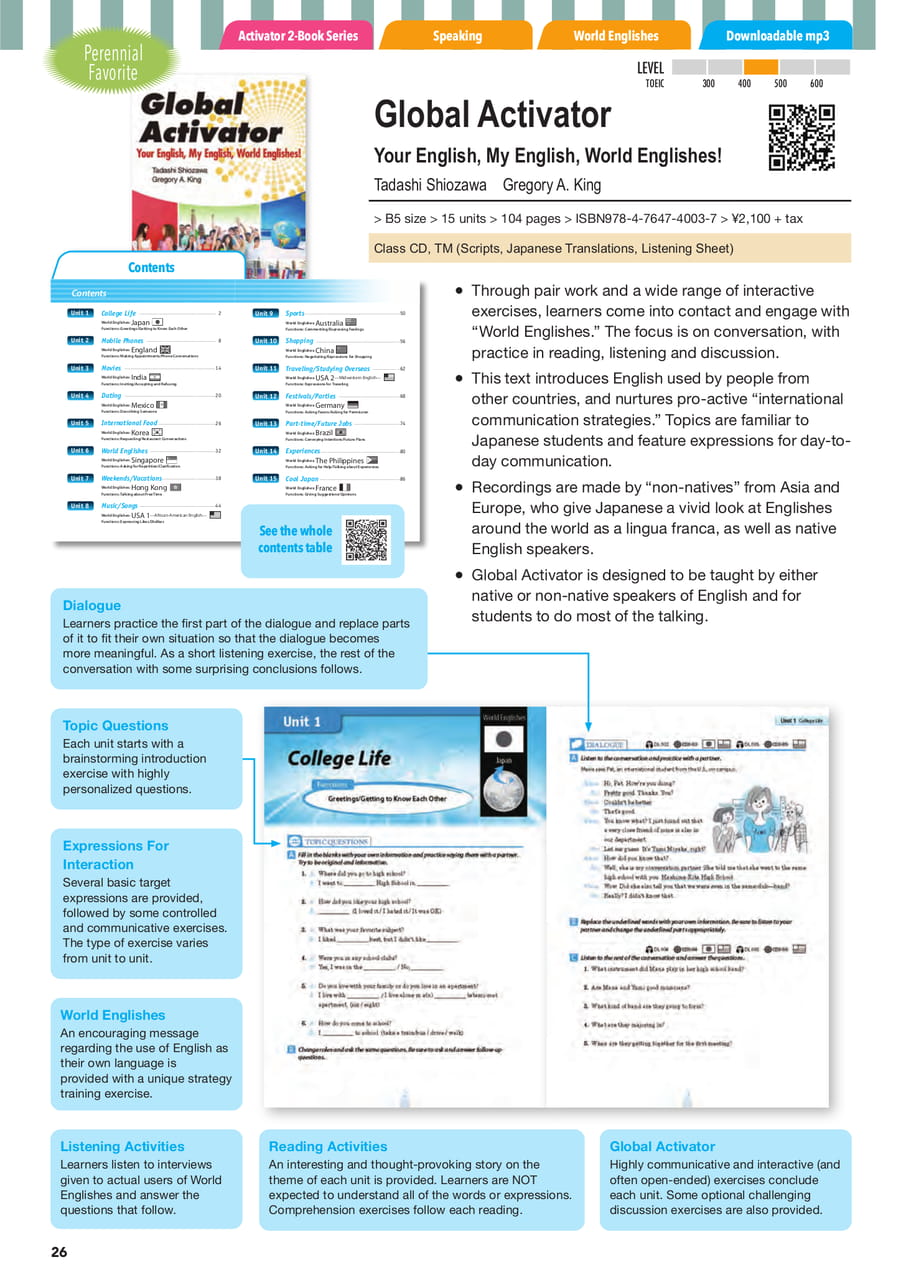
Global Activator
Perennial Favorite
Activator 2-Book Series Speaking World Englishes
Global Activator
Your English, My English, World Englishes!
Tadashi Shiozawa
Gregory A. King
Downloadable mp3
LEVEL
TOEIC 300 400 500 600
Contents
Contents
Unit 1 College Life …………………………………………………… 2
World Englishes: Japan Functions: Greetings/Getting to Know Each Other
Unit 2 Mobile Phones ……………………………………………… 8
World Englishes: England Functions: Making Appointments/Phone Conversations
Unit 3 Movies ………………………………………………………………14
World Englishes: India Functions: Inviting/Accepting and Refusing
Unit 4 Dating ………………………………………………………………20
World Englishes: Mexico Functions: Describing Someone
Unit 5 International Food ………………………………………26
World Englishes: Korea Functions: Requesting/Restaurant Conversations
Unit 6 World Englishes ……………………………………………32
World Englishes: Singapore Functions: Asking for Repetition/Clarification
Unit 7 Weekends/Vacations ……………………………………38
World Englishes: Hong Kong Functions: Talking about Free Time
Unit 8 Music/Songs ……………………………………………………44
World Englishes: USA 1—African-American English— Functions: Expressing Likes/Dislikes
Unit 9
Unit 10
Unit 11
Unit 12
Unit 13
Unit 14
Unit 15 Sports …………………………………………………………………50
World Englishes: Australia Functions: Commenting/Expressing Feelings Shopping …………………………………………………………56
World Englishes: China Functions: Negotiating/Expressions for Shopping
Traveling/Studying Overseas …………………62
World Englishes: USA 2—Midwestern English— Functions: Expressions for Traveling Festivals/Parties …………………………………………68
World Englishes: Germany Functions: Asking Favors/Asking for Permission
Part-time/Future Jobs ………………………………74
World Englishes: Brazil Functions: Conveying Intentions/Future Plans Experiences ………………………………………………………80
World Englishes: The Philippines Functions: Asking for Help/Talking about Experiences
Cool Japan ………………………………………………………86
World Englishes: France Functions: Giving Suggestions/Opinions
See the whole contents table
Dialogue Learners practice the first part of the dialogue and replace parts of it to fit their own situation so that the dialogue becomes more meaningful. As a short listening exercise, the rest of the conversation with some surprising conclusions follows.
> B5 size > 15 units > 104 pages > ISBN978-4-7647-4003-7 > ¥2,100 + tax Class CD, TM (Scripts, Japanese Translations, Listening Sheet) ● Through pair work and a wide range of interactive exercises, learners come into contact and engage with “World Englishes.” The focus is on conversation, with practice in reading, listening and discussion. ● This text introduces English used by people from other countries, and nurtures pro-active “international communication strategies.” Topics are familiar to Japanese students and feature expressions for day-today communication. ● Recordings are made by “non-natives” from Asia and Europe, who give Japanese a vivid look at Englishes around the world as a lingua franca, as well as native English speakers. ● Global Activator is designed to be taught by either native or non-native speakers of English and for students to do most of the talking.
Topic Questions Each unit starts with a brainstorming introduction exercise with highly personalized questions.
Expressions For Interaction Several basic target expressions are provided, followed by some controlled and communicative exercises. The type of exercise varies from unit to unit.
World Englishes An encouraging message regarding the use of English as their own language is provided with a unique strategy training exercise.
Listening Activities Learners listen to interviews given to actual users of World Englishes and answer the questions that follow.
Reading Activities An interesting and thought-provoking story on the theme of each unit is provided. Learners are NOT expected to understand all of the words or expressions. Comprehension exercises follow each reading.
Global Activator Highly communicative and interactive (and often open-ended) exercises conclude each unit. Some optional challenging discussion exercises are also provided.
26
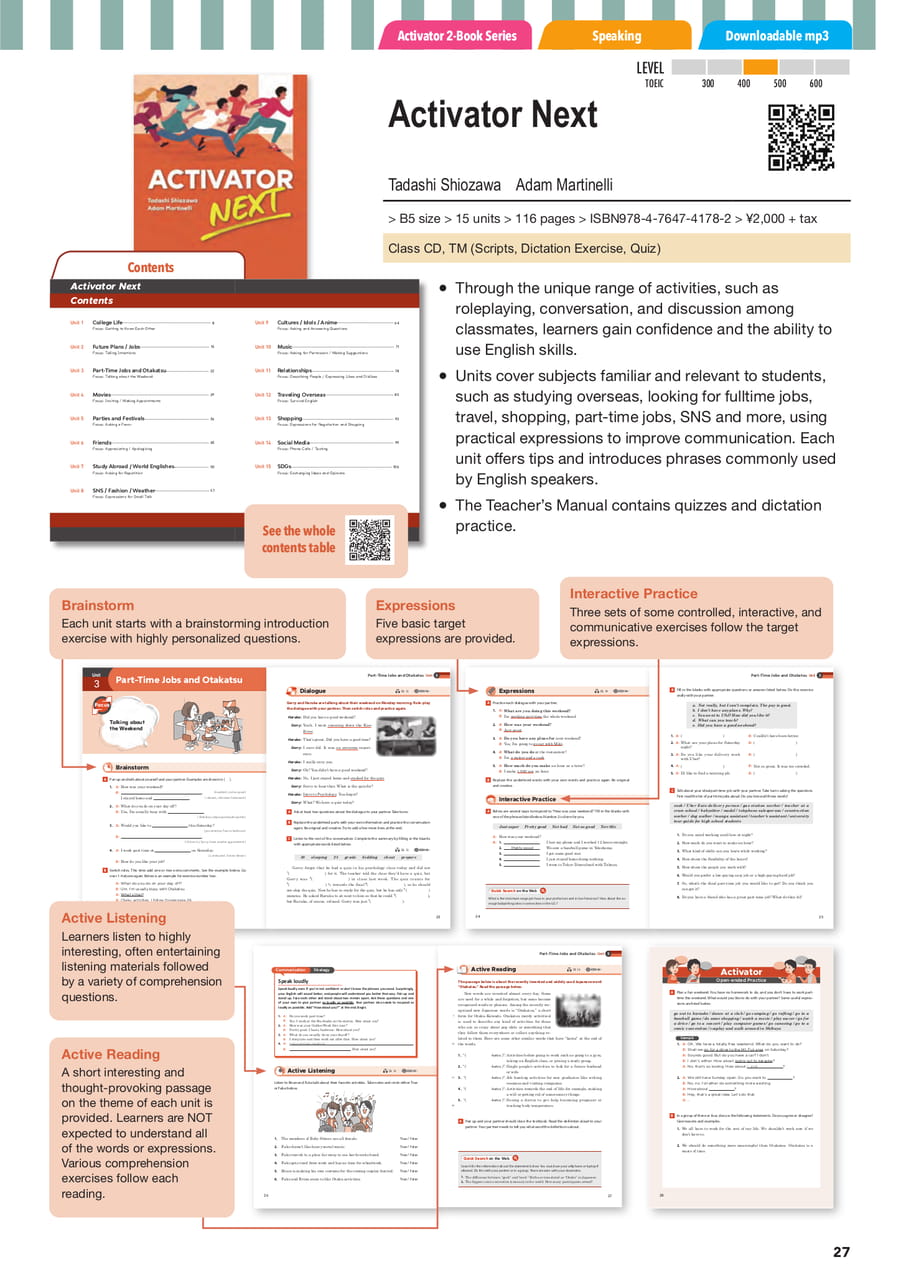
Activator Next
5
10
15
20
Activator 2-Book Series Speaking
Downloadable mp3
Activator Next
LEVEL
TOEIC 300 400 500 600
Tadashi Shiozawa
Adam Martinelli
> B5 size > 15 units > 116 pages > ISBN978-4-7647-4178-2 > ¥2,000 + tax
Activator Next Contents
Contents
Unit 1 College Life 8 Focus: Getting to Know Each Other
Unit 2 Future Plans / Jobs 15 Focus: Telling Intentions
Unit 3 Part-Time Jobs and Otakatsu 22 Focus: Talking about the Weekend
Unit 4 Movies 29 Focus: Inviting / Making Appointments
Unit 5 Parties and Festivals 36 Focus: Asking a Favor
Unit 6 Friends 43 Focus: Appreciating / Apologizing
Unit 7 Study Abroad / World Englishes 50 Focus: Asking for Repetition
Unit 8 SNS / Fashion / Weather 57 Focus: Expressions for Small Talk
Unit 9 Cultures / Idols / Anime 64
Focus: Asking and Answering Questions
Unit 10 Music 71 Focus: Asking for Permission / Making Suggestions
Unit 11 Relationships 78 Focus: Describing People / Expressing Likes and Dislikes
Unit 12 Traveling Overseas 85 Focus: Survival English
Unit 13 Shopping 92 Focus: Expressions for Negotiation and Shopping
Unit 14 Social Media 99 Focus: Phone Calls / Texting
Unit 15 SDGs 106 Focus: Exchanging Ideas and Opinions
See the whole contents table
Class CD, TM (Scripts, Dictation Exercise, Quiz) ● Through the unique range of activities, such as roleplaying, conversation, and discussion among classmates, learners gain confidence and the ability to use English skills. ● Units cover subjects familiar and relevant to students, such as studying overseas, looking for fulltime jobs, travel, shopping, part-time jobs, SNS and more, using practical expressions to improve communication. Each unit offers tips and introduces phrases commonly used by English speakers. ● The Teacher’s Manual contains quizzes and dictation practice.
Brainstorm Each unit starts with a brainstorming introduction exercise with highly personalized questions.
Expressions Five basic target expressions are provided.
Interactive Practice Three sets of some controlled, interactive, and communicative exercises follow the target expressions.
Unit
3 Part-Time Jobs and Otakatsu
Part-Time Jobs and Otakatsu Unit 3 Dialogue DL 12 CD1-12 Expressions DL 14 CD1-14
Part-Time Jobs and Otakatsu Unit 3 B Fill in the blanks with appropriate questions or answers listed below. Do this exercise orally with your partner.
Focus
Talking about the Weekend
Brainstorm A Pair up and talk about yourself and your partner. Examples are shown in [ ].
1. A: How was your weekend?
B: . [ Excellent / not so good ] I stayed home and . [ relaxed / did some homework ]
2. A: What do you do on your day off? B: Um, I’m usually busy with .
3. A: Would you like to this Saturday?
B: .
4. A: I work part time at on Saturday.
B: How do you like your job?
[ Otakatsu / playing computer games ]
[ go canoeing / have a barbecue ]
[ I’d love to / Sorry, I have another appointment ]
[ a restaurant / Seven-Eleven ] B Switch roles. This time add one or two extra comments. See the example below. Go over 1-4 above again. Below is an example for exercise number two.
A: What do you do on your day off?
Gerry and Haruka are talking about their weekend on Monday morning. Role-play the dialogue with your partner. Then switch roles and practice again.
Haruka: Did you have a good weekend?
Gerry: Yeah. I went canoeing down the Kiso River.
Haruka: That’s great. Did you have a good time?
Gerry: I sure did. It was an awesome experience. Haruka: I really envy you. Gerry: Oh? You didn’t have a good weekend?
Haruka: No, I just stayed home and studied for the quiz. Gerry: Sorry to hear that. What is the quiz for?
Haruka: Intro to Psychology. You forgot?
Gerry: What? We have a quiz today? A Ask at least two questions about the dialogue to your partner. Take turns. B Replace the underlined parts with your own information and practice the conversation again. Be original and creative. Try to add a few more lines at the end. C Listen to the rest of the conversation. Complete the summary by filling in the blanks with appropriate words listed below.
DL 13 CD1-13 30 sleeping 25 grade kidding cheat prepare
Gerry forgot that he had a quiz in his psychology class today and did not 1 ( ) for it. The teacher told the class they’d have a quiz, but
Gerry was 2 ( ) in class last week. The quiz counts for 3 ( ) % towards the final 4 ( ), so he should
A
B
A
Practice each dialogue with your partner.
1. A: What are you doing this weekend? B: I’m working part-time the whole weekend.
2. A: How was your weekend? B: Just great.
3. A: Do you have any plans for next weekend? B: Yes, I’m going to go out with Miki.
4. A: What do you do at the restaurant? B: I’m a waiter and a cook.
5. A: How much do you make an hour as a tutor? B: I make 1,800 yen an hour.
Replace the underlined words with your own words and practice again. Be original and creative.
Interactive Practice
Below are several ways to respond to “How was your weekend?” Fill in the blanks with one of the phrases listed below. Number 2 is done for you.
Just super Pretty good Not bad Not so good Terrible
A: How was your weekend?
B: 1. I lost my phone and I worked 12 hours straight. 2. Pretty good We saw a baseball game in Yokohama. 3. I got some good rest. 4. I just stayed home doing nothing. 5. I went to Tokyo Disneyland with Takuya. a. Not really, but I can’t complain. The pay is good. b. I don’t have any plans. Why? c. You went to USJ? How did you like it? d. What can you teach? e. Did you have a good weekend?
1. A: ( )
B: Couldn’t have been better.
2. A: What are your plans for Saturday B: ( ) night?
3. A: Do you like your delivery work B: ( ) with Uber?
4. A: ( ) B: Not so great. It was too crowded.
5. A: I’d like to find a tutoring job.
B: ( ) C Talk about your ideal part-time job with your partner. Take turns asking the questions. First read the list of part-time jobs aloud. Do you know all these words?
cook / Uber Eats delivery person / gas station worker / teacher at a cram school / babysitter / model / telephone salesperson / construction worker / dog walker / manga assistant / teacher’s assistant / university tour guide for high school students
1. Do you mind working until late at night? 2. How much do you want to make an hour? 3. What kind of skills can you learn while working? 4. How about the flexibility of the hours? 5. How about the people you work with? 6. Would you prefer a low-paying easy job or a high-paying hard job? 7. So, what’s the ideal part-time job you would like to get? Do you think you
B: Um, I’m usually busy with Otakatsu. A: What’s that? B: Otaku activities. I follow Dogenzaka 26. A: Oh my!
22
Active Listening Learners listen to highly interesting, often entertaining listening materials followed by a variety of comprehension questions.
Active Reading A short interesting and thought-provoking passage on the theme of each unit is provided. Learners are NOT expected to understand all of the words or expressions. Various comprehension exercises follow each reading. not skip the quiz. Now he has to study for the quiz, but he has only 5 ( ) minutes. He asked Haruka to sit next to him so that he could 6 ( ), but Haruka, of course, refused. Gerry was just 7 ( ).
23
Communication Strategy
Speak loudly
Speak loudly even if you’re not confident or don’t know the phrases you need. Surprisingly, your English will sound better, and people will understand you better that way. Pair up and stand up. Face each other and stand about two meters apart. Ask these questions and one of your own to your partner as loudly as possible. Your partner also needs to respond as loudly as possible. Add “How about you?” at the end. Begin.
1. A: Do you work part-time? B: Yes, I work at the Starbucks at the station. How about you?
2. A: How was your Golden Week this year? B: Pretty good. I had a barbecue. How about you?
3. A: What do you usually do on your dayoff? B: I sleep late and then work out after that. How about you?
4. A: (your original question) B: . How about you?
Active Listening DL 15 CD1-15
Listen to Brian and Fuko talk about their favorite activities. Take notes and circle either True or False below.
1. The members of Baby Sitters are all female. True / False 2. Fuko doesn’t like heavy metal music. True / False 3. Fuko travels to a place far away to see her favorite band. True / False 4. Fuko gets tired from work and has no time for schoolwork. True / False 5. Brian is making his own costume for the coming cosplay festival. True / False 6. Fuko and Brian seem to like Otaku activities. True / False
26
Quick Search on the Web
What is the minimum wage per hour in your prefecture and in San Francisco? How about the average babysitting rates in some cities in the U.S.?
24
Part-Time Jobs and Otakatsu Unit 3
Active Reading DL 16 CD1-16
The passage below is about the recently invented and widely used Japanese word “Otakatsu.” Read the passage below.
New words are invented almost every day. Some are used for a while and forgotten, but some become recognized words or phrases. Among the recently recognized new Japanese words is “Otakatsu,” a short form for Otaku-Katsudo. Otakatsu (nerdy activities) is used to describe any kind of activities for those who are so crazy about pop idols or something that they follow them everywhere or collect anything related to them. Here are some other similar words that have “katsu” at the end of the words.
1. “( -katsu )”: Activities before going to work such as going to a gym, taking an English class, or joining a study group.
2. “( -katsu )”: Single people’s activities to look for a future husband or wife.
3. “( -katsu )”: Job hunting activities for new graduates like writing resumes and visiting companies.
4. “( -katsu )”: Activities towards the end of life; for example, making a will or getting rid of unnecessary things.
5. “( -katsu )”: Seeing a doctor to get help becoming pregnant or tracking body temperature. A Pair up and your partner should close the textbook. Read the definition aloud to your partner. Your partner needs to tell you what word the definition is about.
Quick Search on the Web
Search for the information about the statement below. You could use your cellphone or laptop if allowed. Do this with your partner or in a group. Share answers with your classmates.
1. The difference between “geek” and “nerd.” Both are translated as “Otaku” in Japanese. 2. The biggest comic convention (comicon) in the world. How many participants attend?
27 28 can get it? 8. Do you have a friend who has a great part-time job? What do they do?
Activator Open-ended Practice A Plan a fun weekend. You have no homework to do, and you don’t have to work parttime this weekend. What would you like to do with your partner? Some useful expressions are listed below.
go out to karaoke / dance at a club / go camping / go rafting / go to a baseball game / do some shopping / watch a movie / play soccer / go for a drive / go to a concert / play computer games / go canoeing / go to a comic convention / cosplay and walk around in Shibuya
Example
1. A: OK. We have a totally free weekend. What do you want to do? B: Shall we go for a drive to the Mt. Fuji area on Saturday? A: Sounds good. But do you have a car? I don’t. B: I don’t, either. How about going out to karaoke? A: No, that’s so boring. How about (...ing) ?
2. A: We still have Sunday open. Do you want to ? B: No, no. I’d rather do something more exciting. A: How about ? B: Hey, that’s a great idea. Let’s do that. A: ... B In a group of three or four, discuss the following statements. Do you agree or disagree? Give reasons and examples.
1. We all have to work for the rest of our life. We shouldn’t work now if we don’t have to.
2. We should do something more meaningful than Otakatsu. Otakatsu is a waste of time.
25
27
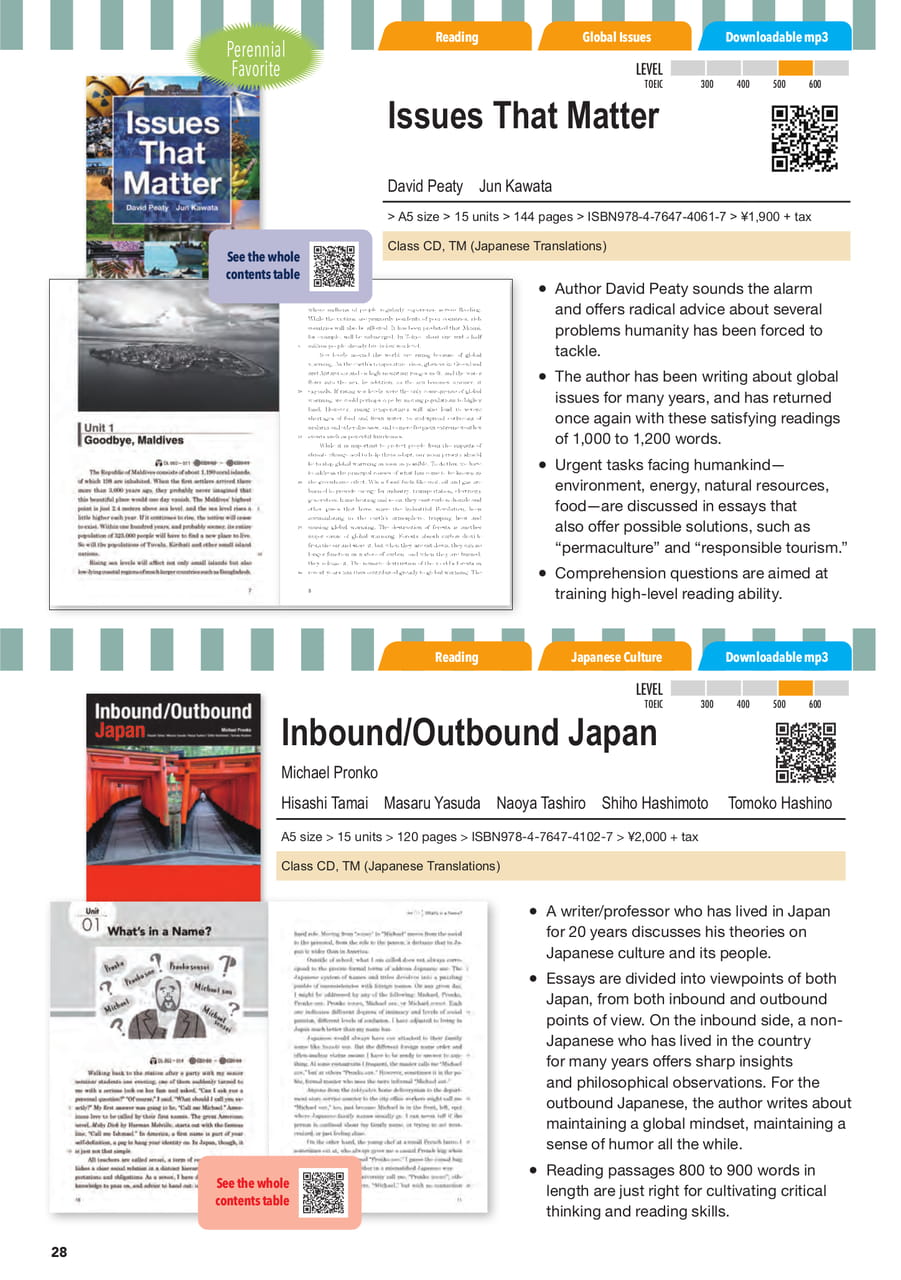
Global Issues
Perennial Favorite
Reading
Global Issues
Issues That Matter
Downloadable mp3
LEVEL
TOEIC 300 400 500 600
David Peaty
Jun Kawata
> A5 size > 15 units > 144 pages > ISBN978-4-7647-4061-7 > ¥1,900 + tax
See the whole contents table
Class CD, TM (Japanese Translations) ● Author David Peaty sounds the alarm and offers radical advice about several problems humanity has been forced to tackle. ● The author has been writing about global issues for many years, and has returned once again with these satisfying readings of 1,000 to 1,200 words. ● Urgent tasks facing humankind— environment, energy, natural resources, food—are discussed in essays that also offer possible solutions, such as “permaculture” and “responsible tourism.”● Comprehension questions are aimed at training high-level reading ability.
Reading Japanese Culture
Downloadable mp3
Inbound/Outbound Japan
LEVEL
TOEIC 300 400 500 600
Michael Pronko
Hisashi Tamai Masaru Yasuda Naoya Tashiro Shiho Hashimoto Tomoko Hashino
A5 size > 15 units > 120 pages > ISBN978-4-7647-4102-7 > ¥2,000 + tax Class CD, TM (Japanese Translations)
See the whole contents table ● A writer/professor who has lived in Japan for 20 years discusses his theories on Japanese culture and its people. ● Essays are divided into viewpoints of both Japan, from both inbound and outbound points of view. On the inbound side, a non- Japanese who has lived in the country for many years offers sharp insights and philosophical observations. For the outbound Japanese, the author writes about maintaining a global mindset, maintaining a sense of humor all the while. ● Reading passages 800 to 900 words in length are just right for cultivating critical thinking and reading skills.
28
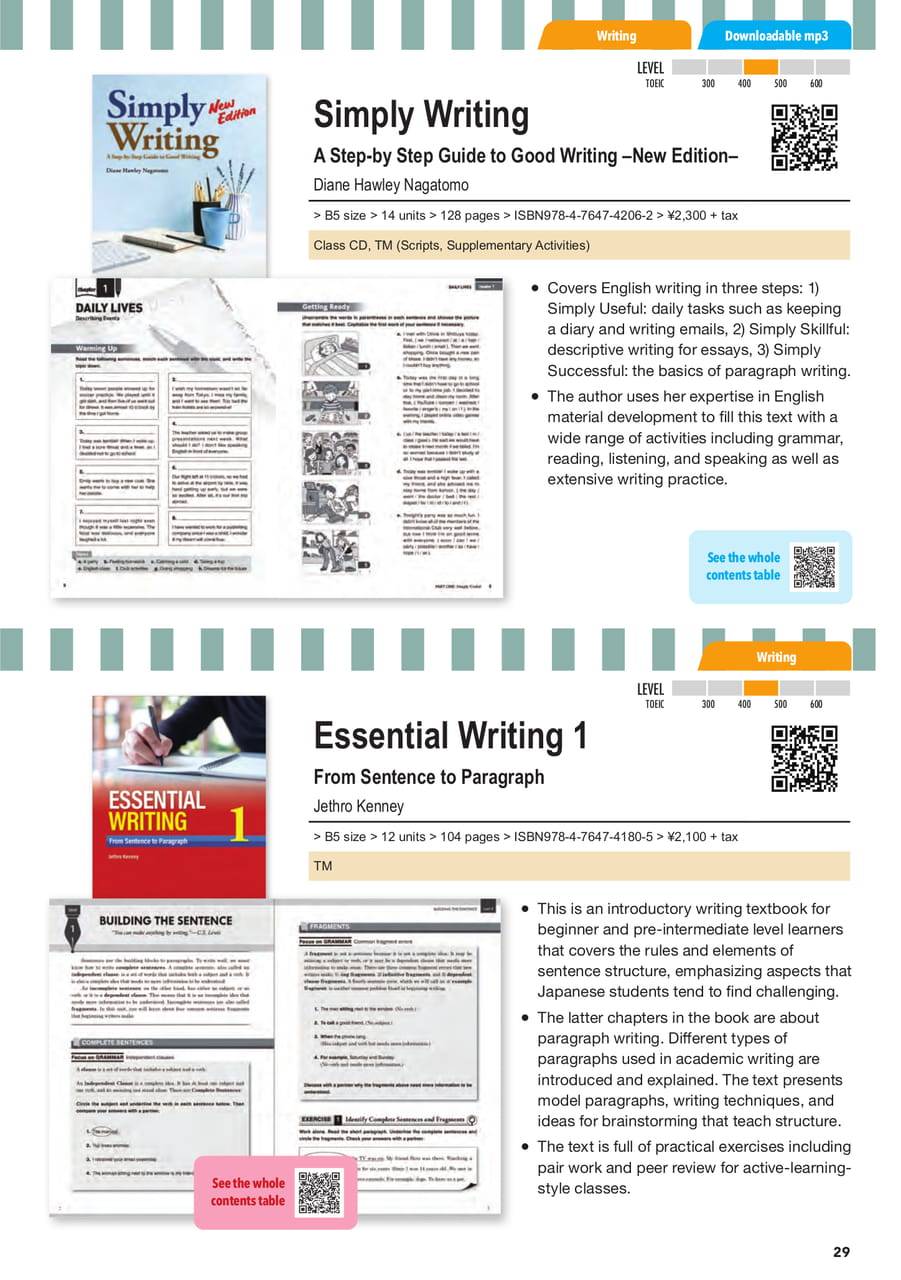
Simply Writing
Writing Downloadable mp3
Simply Writing
LEVEL
TOEIC 300 400 500 600
A Step-by Step Guide to Good Writing –New Edition–
Diane Hawley Nagatomo
> B5 size > 14 units > 128 pages > ISBN978-4-7647-4206-2 > ¥2,300 + tax Class CD, TM (Scripts, Supplementary Activities) ● Covers English writing in three steps: 1) Simply Useful: daily tasks such as keeping a diary and writing emails, 2) Simply Skillful: descriptive writing for essays, 3) Simply Successful: the basics of paragraph writing. ● The author uses her expertise in English material development to fill this text with a wide range of activities including grammar, reading, listening, and speaking as well as extensive writing practice.
See the whole contents table
Writing
Essential Writing 1
From Sentence to Paragraph
Jethro Kenney
LEVEL
TOEIC 300 400 500 600
> B5 size > 12 units > 104 pages > ISBN978-4-7647-4180-5 > ¥2,100 + tax TM
See the whole contents table ● This is an introductory writing textbook for beginner and pre-intermediate level learners that covers the rules and elements of sentence structure, emphasizing aspects that Japanese students tend to find challenging. ● The latter chapters in the book are about paragraph writing. Different types of paragraphs used in academic writing are introduced and explained. The text presents model paragraphs, writing techniques, and ideas for brainstorming that teach structure. ● The text is full of practical exercises including pair work and peer review for active-learningstyle classes.
29
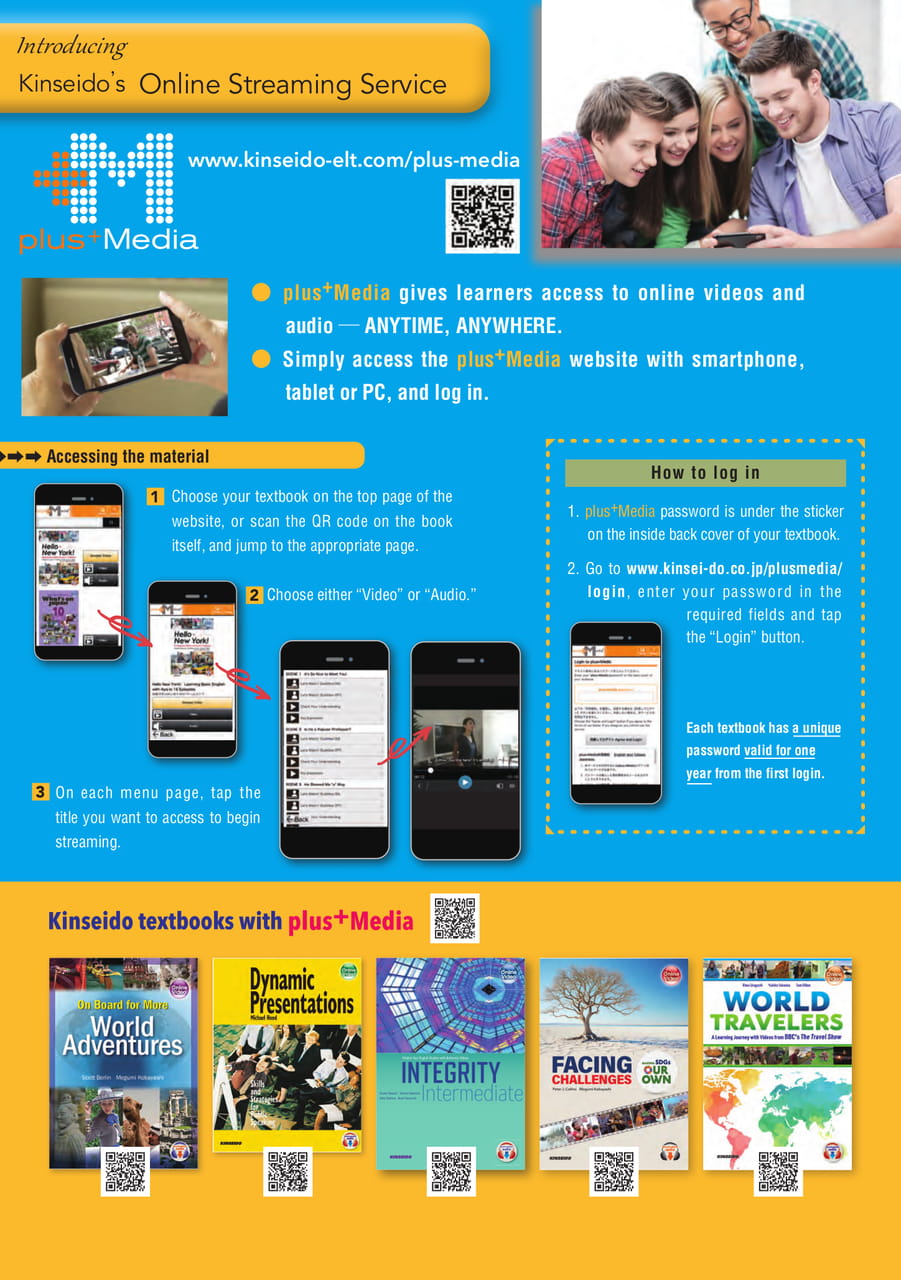
Online Streaming Service
Introducing Kinseido’s Online Streaming Service
www.kinseido-elt.com/plus-media ● plus + Media gives learners access to online videos and audio ─ ANYTIME, ANYWHERE. ● Simply access the plus + Media website with smartphone, tablet or PC, and log in.
➡➡ Accessing the material 1 Choose your textbook on the top page of the website, or scan the QR code on the book itself, and jump to the appropriate page. 2 Choose either “Video” or “Audio.”
How to log in
1. plus + Media password is under the sticker on the inside back cover of your textbook.
2. Go to www.kinsei-do.co.jp/plusmedia/ login, enter your password in the required fields and tap the “Login” button.
3
On each menu page, tap the title you want to access to begin streaming.
Each textbook has a unique password valid for one year from the first login.
New Kinseido textbooks with plus+Media
CMYK
Facing Challenges
ABC NEWSROOM 3 British News Update 7 (BBC) JAPAN QUEST (NHK)
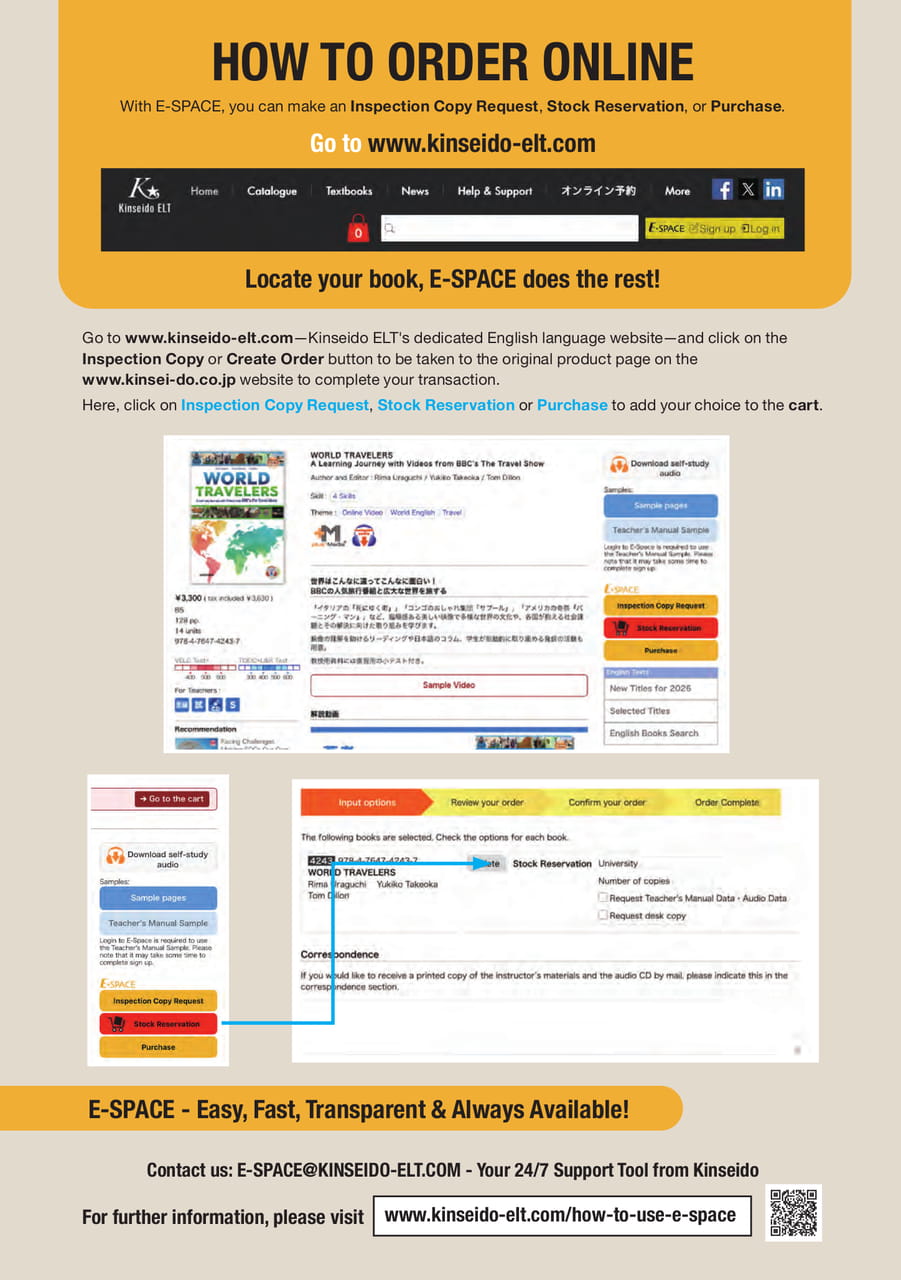
HOW TO ORDER ONLINE
HOW TO ORDER ONLINE With E-SPACE, you can make an Inspection Copy Request, Stock Reservation, or Purchase. Go to www.kinseido-elt.com
Locate your book, E-SPACE does the rest!
Go to www.kinseido-elt.com—Kinseido ELT's dedicated English language website—and click on the Inspection Copy or Create Order button to be taken to the original product page on the www.kinsei-do.co.jp website to complete your transaction. Here, click on Inspection Copy Request, Stock Reservation or Purchase to add your choice to the cart.
E-SPACE - Easy, Fast, Transparent & Always Available!
Contact us: E-SPACE@KINSEIDO-ELT.COM - Your 24/7 Support Tool from Kinseido For further information, please visit www.kinseido-elt.com/how-to-use-e-space
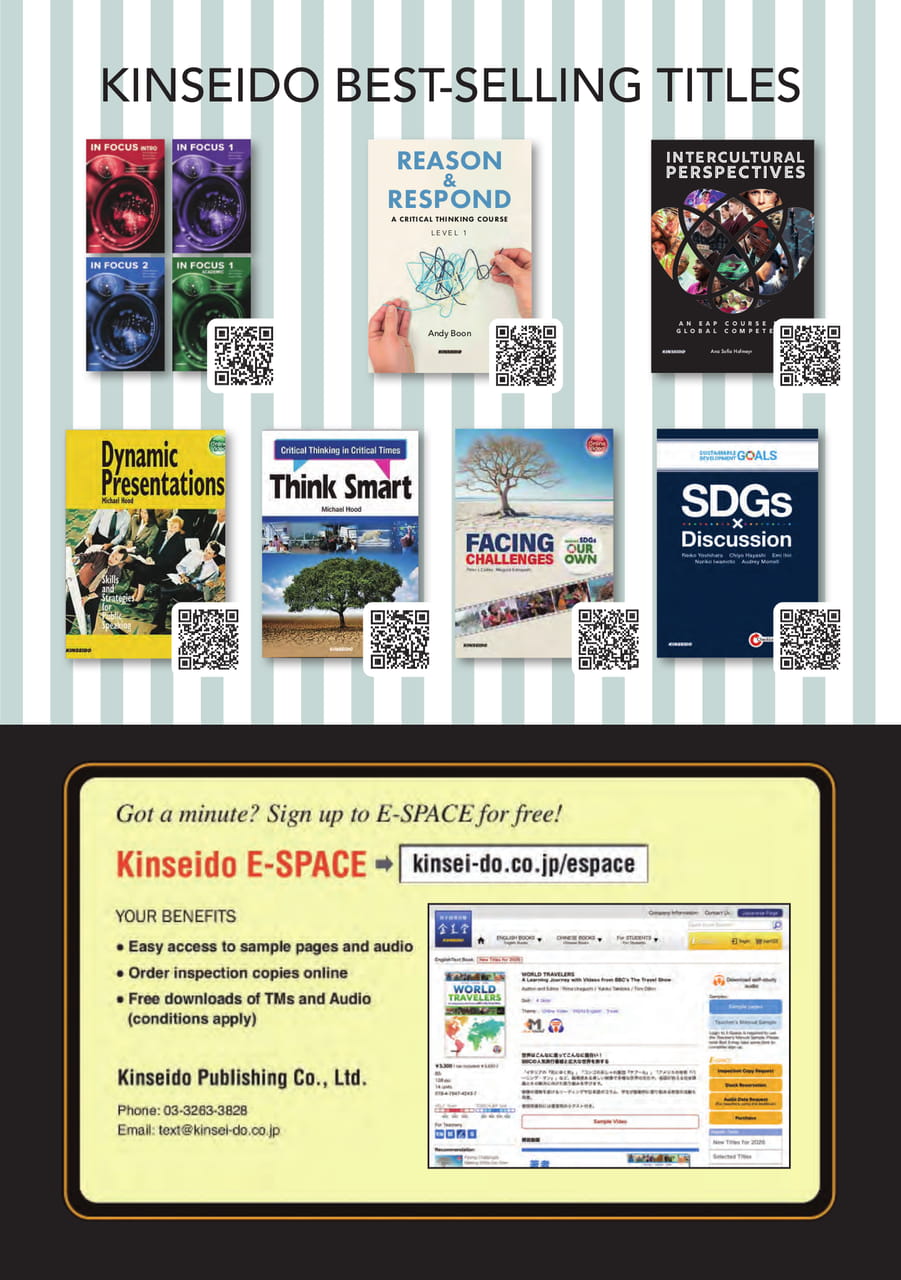
KINSEIDO BEST-SELLING TITLES
Ana Sofia Hofmeyr
KINSEIDO BEST-SELLING TITLES
REASON & RESPOND
A CRITICAL THINKING COURSE LEVEL 1
INTERCULTURAL PERSPECTIVES
Andy Boon
AN EAP COURSE FOR GLOBAL COMPETENCE