BookmarkBookmark
テキスト表示モード

TRANSFER PRICING NEWS
TRANSFER PRICING NEWS (Japan) New Document Retention Rules for Intragroup Transactions
Forvis Mazars Tax Corporation
August 2026 Release #3
New Document Retention Rules
New Document Retention Rules for Intragroup Transactions
The 2026 Tax Reform introduced new documentation retention requirements applicable to certain transactions between Japanese domestic corporations (“Japanese corporations”) and their related parties. Under the new rules, taxpayers are required to obtain, prepare, and retain detailed supporting documentation demonstrating how consideration for such transactions has been determined. The requirements are particularly relevant to service and intangible asset transactions, where taxpayers may be expected to maintain documentation explaining the underlying services or assets, the amount charged, and the basis on which the consideration was calculated. Given that non-compliance may result in the revocation of blue return filing status, the reform is expected to lead to increased scrutiny of related-party transactions during future tax audits.
This newsletter provides an overview of the new rules, the policy objectives underlying the reform, the practical level of documentation expected by the tax authorities, and the key steps companies should consider in responding to the new requirements.
Overview of the Rules
Requirement: Documentation evidencing the basis for calculating the consideration
Applicable to: Japanese corporations
Effective Date: Fiscal years beginning on or after 1 April 2026
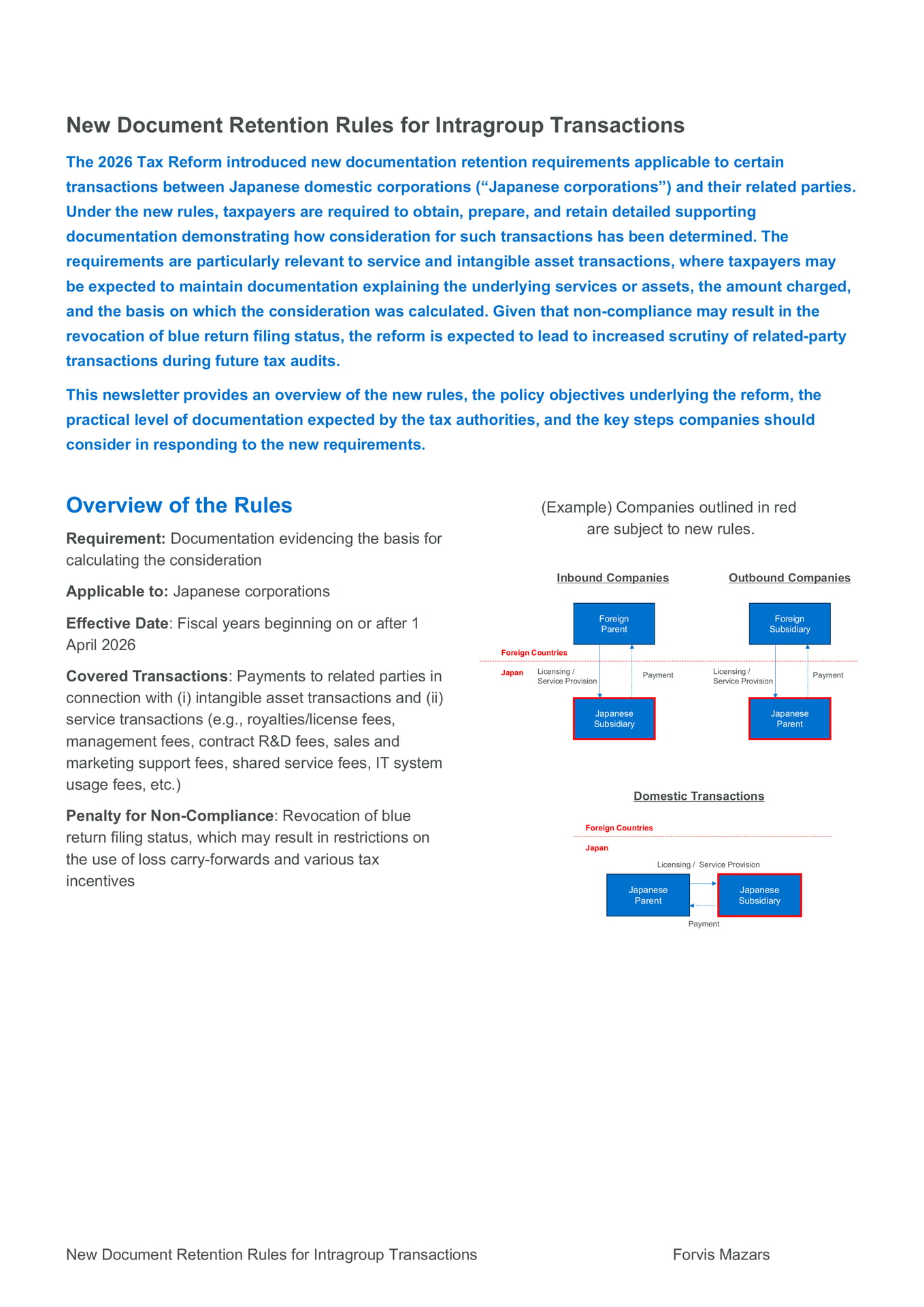
Covered Transactions: Payments to related parties in connection with (i) intangible asset transactions and (ii) service transactions (e.g., royalties/license fees, management fees, contract R&D fees, sales and marketing support fees, shared service fees, IT system usage fees, etc.)
Penalty for Non-Compliance: Revocation of blue return filing status, which may result in restrictions on the use of loss carry-forwards and various tax incentives
Foreign Countries
(Example) Companies outlined in red are subject to new rules.
Inbound Companies
Foreign Parent
Japan Licensing / Payment
Licensing /
Service Provision Service Provision
Japanese Subsidiary
Foreign Countries
Japan
Domestic Transactions
Japanese Parent
Licensing / Service Provision
Outbound Companies
Japanese Subsidiary
Foreign Subsidiary
Japanese Parent
Payment
Payment
New Document Retention Rules for Intragroup Transactions Forvis Mazars
Policy Background
Policy Background
As part of the 2026 Tax Reform, a new regime entitled the “Special Documentation Retention Rules for Related-Party Transactions” 1 was introduced. Under these rules, where existing documentation such as contracts and invoices does not sufficiently explain the nature of a group transaction or the basis for the determination of the consideration, taxpayers are required to obtain, prepare, and retain supplementary documentation (referred to as “specified information documents”) containing the missing information.
The introduction of these rules is a legislative response to the fact that documentation relating to intercompany transactions and pricing methodologies is often less detailed and less explanatory than documentation prepared for transactions between independent parties. In practice, charges from a parent company or regional headquarters to a Japanese corporation for management services, IT support, research and development support, brand licensing, and similar activities are frequently invoiced under broad descriptions such as “management fee,”“service fee,” or “outsourcing fee,” without further detail. Such documentation alone may be insufficient to objectively ascertain the specific services provided, the methodology used to determine the underlying cost base, or the reasonableness of the allocation keys applied.
The purpose of the new rules is to address these issues and enhance transparency regarding both the substance of related-party transactions and the process by which the related consideration is determined. The National Tax Agency (“NTA”) similarly states in its “Basic Principles and Administrative Guidance for the Application of the Special Documentation Retention Rules for Related-Party Transactions” 2 (the “Administrative Guidelines”) that detailed documentation is often not prepared for related-party transactions because of the control relationship between the parties. As a result, information about the transaction is often difficult for a third party to access, making it challenging for the tax authorities to ascertain the actual substance of such transactions. The NTA cites this concern as one of the principal reasons for introducing the new regime.
A particularly important aspect of the new rules is that failure to comply may constitute grounds for the revocation of blue return filing status. Loss of blue return status may have significant consequences for a taxpayer, including restrictions on the utilization of loss carry-forwards and other tax incentives.
The rules now provide the tax authorities with a legislative basis for requesting information relating to the substance of related-party transactions and the basis on which consideration has been calculated. Accordingly, future tax audits are expected to focus increasingly on the information maintained under this regime. Companies should therefore view these rules not merely as an additional compliance requirement, but as an important development from both a tax risk management and group governance perspective.
Practical Level of Documentation Required
In the Administrative Guidelines, the NTA states that the required documentation should take into account the nature and characteristics of the transaction and should enable an independent third party to objectively understand the substance of the transaction.
In light of this guidance, the rules require substantially more than simply mentioning the amount charged or providing the underlying agreement. Rather, taxpayers are expected to maintain information that allows the tax authorities to trace which transaction the payment relates to, what services or assets were provided, and on what basis the consideration was calculated.
For example, where an invoice simply refers to a “management fee” or “service fee,” taxpayers should be prepared to provide supporting documentation explaining the nature of the services performed, the underlying cost base, the allocation keys applied, and the methodology used to calculate the charge. Similarly, where a Japanese corporation makes payments to related parties for royalties or license fees, contract R&D fees, sales and marketing support fees, shared service fees, IT system usage fees, or similar charges, taxpayers are likely to face increased expectations to demonstrate both the commercial
1
Articles 59-2 and 67-2 of the Ordinance for Enforcement of the Corporation Tax Act.
2 https://www.nta.go.jp/law/jimu-unei/hojin/kaisei/260630_01/00.htm
New Document Retention Rules for Intragroup Transactions Forvis Mazars
Practical Actions for Companies
substance of the transaction and the process by which the consideration was determined. practices and enhance tax governance over relatedparty transactions.
Practical Actions for Companies
In responding to the new rules, companies should first assess whether their existing related-party transactions are supported by sufficient information to objectively explain the nature of each transaction and the process by which the consideration was determined, rather than producing a new set of documentation for all transactions. Accordingly, companies should consider taking the following actions:
① Identify all related-party transactions involving payments
② Review the basis for determining each payment amount, using existing documentation such as contracts, service reports, invoices, allocation methodology, and transfer pricing documentation (including transfer pricing policies, master files, and local files)
③ Collect additional information for transactions where the basis for calculating the consideration is not sufficiently documented, and consider how the calculation methodology can be appropriately explained
④ Prepare a consolidated summary of the review process above Implementing the above measures will require coordination not only with related parties, including parent companies and regional headquarters, but also with internal stakeholders across functions such as accounting, tax, and business operations. In addition, determining the appropriate level of documentation to be maintained for tax authority purposes will require a case-by-case assessment based on the specific facts and circumstances of each transaction. Accordingly, companies should consider seeking advice from internal or external tax specialists, where appropriate, and establishing an operational framework that enables information relating to related-party transactions to be obtained, maintained, and retained on an ongoing basis.
Compliance with the new rules should not be viewed merely as a document retention exercise but as an opportunity to strengthen information management
Conclusion
The new documentation retention rules represent a significant development in the management of relatedparty transactions in Japan, placing greater emphasis on taxpayers’ ability to explain the process by which consideration has been determined. As the appropriate level of documentation may not always be clear in practice, companies should consider undertaking a comprehensive review of their related-party transactions and strengthening their information management framework. Where necessary, support from tax specialists may also help ensure that the new requirements are addressed in an effective and sustainable manner.
Contact
Leveraging its global network across more than 100 countries, Forvis Mazars Tax Corporation provides various domestic and international tax services to Japanese and foreign clients.
Please feel free to reach out to our tax professionals below for more information on this news release or on our service offerings.
Forvis Mazars Tax Corporation
Partner, Head of Transfer Pricing Sho Matsukizono sho.matsukizono@forvismazars.com
Partner, Head of Tax Fumiyo Kawaguchi fumiyo.kawaguchi@forvismazars.com
Forvis Mazars Group SC is an independent member of Forvis Mazars Global, a leading global professional services network.
Operating as an intercompany integrated partnership in over 100 countries and territories, Forvis Mazars Group specialises in audit, tax and advisory services. Visit forvismazars.com to learn more. ©Forvis Mazars 2026
New Document Retention Rules for Intragroup Transactions Forvis Mazars