BookmarkBookmark
テキスト表示モード
Page 001
Page 002
一百八つのねがい一10VlNGClOMPASSlON-108Meditations一沼田智秀著
Page 003
Copyright02004byToshihideNumataAnypartofthisbookmaybequotedwithoutpermission.WeonlyaskthatBukky~Dend~Ky~kai,Tokyo,becreditedandthatacopyofthepublicationbesenttous.Thankyou.BUKKYODENDOKYOKAl(SocietyforthePromotionofBuddhism)3-14,4-chome,ShibaMinato-ku,Tokyo,japan,I08-0014Phone:(03)3455-5851Firstedition,2004EditorialDesignedbyProArt,Ltd.PrintedbyK~said~PrintingCo.,Ltd.Tokyo,japan
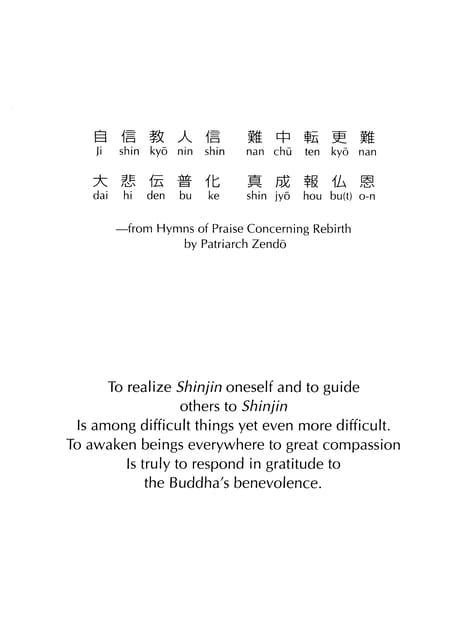
Page 004
~1ji4~~~shinky~)~4i~~]ninshin~f~[flnanchO~~l~~:tenky~~f~nan~~daihiden~~=(~b~ke~;~i~shiniy~~~4~¥houbu(t)/~!L)¥O-nfromHymnsofPraiseConcerningRebirthbyPatriarchZend~TorealizeShinjinoneselfandtoguideotherstoShinjinIsamongdifficultthingsyetevenmoredifficult.ToawakenbeingseverywheretogreatcompassionIstrulytorespondingratitudetotheBuddha'sbenevolence.
Page 005
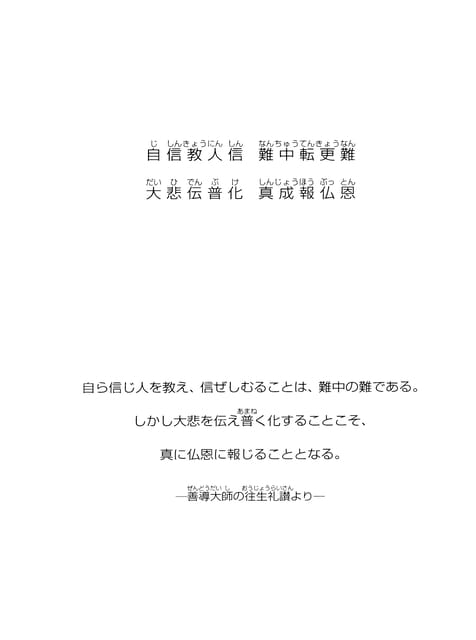
じしんきょうにんしん自信教人信だいひでんぶけ大悲伝普化なんちゅうてんきょうなん難中転更難しんじょうほうぶっとん真成報仏恩自ら信じ人を教え、信ぜしむることは、難中の難である。あまねしかし大悲を伝え普く化することこそ、真に仏恩に報じることとなる。ぜんどうだいしおうじょうらいさん一善導大師の往生礼讃より一

Page 006
目次CONT[NTS
Page 007
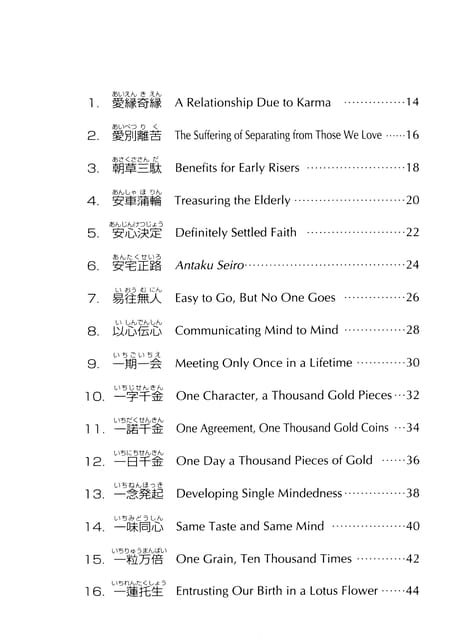
l.~~U~~~/v#*~~/vARelationshipDuetoKarma.14~,.~~UI~:~)D<~J~~TheSufferingofSeparatingfromThoseWeLove・・-.163.ai5*-<*-*-/'I~~1~:-,~~BenefitsforEarlyRisers.184.~i5/vU~l~O'h'~"h~:~**i~-.'~~~~iTreasuringtheElderly''205.~5/~Ulvl~~)U~~~~~]'~L¥~)~E=~~:DefinitelySettledFaith.22e.a~5/vtt<ttU~;~~H~:Ei:=~1E~~~r:lAntakuSeiro'''''.247.ul~~~~SfCl*~~/':~:~33~l~77ll"~'AEasytoGo,ButNoOneGoes.26S.U1U/'~~/'U/~L+/'~L¥~:,~~L¥~L(CommunicatingMindtoMind・・・・-.289.U1~5-*'U1~5~~~.~:~l~MeetingOnlyOnceinaLifetime""''''30lO.U1~5L)t~/'~~*l'~~:=~lf~~OneCharacter,aThousandGoldPieces'.32ll.U115t~<tt/~~*~~:~f~OneAgreement,OneThousandGoldCoins'.34l~.UI~l[~5t~/~~*/~El~f~OneDayaThousandPiecesofGold.36l3.UI~I~lvl~1)~~*~~~~~:~~;DevelopingSingleMindedness'''''.38l4.U~~5a~~i~U~D~]/'~L¥~~SameTasteandSameMind'40l5.l6.U~~5D~~~/'1~:U1"~l~*7~~:~4ul~rL/~f*"'<U~57~~~:~~~EOneGrain,TenThousandTimes""".42EntrustingOurBirthinaLotusFlower"".44
Page 008
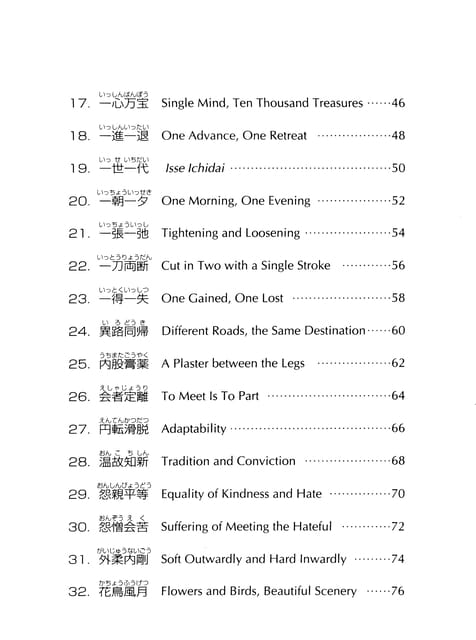
l7.l8.l9.~0.~1.~Z~.ul~U/*[~/~l~~/'~L¥7~:S~:~=:F~ul~u~u~~)r*'-ul~~~~;u~~ttu~~5ft::ult~!:~J~ul~~~~u~~t~~*~1~~ul~)1~d=~u~l)u~~~~~u~~d:~~d~~t~/¥'7]~l~l~~fSlngleMlndTenThousandTreasures"""46OneAdvance,OneRetreat・・・・・・・・・・lsselchidai・・・・・・・・・・・OneMorning,OneEvening"""'"""52TighteningandLoosening''''''''''''''54CutinTwowithaSingleStroke''''''''''''56~3.~4.~5.~6.27.~8.~9.30.31.3~.u~~~:<u~~)ul)f'~f~~F~:u~~~~~)~~:~~~n~~~~]~~~~i~f*---'~~~<Il~~~'~~~~~]=~~U~L)d~~O'~~L=~~~~clEi~EF~Itt~~/~~c/'b^~)/t~~)~FEEi!*'~"~~~F~~~FEI~~5/~c~U/'$E3~~~~~~/nnd5/vU/vCjd:~~(~:~~~/v~~~~<b~ulU~)~t~~ulC:~b~~~=~'~'~llr~)T~,~T~L~lOneGained,OneLost・・・・・DlfferentRoadstheSameDestlnatlon"""60APlasterbetweentheLegs''''''''''''62ToMeetIsToPart・・・・・・・・・・Adaptability''''''''''''''66TraditionandConviction""'"""68EqualityofKindnessandHate"""'""''70SufferingofMeetingtheHateful・・・・・・・・・・・・72SoftOutwardlyandHardInwardly""'""74FlowersandBirds,BeautifulScenery"""76
Page 009
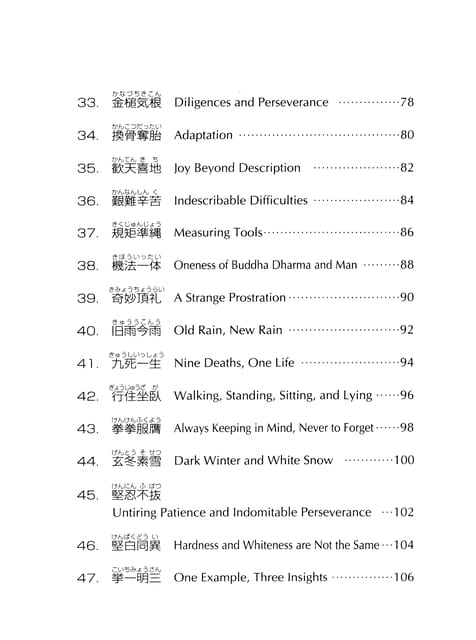
33.'~'b'-t~~~)~~~~~~:~~,~'~Diligences5~*C/'andPerseverance...."""..7834.b*/'c~f~.f~u~Adaptation"""'35.36.37.3S.39.40.41.4~.43.44.45.46.47.~+/'~~~*~~i~~~~:~t~joyBeyondDescription'''''''82b^/~f~1~/'U/'<~~;~~~~~~~IndescribableDifficulties"'""''84~*<L)F~/'L)~~~~]~~~~~~MeasuringToois'''''''''''86~*[~~u~'f*-u~~!~~~~(~l~OnenessofBuddhaDharmaandMan'''''''''88~*~~d=~;~5~~~u~~~f~y/J¥T_~~LAStrangeProstratlon''''''90~*~~~~[/~~IEI~~1~~~~IOldRain,NewRain"'"""92**~~uu~'u~~7L~E~ENineDeaths,OneLife""'"'"'94~~:~=~u;h~~~~b<~~:(~E~~~AWalking,Standing,Sitting,andLying''''''96[~/'{~/~'~+<:~~~~~~;~~f~iAlwaysKeepinginMind,NevertoForget・・・・・・98If/'d:~~t~~)~:~L~:~~'DarkWinterandWhiteSnow'''''''''IOO[~/'f[/"~+I~l)~~~:~~~~¥+i::='ctJ'~[+j~l~(UntiringPatienceandIndomitablePerseverance"'102[~/'f~<~~:~ul~~E~1~]~~HardnessandWhitenessareNottheSame'''I04cul~5a~~~*-l'~~~~l-OneExampleThreeInslghts"""I06
Page 010
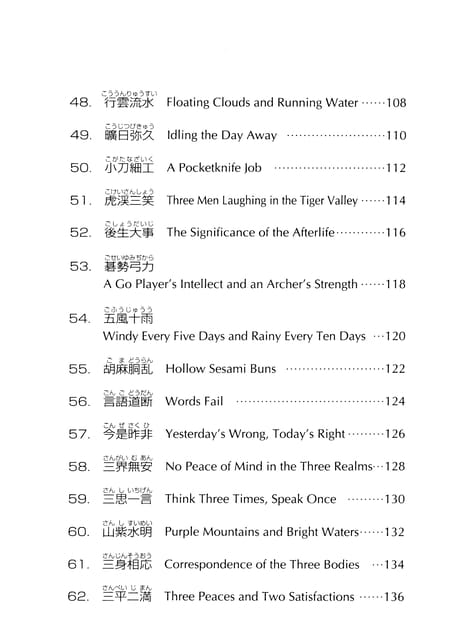
48.49.50.51.5~.53.54.c~~/'D~~~ru~~~:~:'/)l~L7~<FloatingCloudsandRunningWater''c~L)~)cF**~~~~~iEl~~~~IdlingtheDayAway~b<ttf~~~u~<jJ¥7]~~[1APocketknifeiobcl~u~*-/'u~<~~~:~~-~:*~ThreeMenLaughlngIntheTlgerValley~-"u~~f~u~L)'(i~~E~l~~:TheSignificanceoftheAfterlife""'-*'ttu*~)~~~+~~~=*/'~L~~j]AGoPlayer'sIntellectandanArcher'sStrength・-*'*,~,~L)~~~~:J~Lf~~1WindyEveryFiveDaysandRainyEveryTenDays'I08'110.112.114.116.118'12055..~~~~~E~~LHollowSesamiBuns.12256.='/~=-'(~~~f~:/~~~-_-ii:)~~j'L~':~r:1rlF:lWordsFail.12457.C/~t~~-<C>~+E3B~~~7~EYesterday'sWrong,Today'sRight・-.1265S.~~-/~b~U~~lS8~/~-~EY~~h~~~.,*~~~NoPeaceofMindintheThreeRealms.12859.~-/~UU1~51~f/v_EEI/U+¥irll~ThinkThreeTimes,SpeakOnce'130eO.~-/~U~~Ul~)U1LLl~~7~<E~~lPurpleMountainsandBrightWaters''''.13261.~-/~L)/v~~~~~~i-~k~~Ft~CorrespondenceoftheThreeBodies.1346~.~-/v~:.UIL)~!~/v-IF''~/ThreePeacesandTwoSatisfactions'''..136
Page 011
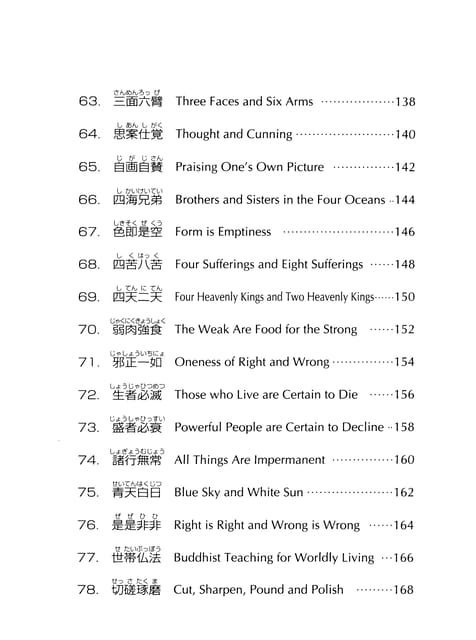
63.64.65.66.67.68.69.70.71.7~.73.74.75.7e.77.78.~~-/v~~lv~~~iF_~'~~~i7~F~Ua~/vUb~</EBL~¥~~;4i~;f~~L)b~U~./vUb+U~l~U~~'U1U~*~<t~<~~;~~;~~~~U<[~~)<~11~~~)~~~~U~/vlcICl~~~l~~~~U~<f[<~*d~~UJ<<L)~'U~~~ull5l~~~~~IE~~U~~U~C>~~)1)~Eb~~;~¥~~~~LU~~U~C}1)~ru~~:~Lb~;~¥~U~~~~~~SUd=~~/'cF~~~~~~sl'-o~lJ"~~rllttuI~~/~l~<U~)~;ATd:lr:1[:lLllt~t~CyC>~~i~~~~~~ttf*-U1'3~~)f~5tt~)*-f*<~:~ThreeFacesandSixArms""''""'138ThoughtandCunning"""""""""""I40PraisingOne'sOwnPicture"""'"""I42BrothersandSistersintheFourOceans・・144FormisEmptiness'''''''''''''''''''''''''''146FourSufferingsandEightSufferings""''148FourHeavenlyKingsandTwoHeavenlyKings・・・・・・150TheWeakAreFoodfortheStrong''''''152OnenessofRightandWrong''''''''''''''154ThosewhoLiveareCertaintoDie''''''156PowerfulPeopleareCertaintoDecline"158AllThingsAreImpermanent・・・・・・・60BlueSkyandWhiteSun'''''''''''''''''''..162RightisRightandWrongisWrong"""164BuddhistTeachingforWorfdlyLiving'''166Cut,Sharpen,PoundandPollsh・・・・・68
Page 012
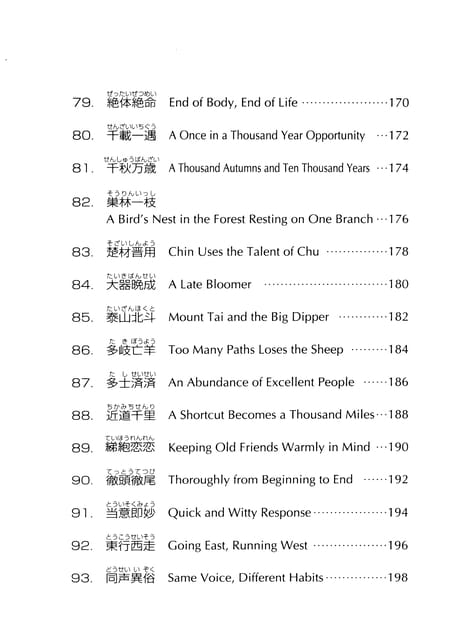
79.80.t~.f*ult~l)~)u*~,~(~l~~,~f~~EndofBody.EndofLife''''t!:/'**u~u~~<:'~~F~~~~,AOnceinaThousandYearOpportunity'170.17281.S~.t!:/'u~~[~/'*-u~f~~7~~~~~AThousandAutumnsandTenThousandYears'~~)D/'u~'u~!~~~~ABird'sNestintheForestRestingonOneBranch'.174.17683.~*-u*U/'d<~IDZChinUsestheTalentofChu.178S4.f*-'ul~*[~/'ttU1~~~~~~~~:~ALateBloomer'180S5.f*"'U~~r.1'1~<~:MountTaiandtheBigDipper.18286.f*'=~*l~~~;:~TooManyPathsLosestheSheep.184S7.f*'-Ut~UlttU1~~~~[L;~~f;~fAnAbundanceofExcellentPeople.18688.89.~5b+~~tt/~D~ulf~~5rl/'rL/~~itS'-*"~~AShortcutBecomesaThousandMiles'KeepingOldFriendsWarmlyinMind-.188'19090.ThoroughlyfromBeginningtoEnd.19291.~:~ul~<~d=~~~~:~n~~//J¥QuickandWittyResponse'''''.1949~.~l~C~ttu~~~~:~~:~i~:GoingEast,RunningWest・・・・・・・・・・・・・・・-.19693.~~~jttulu~~~<~l~T~~~f"SameVoice,DifferentHabits'''''''.198
Page 013
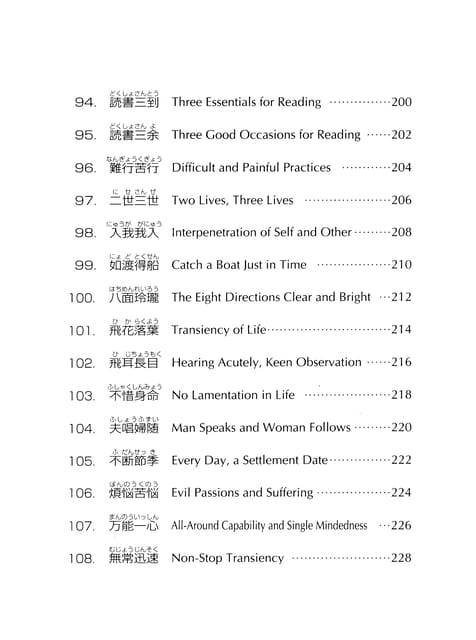
94.~i<u~*-/'~~~)~~~:-~lJThreeEssentialsforReading'20095.~~<:u~~-/'d~~)uI~ThreeGoodOccasionsforReading'''20296.~E~~:~~~i:~'DifficultandPainfulPractices'20497.f[tt*-/'t~-t~!:-t~tTwoLives,ThreeLives'2069S.[[~)~bb[*~~1))~~~;)~InterpenetrationofSelfandOther''''''20899.l[~~~l<tt/~'B,l¥CatchaBoatJustinTime'210lOO.[~~~)/'~lu~~~)~~i~TI~'I~~TheEightDirectionsClearandBright'212lOl.c~b+5<~~~j~h~<E~os~7~+*~~-;~~:~~TransiencyofLife''''''.214l0~.~L)~5~~~'<HearingAcutely,KeenObservation"'216l03,~~'l'E~I~krlr]if'~NoLamentationinLife.218l04.~:D~~~~~:ManSpeaksandWomanFollows''''220l05.'~'/~~/'t~~)~*~~L~':~*~l^~n~~;EveryDay,aSettlementDate'''.222l06.[~'lvcD~<OD~,~'~EvilPassionsandSuffering"'".224l07.~~/'~)~U~~U/~7jr~~/'~L¥All-AroundCapabilityandSingleMindedness.226l08.~l~L)~~L)/'~<''*,Non-StopTransiency.228
Page 014
㌧、百八つのねがい一LOV置NGCOMPASSlON-108Meditations一
Page 015
1.Aieηκ7eη0亀Relafioη5㈱0∬eωκarmaノノFromthetimeofSakyamuniBuddha,thethinkingwasthatmyIifeandeverythingaroundmewasaresuItofthewiliofGod.However,therewerealsomanypeoplewhothoughtthateverythingwasanaccidentofplaceandtime.AtthesametimetherewerethosewhopreachedthatbecauseeveryoneindMduallywasbomintothisworldwiththeirdestinyontheirbacks,therewasnootherwaytolivebutbeledbydestiny.Thiswastheirlife.ノlncontrasttotheseotherideas,SakyamuniBuddhataughtthateverythingcameintobeingandremainsinexistencethroughdirectcausesandindirectconditions.Heespeciallyemphasizedtheimportanceofindirectconditions.Thisteachingbecamealeηた1eη」notherwords,whentwopeoplecametoIoveeachotheritwastheresultofinconceivabIeindirectconditions.ThisdefinitionIedtotheexpression”arelationshipduetokarma.”14
Page 016
あいえんきえん1.愛縁奇縁私たちの周りにあるものも、私自身の人生も、すしゃかべてが神さまの意志によるという考え方は、お釈迦さまの時代からありました。いや、そうではなく、すべてのことは、その時、その場の偶然の結果であって、神さまの意志などどこにもないと考える人も、当時多くいたようです。いやいや、そうでなくて、人間はそれぞれ自分で気づかないだけで、みんなそれぞれ自分の運命を背負って、この世に生まれてきたのであるから、自分の運命に導かれて生きるしかないのが人生だと説く人もいたということです。それに対して、お釈迦さまは、すべてのことは因(直接原因)と縁(間接条件)によって成立しているのだと説かれ、特に縁の大切さを強調されました。このお釈迦さまの教えが、「愛縁奇縁」すなわち、お互いに愛し合うようになったのも不思議なこ縁によるという言葉になったのでしょう。15
Page 017
2.ノ舗bef5乙rIR’たμ価e5嵌痂gof5eparafiη8含om7ho5eWeloye♪Forhumanbeingswhateverthesorrow,thereisnothingsadderthanseparatingfromalovedone.[specia”ythereisnothingmoreunbearablypainfulasseparationbydeathfromaIovedone,bywhichwecanneverseeeachotherinthisworldagain.The3rdabbotoftheHongwanji,Kakunyo,wroteinhisexegesis,κudeη5んδ:Amongtheeightsufferingsofhumans(birth,oldage,sickness,death,sufferingofseparatingfromIovedones,sufferingofmeetingthoseonehates,sufferingofnotgettingwhatoneseeks,andsufferingaccompanyingthegrowthofone’smindandbody),themostacuteisthesufferingofseparatingfromlovedones.Therefore,thereisnothingasdifficultasvisitingabereavedfamily.ltisasituationthatwereadaboutinZendo/s5aηzeη8i.”Weonlyhearlamentations.”Weoftenencountersuchsituations.[ntheκudeη5ゐδ,KakunyostatesthatwhenyouvisitabereavedfamiIyyoushouldbynomeansaddtotheirsorrow.ThenheaddsthewordsofShinran,”This5aたθiscalledb6Fy♂Zβ6テy∠7meanstolforgetyoursorrows!Youshouldconsolethembyencouragingthemtodrinkuntiltheylaugh.Andthenyoucanleavethehouse.”16
Page 018
あいべつりくト2.愛別離苫人間、なにが悲しいと言っても愛しい人との別れほど悲しいものはありません。特に、もうこの世であいまみ再び相見えることのできない愛しい人との死別ほど辛いものはありません。かくにょしょうにん本願寺三代目覚如上人は、はっくしょうろうびょうしあいべつりくおんぞう人間の八苫(生・老・病・死・愛別離苦・怨憎えくぐふとっくこうんじょうく会苦・求不得苦・五紹盛苫)のなかに、さきにせついうところの璽別離苦、これもっとも切なりくでんしょう(『ロイ云金少』)といわれています。ちょうもんですから、最愛の人と死別された家族を弔問するしゅうたんほど心の重いことはありません。「ただ愁嘆の声をぜんどうだいしさんぜんぎ聞く」(善導大師『散善義』)場で、言葉を失うこともしばしばです。『口伝紗』には、かなしみにか:なしみを添うるようには、ゆめゆめとぶらうべからずとのこ注意のあとに、ぼうゆう酒はこれ忘憂の名あり、これをすすめて、笑うほどになぐさめて、去るべしという親鸞聖人のお言葉が紹介されています。17
Page 019
3・A5a髭u5a5aηd㌶8eηe翫51brεaげγR’5er5ナCuttinga5aηdaofgrassbeforebreakfastwascalIeda5∂たu5∂5aηda.ThisistheamountanordinarymancouIdcut.(/cんid∂istheamountofgrassthatonehorsecancarry.5∂ηdaistheloadthatthreehorsescanpack.)Inmodemtimes,peoplewhoworkbeforebreakfastarefew.Whenlwasachild,everyonewouldnatura”yhavebreakfastaftercompletingachore.Atsunriseeveryonewouldgoouttothefields,andwhenthesunsets,peopIewouIdstartgoinghome.Andthenalltogethertheywouldhaveaneveningservice.Thatconcludedonedayfortheordinaryperson.Thosedaysarelonggone.Amonglapaneseproverbs,therearemanythatexpressthevirtuesofarisingeariyinthemoming.lflmayshareafew,theyare:1.Earlyrisersreceivethreecentsworthoftime.2.3.4.5.Earlyrisershavesevenvirtues.Goodfortunecomestothehouseofeariyrisers.Earlyrisersreceivetheirrewards.Onemorninghourisworthtwointheevening.TherearemanywordstoexpressthewonderfuIvirtueOfriSingearly.18
Page 020
あさくささんだ3.朝草三駄朝食の前に草を三駄(一駄は馬一頭に背負わせるくらいの分量)刈ることを朝草三駄というのですが、これくらいが普通の人の労働量であるという言葉です。現代では朝食の前に仕事をする人が少なくなりましたが、私たちの子どもの頃には、一仕事終えて朝食を済ますというのが当然のことでした。日が昇ると同時に田畑に出て、日が沈むと家路につき、家族揃って夕べのお勤めをする。それが普通の人の一日だったのですが、遠い昔のことになりました。日本のことわざには朝早く起きることの素晴らしさを表すものが多くあります。二、三あげてみますと、朝起に三文の徳あり同じようなものに、「朝起は七つの徳あり」「朝起の家には福来る」というのもあります。朝駆けの駄賃だちんいっときふたとき朝の一刻(約2時間)は晩の二刻に当るという朝起きの素晴らしさをいう言葉が多くあります。19
Page 021
4・Aη5AaHor’ηで7}℃a51∬iη8fhe」E,der,γ♪ハη5ゐameansacartwhichismadesothattheelderlyandillpeopleandothersindifficultycansitcomfortably.Horinisthewheelthatiswrappedwithcattailleaves,tosoftenthewobblingofthecart。Thewords∂η5ゐ∂ゐoriηhavethemeaningofrespectingelders,treatingthemkindlyandtreasuringthem.lftheworldcomestoevaluatingeverythingasusefulornot,andwhetheromotmorecanbeproduced,thenastheworldchanges,therewi”bemoreoIderpeopleonsma”fixedincomes,andneedingthehelpofotherpeople,whowilIbeevenlessrespectedandfurthertreatedasvalueless.ltisalreadyheadinginthatdirection.However,inChinathereisaproverbthatsays,”Anoldhorsedoesnotforgettheway.”ThisproverbdescribesthewonderfulsideofeIderlypeoplewhohaveaccumulatedvaIuableexperiencethroughthelongpathoflifethatcannotbelearnedinschooloranyotherway.Asconfusionintheworlddeepens,themoredifficuItitbecomestoseeahead,andthemoreweneedthewisdomofoIderpeople.20
Page 022
あんしゃほりん4、安車蒲輪「安車」とは、老人や病人などのために安座できるように作った車のことです。がま「蒲輪」とは、蒲の葉で車輪を包み、車の揺れを和らげるようにしたものです。ですから「安車蒲輪」とは、老人を重んじ、いたわって大切にしようという言葉です。すべてのものを、役に立つか立たないか、もっと言うと、お金をたくさん得るか、そうでないかで、ものの値打ちを決める世の中になればなるほど、収入がなぐなり、他の人に世話をかける老人は粗末にされる傾向にあります。しかし、中国に、老いたる馬は道を忘れずという、ことわざがあります。これは、「経験を積んだ者はものことの方針や判断を誤らない」ということを言ったことわざで、長い「いのち」の歩みのなかで、学校等で学ぶことのできない貴重な経験を積んだ老人の素晴らしさを言った:ものです。世の中が混迷の度を深め、先が見えにくくなればなるほど、老人の知恵が必要です。21
Page 023
5.Aηiiηκむε5ε4σ‘Oe育’7ife,γ5e甜1edl臼ifhノOrigina“y,thistermwasatechnicaltermofthel6doSchoolofBuddhism.Thel6doSchooipreachesthatbyanencounterwithAmidaBuddha/serrorlessmind,ourfanaticaIlytightmindsbecomepeacefulandopen.Thisissalvation.Whenwehavelostalldoubt,andourmindsandbodieshavebecomepeaceful,thisstateiscalledAηノiη.Aηノ1ηisthestateofmindinwhichwehavenodoubtaboutAmidaBuddha’sreliabiemind,whichisaiwaysworryingaboutus。Whenweenterthatstateofmind,thatiscaIledたe蜘1δ.lnthePureLandteachingaηノ1ηhastheidenticaImeaningas5ゐiηゾiη,therefore,∂ηゾ1ηたα5αノδisthesameas5んiηゾi欲α5αゆ.5ゐiηノ1ηdoesnotmean”mymind”thatbelievesinsomething.Theノ加of5ゐiηノiηmeansthemindofAmidaBuddha,whichisperfect.The5ゐiηisthestateofmindthathasbecomeridofalldoubts.Therefore,5ゐiηガηmeansthatanydoubtwemighthaveheldastoAmidaTathagata’smindhasbeena”clearedupandwehavebecometrulypeacefuLAmidaBuddha/scaHingvoicesays,”Whatevermayhappen,lwi“neverabandonyou.”lfyouhearthatvoice,itmeansthatyourdoubthasbeenclearedup.Whena“doubtsaboutAmidaBuddha’smindbecomeeliminated,thatis∂ηゾiηたα5αゾδ(definitelysettledfaith).22
Page 024
あんじんけつじょう5.安心決定もともとは、間違いのない阿弥陀如来のお心に出であこ遇って、凝り固まった私たちの心が開かれるのがすくいであると説く、浄土教の言葉です。安心とは、変わることなく私たちを案じてくださる阿弥陀如来の確かなお心に一片の疑いもなくなって、身心が和らいだ状態です。そのような状態が私たちの身に確定するのが決定です。浄土教では、安心は信心と全く同じ意味で使われしんじんけつじょうますから、「安心決定」とは、「信心決定」のことです。信心とは、何かを信じる私の心ということではありません。信心の「心」は間違いのない阿弥陀如来のお心であり、「信」とは一片の疑いもなくなった状態ですから、「信心」とは、確かな阿弥陀如来のお心に疑いが晴れて、心が真に安らぐことです。「どんなことがあってもあなたを捨てない」とよびかけてくださる南無阿弥陀仏のよび声が聞こえるままが、疑いが晴れた状態です。阿弥陀如来のお心に疑いが晴れたのが、「安心決定」なのです。23
Page 025
6.Aη循aたu・5e’roAηf欲urefersto/iηbenevolenceand/iηisaplacewheremanshouldestablishhimself.house.ノ1ηexemplifiesmetaphoricallyapeacefulandsafeThischaracter/iηcanaIsobereadasif5σたα5ゐ’mα,5ゐif∂5ゐimα,andmegαノηα.ltrepresentsthefeelingofloving-kindnessandintheConfuciantraditionitisconsideredthehighestvirtueofhumankind.lnthethreebooks,”Mencius,””Li』i”and”ZhongYong”wereadthatliηandhumanbeingsareusedwiththesamemeaning.lnotherwords,thosewhohavefeelingsoflovingkindnessaretrulyhuman.Butthosewhodonothavethefeehngofiovingkindnessarenothuman.lbelievebenevolencecreatesanddefinesaman.Therefore,ノiη,thefeelingofloving-kindnessgivestruepeacefulnesstopeople.Later/iηtookonthemeaningofノ’aiwhichislovingharmonyandcloseness.ForpeoplewhostudyConfucianteachings,ノノηrepresentsthehighestvirtue.5eiromeans8’i(righteousness),thewaypeopleshouldproceedanditmetaphoricallyexemplifiestherightpath.Giwasusedincompoundwordslike5e18’1(theproperway),g’ir1(oわ1ig’afioη,)g汝o(rightaction),andfromancienttimes,ithasbeenusedtorefertowhatisright.24
Page 026
あんたくせいろ6.安宅正路じん安宅とは、仁のことで、仁は人の身を立てるべき地で、安らかな住居(安宅)に例えられるのです。仁は、いつくしむ、したしむ、めぐむとも読み、じゅきょう親愛の意昧であり、儒教では、人の最高の徳とするもうしらいきちゅうようもので、「孟子」や「礼記」や「中庸」には、「仁は人なり」とあり、仁と人は同じ意味に使われています。すなわち、親愛の情をもつものが人であり、親愛の情のないものは人でないというのです。そういう意味で、仁こそが人を人とならしめるものであるというのです。ですから、仁すなわち親愛の情こそが人に本当のやすらぎをあたえるということです。後には、仁はこうし慈愛和親の意となり、孔子の教えを学ぶ人にとっては最高の徳目にまで高められました。正路とは、義のことで義は人のふむべき道であり、正路に例えられたのです。義は、正義・義理・義行と熟語され、昔から、正しく善なるものの意味で使われてきました。25
Page 027
7.1σ伽ηiη侮5γfoGo,Bαf~00ηeGoe5ナBeingattachedtothesmaIIselfegoandusingalltheirownpowertopushtheirideasontootherpeople,nottryingtoacceptotherpeoples’feelings,andlosingsightofthelifeofthepeoplearoundus,thissituationisca”ed”thedarknessofignorance”intheBuddhisttradition.Toescapefromthedarknessofignoranceisthemostimportantthinginthislifeandthethingweshouldmosthurrytodo.ThisistheteachingofBuddhism.lnordertoridusoftheattachmenttooursma“egoandleavethedarknessofignorance,thereisnootherwaythantoencounterthegreatAmidaTathagata’smind.Soteaches∫6doShinsh〔】.”Toescapethedarknessofignorance”meanstogotothePureLand。日iminateattachmenttotheselfandbebomintotherealmofenlightenment.BecauseonlyanencounterwithAmidaBuddha’smindisnecessaryforourbirthasaBuddha,itwouldseemeasytogotothePureLand,butthereisnoonewhoissobom.Thisweca”1δmαηiη(easytogo,butnoonegoes).Theword/iδmσηiηノclearlyshowsthestrengthofattachmentofthehumanegotoitseIf.26
Page 028
いおうむにん7.易往無人じがと小さな自我に執らわれ、自分の思いを周りの人に押し付けることだけに力が入り、周りの人の気持ちを受け止める営みがお留守になって、周りの「いのむみょうやみち」を見失っている状態を仏教では無明の闇といいます。この無明の闇を出て離れることが、「いのち」にとって何より急ぐべきことであり、何より大切なことだという教えが仏教です。小さな自我の執らわれから離れ、無明の闇を出るであには、大きな大きな阿弥陀如来のお心に出遇うしかないと教えるのが浄土真宗です。ゆ無明の闇を出るがまま光の国(浄土)に往くということです。自我の執らわれを離れてさとりの国(浄土)に生まれるのです。阿弥陀如来のお心に遇うだけで往生が実現するのやさですから、浄土に往くことは易しいはずなのですが、浄土に生まれる人がいないというのです。そのことを易往無人(往き易くして往く人なし)というのです。人間の自我の執らわれの強さが明かされているのが、易往無人という言葉です。27
Page 029
8・15AiηOeη5ゐiηでCoπ2m∬41icaガπ8『ル露’7d「foルfi’7d)lsupposethequickestwaytocommunicateandconveymythoughtisthroughwords.WhenwecannotconveyourmindtotheotherpersonusingonIywords,wetrytodosousinghandgestures,andevenourentirebodies.However,wordsaresurelythemostconvenientmethodtotransferourownthoughtstoothers.Sometimes,butprobablymoreoftenthannot,mythoughtsreachestheotherpartytwistedratherthancorrectly.Thereareoccasionswhenthemorewespeak,thewideranddeeperthegulfbetweenusbecomes.Andthenwishingtodosomethingtoconveymythought,thehandgestures,andbodymovementsbecomeexcessive.Sometimesthisieadstoasituationmakingtheotherpersonfeeluncomfortable.ThissadsituationoccursbecausehumanrelationshipsarenOtexaCtlyintUne.lnourdailylives,ifhumanrelationswereinharmonyeveniftherewerenowords,nohandgestures,orbodymovements,mymindwouidbeunderstoodbytheotherρer50n./5hiη0θη5hiρ(teleρathy)cannotbeconsideredwithoutacbse,completelytrustingPersonalrelationship.28
Page 030
いしんでんしん8.以心伝心自分の思いを他の人に伝える一番手っ取り早いのが言葉でしょう。言葉だけで伝わらない時には、手振り身振り、全身を使って、私たちは自分の思いを伝えようとします。ところが、言葉は確かに自分の思いを他の人に伝える一番便利な方法ですが、時にはというか、多くゆがの場合、正しく伝わるより、歪んで伝わります。語みぞれば語るほど相手との溝が広がり深まることがあります。そこで、何としても自分の思いを伝えたいと手振り身振りがオーバーになるのですが、それがかえって相手に不快感をあたえるような悲しいことになることもあります。人間関係がきちっとできていないから、そのような悲しいことになるのです。普段から親密な人間関係ができていれば、言葉はなくとも、いわんやオーバーな手振り身振りを交えなくとも、自分の心は相手に伝わるものです。以心伝心は親密な人間関係を抜きにしては考えられません。29
Page 031
9・1cわ磐01cゐieζMeα’η80η,γ0ηceiηa伽f加e少Regardlessofhowmanytimestheymeet,themeetingoftwopeopIeatthistime,atthispIace,andinthisconditionofmind,wi”neverhappentwice.lnthatsenseeveryoneofthemeetingsoccuronlyonceinalifetime.Theteaching”AmeetinghapPensonlyonceinaIifetime,”firstapPearedinCゐaη〇yu5んaκ∂女α90/1ffalwrittenbySojiYamanoue.lnthebooktitiedCゐanoyα1cゐノe5ゐσ,themindo〆1cんi801cんieisexplainedbelow:Nowwewi”haveateaceremonytobecalled,”Ameetinghappensonlyonceinalifetime!’However,manytimesthemasterandguestsmeet,whenwethinkwewiIInevercomebacktotoday’smeeting,trulyitisauniquemeetinginourentirelifetime.Therefore,themastershouldconsidereverything,andanyimperfectionshouldbeavoided.YoushouIdtreatyourguestswithtruesincerity.Thisisca“edlcん1golcんノe.Rennyosaidfromaslightlydifferentviewpoint,Onemistakeisthemistakeofanentirelife.Oneindiscretionisaiifetimeofindiscretions.Thereasonforthisisthatifyoudieatthatmoment,itbecomesthemistakeofyourwholelife.30
Page 032
いちこいちえ9.一期一会人と人との出会いは何度出会っても、この時この場で、この心境この状態での出会いは二度とありません。そういう意味で、その時その時が一生に一度の出会いです。せんのりきゅうやまのうえのそうじ干利休の弟子であった山上宗二の著した『山上宗二記一茶湯者覚悟十体』に「一期に一度の会」とあるのが、一期一会の言葉のはじまりですが、『茶湯一会集』には、そもそも抑茶湯の交会は、一期一会といいて、たとえば、幾度おなじ主客交会するとも、今日の会にふたたびかえらざる事を思えば、実に我一世一度の会なり。去るにより、主人は万事に心を配そまつり、いささかも鹿末なきよう〈略〉実意を以て交わるべきなり。是を一期一会というと、その心が明かされています。れんにょしょうにん本願寺の蓮如上人は、少し視点を変えて、一度のちがいが、一期のちがいなり。一度のたしなみが、一期のたしなみなり。いのちそのゆえは、そのまま命おわれば、一期のちがいになるによりてなりと言われました。31
Page 033
70.1c岬5e面η‘0ηeCharacfe’》a訪o∬5aηdFGo,o「P’ece5ナ1cゐi/i5eηたiηisthephrasethatteachesusthatincaliigraphy,theexpressionusedineverysingiecharacterisveryimportant,andhasthevalueofonethousandpoundsofgold.ThisphraseoriginatedinastoryaboutapersoncaIledLuBuweioftheQinDynasty.Hewrotethebook,springandAutumnofLu.ThebookwashungonthegateofXianYangcitytogetherwithonethousandgoldcoins.AndLuBuweisaidifanyonecouldfindevenonewrongcharacterhewouldpaythatpersonathousandpoundsofgold.lnmodemtimeswhenwordsandcharactersareusedcarelessly,lwishwecoulda”regainthemindtoplacegreaterimportanceuponevenonecharacter。ThereareIotsofwordswhichdescribethevalueandimportanceofonecharacter.1cゐヴiηooη(obligationtoonecharacter)meanstheobligationthatlwastaughtbyevenonecharacter.AboutthisobIigationthereisaquotation,ic脚ηooηηi5ゐif∂woη派e.Explanation:Theobligationwereceivefromeven・necharacterisvery8reat.T・repaythat・bligationyoumustdowhatevernecessary.1cゐヴiη05ゐi(teacherofonecharacter)meansthatinthecaseofaChinesepoem,thesuitabilityofonecharacterwouldchangethevaIueofthewholepoem.Therefore,theteacherwhocorrectedevenonecharacterwouldbehighlyvalued.32
Page 034
いちじせんきん10.一字干金きん詩文の表現や筆跡においては、一字一字が千斤の金に値するほど大切であることを教えてくださる言葉です。りよふいこの言葉は、秦の呂不箆という人が『呂氏春秋』かんようを著した時、成陽の市門に干金と共に掛けて、一字でも添削できた者には、この干金を与えようと言った故事(r史記一呂不葦伝』)からきています。言葉や字が粗末に使われる現代において、お互い一字の重みを大切にする心を取り戻したいものです。一字の重さ大切さを言う言葉はたくさんあります。二、三紹介しておきましょう。「一字の恩」。一つの文字について教えを受けた恩のことですが、その恩について、「一字の恩に舌を抜け」という言葉もあります。一字でも教えを受けた恩は極めて大きく、その恩にはどのようなことをしてでも報いなさいという言葉です。「一字の師」とは、漢詩などで一字の適不適で全体の価値が左右されるので、一字を直してくれる師を大切にしなさいという言葉です。33
Page 035
11.1chidh盈・“5eη漏【’ηで0ηeA87eeme砿0ηe7hoμ5aηdGo,dCoiη5,Onceyoumakeanagreementthatagreementshouldhavetheweightofonethousandgoldpieces.Apromiseisamatterofgreatimportanceandweight.lnthisworldwemakemorecareIesspromisesthanwerealizelagoodexample,promisesmadeduringelectioncampaigns.FormanythingsapromiseistreatedIightly.Therearetoomanythingswecannottrusttoday.Weca”modemtimesasthetimehumanscannotbetrusted.Oneofthecausesisthatwehavelostthephraselcんid∂メαノ5eηた1η.Amonghumanbeingsthereisnopromisewhichincludesthewords”withoutfaii.”Peoplemakepromises,whichfromthebeginning,theyhavenointentionkeepingbutthatisnotoursublecthere.Therearecaseswhenwecannotsay,”Wewi”keepourpromisewithoutfaii!’Howevermuchweintendtokeepthepromisethereareoccasionsandunderwhichwecannotkeepourpromises。ofconditionsThereforetheTathagatamightbetheonlyoneabletokeephispromiseswithoutfaiLShinranneverusedthewords”withoutfail”exceptwhenreferringtotheTathagata’spromise.ThetermwasusedintheVowwhichwithoutfaiIwi”takeustoenlightenmentandwithoutfailwilltakeustotheLandoflnfiniteLight(PureLand).34
Page 036
いちだくせんきん11.一諾干金一度承諾すれば、その承諾は干金の重みがなければなりません。約束とは、それほど重いものであり、大切なものなのです。この世の約束は、案外いい加減なものです。それは選挙の公約だけのことではありません。何かにつけて約束が軽くなり、信用できないことがあまりに多いのが現代という時代です。現代を人間不信の時代と言いますが、その原因の一つが「一諾干金」という言葉を失ったところにあるのではないでしょうか。人間には、必ずという約束はありません。はじめから守る気がないのは論外ですが、私たちの場合どれほど約束を守るつもりでも、その時の状況でどうしても守れないことがあります。「一諾干金」、必ずという本当の約束は、如来さまにおいてしかないのかもしれません。親鶯聖人は必ずという言葉を如来さまのお約束としてしか使われません。「必ずさとりに至らしめるむりょうこうみょうど願い」とか、「必ず無量光明土(浄土)に至らしめる」という具合です。35
Page 037
12.1chiηichi5eηム【iηでOneρaγa殆o”5aηdP’ece50fGo,のThephraseicゐiηicゐi5eηた1ηisusedintwoways。rirst,dependingonthecircumstances,itmeansthatonedayisconsideredasvaluableasathousandpiecesofgold.Atypicalexampleofthisusageisfoundintheintroductiontothe5eたeηmuη∂z∂ηyδ:FromthefirstdayoftheNewYearuntilthelastdayoftheyear,oneshouldmaintainaverycarefulmentalcaiculationthateverydayisworthonethousandpiecesofgoid(1cゐiηichi5eηたiη).Second,itcanmeanspendingathousandpiecesofgoIdinoneday.ThisusageapPearsinchapterthreeofthe5eたeηmαηazaηyδ:Spendingath・usandg・ldpiecesinonedayinthepleasurequarters,claiminghe’dpayhisbiIlsifonlyhecouldgetthemoney.Whicheverthemeaning,wetendtoidleawaytimewithoutpayingmuchattentiontoitssignificance.However,whetherpositiveornegativeinmeaning,thephraseicゐiη1cゐi5e脈iηremindsusthateachandeverydayholdsgreatmeaningforourlives.Therearesimilarsayin8s/suchas”onedaylatebecomestendayslate,”or”onedaゾsdeIayaffectsthenextonethousanddays.”lfwedon/tdowhatwehavetodotoday,itcantaketenmoredaystocatchup,orworseitmighthaveanegativeeffect”foronethousanddays,”whichmeanswemightnotbeabletofinishever.36
Page 038
いちにちせんきん12.一日干金「一日干金」には二つの使われ方があります。一つは、事と次第によっては、一日が千金に価するほど貴重なものであるという使い方です。この使い方の代表的なものに『世間胸算用一序』の元日より胸算用油断なく一日干金の大晦日をしるべしがあります。二つには、一日に干金もの多くのお金が使われるという使い方です。これも同じく『世間胸算用一三』に、一日千金の色所に遊び、十分請取銀あれば、其内に不足こしらえとあります。どちらにしても、今日一日ぐらいと、一日一日を案外なんとも思わず過こしていますが、いい意味でも悪い意昧でも、今日一日一日が人生に重い意味をもっているという言葉が「一日干金」です。「一日の遅れは十日の遅れ」とか、「一日延ぶれば干日に向かう」という言葉もあります。今日すべきことをしなかったら、十日の遅れぐらいならいいのですが「千日に向かう」、すなわち永遠にできないことになることもあります。37
Page 039
73.1chiηeηHo舷iρeye,opiη95’η8,eM’ηdedηe55ナAccordingtothedictionary,”spiritualawakening”isexplainedas,”tomakeupone/smindtoattainenlightenment,torefocusthemindandbecomeseriousOneverymatter!ノShinranmadethisclearinhisTheTrueTeaching,PracticeandRealizationofthePureLandWayκyδgyδ5ゐiη5ゐδ:Bythewordicゐ1ηeη(single.heartedmind)itmeansthat5ゐ1ηノiηdoesnothavetwominds.Weca”itsinglemindedness.SingIemindednessisthetruecauseofbirthintothePureLand.5ゐiηゾiηηi5んiηηaたi(5ゐiηノiηdosenothavetwominds)meansinthiscasetoaskwhichBuddhaorgodmightbebetter,Le.whichonewouldgivemorebenefits.Thisistheideaeveninthecaseof5んηノiη.ltinvolvesconsiderationfromthepointofviewofbenefitsornonbenefits.Single-mindednessisnotthisorthat.Themorewereaiizeourtrueselves,themoredecisivelyitbecomesfixedinourmindsthatthereisnootherwaybuttoleaveittoAmidaBuddha.ltisAmidawhoiscallingusandcontinuallyworkingtosaveus.Thisisthemindthatisdefinitelysettled.Shinrantaughtusinthe”ARecordinLamentofDivergences,”(7aηηi5ゐδ):BecausewereceivetheglowofAmida/slight,ourownsingle-mindednessarises.38
Page 040
いちねんほっき13.一念発起辞書には「いままでの心を翻して、悟りを開こうほっしんと発心すること。転じて、何ことについてもそれまでの考えを改めて、熱心になること」とあります。しんらんしょうにんけんじょうどしんじつきょうぎょうしょうもんるい親鸞聖人は、『顕浄±真実教行証文類』の中で、しんじんにしん「一念」というのは、信心二心なきがゆえに一念という。これを一心と名づく。しょうじょうほうどしんいん一心はすなわち清浄報土の真因なりと明かしてくださいます。「信心二心なき」とは、この場合、どちらの仏さま神さまに祈る方が得か、この場合はどちらの仏さま神さまにすがる方がこ利益が多いか、信心さえも利害損得を基準に二者択一に考えるあり方です。「一念」とは、あれかこれかでなく、自身を知らされれば知らされるほど、自身のすくわれていく道は、「そのまますくう」とよびかけ、はたらきつづけてくださる阿弥陀如来のお心にお任せするしかなけつじょういと決定したあり方です。親鸞聖人は、弥陀の光明に照らされまいらするゆえに、一念発起すると教えてくださいました。39たんにしょう(『歎異抄』)
Page 041
74.1chimioσ5hiη6ame㌃5feaηdF5ameMiηのThetermicんimidlδ5ゐ’ηisusedgeneraHyinthesenseofjoiningagrouptoincreaseitspowerforacommonobjective.Thereisasentenceinthe”TalesofHeike”(Heiたe,Moη09∂far∂whichi“ustrateslcゐimidlδ5ゐiηasfoIIows:Allthepriestsdiscussedtheircommonthoughts,andsteaIthilysentIetterstobothtemplecomplexes(EnryakujionMt.HieiandK6fukujiinNara).lnthePureLandteachingthewordicゐimimeansbyencounteringAmidaTathagata’sgreatmind,theshellaroundthesmallegoisbroken,andeveryIMngthingbecomesonewithoutanyhindrance.Herelcゐimlistalkedaboutasabenefitof5ゐiηゾiη.Shinraninthe”GathaoftheTrueFaithintheNembutsu”(5わ(55んiηge)states:Whenignorantandwise,evengraveoffendersandslanderersoftheDharma,allaliketumaboutandenter5んiηゾiη,theyarelikewatersthat,onenteringtheocean,becomeoneintastewithit.Andinhis50η8δ5んiηzδmelmoη,Shinranclarifiesthisideasaying:Sma“andholy,ordinarypeople,thoseguiltyofthefiveatrocities,slanderersoftherightDharma,thosewhodonotfollowthefiveprecepts,andthosebeyondsalvation,a”turnaroundandgointotheoceanoftrue5ゐiηゾiη.ltislikemanywatersenteringintotheoceanandbecomingonetaste.Also‘1δ5ゐ1η(samemind)canbewrittenwithdifferentChinesecharacterstomean”same5ん1ρノiη,””sameparent,”and”samebody!ノ40
Page 042
いちみどうしん14.一味同心一味同心という言葉は、一般には同じ目的の下に力を合わせ、心を一つにすることという意味で使われます。また時には、心を一つにする人びとという意味でも使われます。『平家物語』の中に「一味同せんぎ心に愈議して、山(比叡山延暦寺)も奈良(興福寺)ちょうじょうへも牒状をこそおくりけれ」という文章があります。浄土教では、この一味は阿弥陀如来の大きなお心あじがからに遇って小さな自我の殻が破られ、生きとし生きるすべての「いのち」が何の隔たりもなく一つになることをいいます。りやく一味は信心の利益として語られるのです。しょうしんげ親鸞聖人は『正信偶』の中で、ぼんしょうぎゃくほうえにゅうしゅすいうみ凡聖逆諺ひとしく回入すれば、衆水海にいりて一味:なるがことしそんこうしんぞうめいもんと讃えられ、『尊号真像銘文』で、そのお心を、しょうしょうぼんぶこぎゃくほうぼうせんだいえしん小聖・凡夫・五逆・諺法・無戒・閏提みな廻心して、真実信心海に帰入しぬれば衆水の海にいりてひとつ味わいとなるがことしと明かしてくださいます。また同心は、同信であり同親であり同身でもあります。41
Page 043
15.IchiryuManbai(OneCrainlTenThousandTimes)ThesourceofthisexpressionisasentenceintheH~onky~Sutra,whichsays:"Ifyouplantonegrainofriceitmultlples10,000times.Thereforeitisimportantfirstofalltoplantonegrainofseed."Sothiswordisusedasanexamplethatyoucangainbigprofitsfromafewsmallthings.Again,evensmallthings,ifyouarenotcareful,mightleadtoagreatloss.Thususedasateaching,wemustcarefullyuseevensmallthings.Truly,peopleintheoldendaysoftenusedthewordmottainai,meaningtooprecioustowaste.ThereisastorywhichremainsthatRennyosawascrapofpaperinthehallway.Hesaid:"ItissacriligioustotreatthingswastefullywhichwereceivefromtheBuddha."Sosaying,heshowedhisrespectbypickingupthescrapofpaperandbowingtoit.Thethoughtof"It'sjustapiec:eofpaper,"changedtheworld.Ourworldissofullofwastethatwehardlyknowwhattodo.42
Page 044
いちりゅうまんぱい15.一粒万倍この言葉の出典は『報恩経』にある「世間において利を求めて田を耕すものを先とするなかれ、一つの種は万倍となるなり」という経文です。ま一粒の種子を蒔けば、その万倍もの粒となるのですから、まず一粒の種子を蒔くことが大切であるという教えです。そこでこの言葉は、わずかなものから非常に多くの利益をあげることの例えとして使われたり、また、小さなことでもいい加減にすると、それが大きな損害につながることがあるという意味に使い、小さなことやものでも大切にしないといけないという教えとしても語られてきました:。まさに、古人が二言目には「もったいない」と言いましたが、そういう意味で使う言葉でもあります。蓮如上人は、廊下に落ちている紙片をこ覧になっもって、「仏祖より拝領したものを粗末にするとは御勿たい体ない」と紙片を拾い上げて両手で丁寧にいただかれた、という話が残っていますが、「紙片ぐらい」の心が、ゴミでどうにもならない世にしているのです。43
Page 045
16.’chireη7ak∬5hσ伽加5fiη80∬r8’舳iηa正o加5F,oweηTobeborninthesamelotusflower,whichbloomsinAmidaBuddha’sPureLand,isca”edlcゐireηf∂たu5んδ.Butmanypeopleusethiswordtoonlymeansharedactionanddestiny,withoutregardtoitsgoodoreviinatureortheresultsoftheaction.ThissayingwasusedinoIdentimes,inthesensethatpeoplewoulddieforthepromiseofundyingIove.ltwasusedonthestage,andwasoftenusedduringtheEdoPeriod.lnthebook,5んiρ5んoたαgoたa励oitsays:Letushurryandkillourselveswithnoregretslcんireηfaたu5ゐδ(entrustingourbirthinalotus刊ower),NamuAmidaButsu.ThefundamentalPureLandSchoolteachingsdonotpreachthatthosewhoarebornonthelotuswilIbecomfortableandunfulfiliedearthlyloveswi“befulfiIled.Thepeoplewhowereconcernedonlyabouttheirownpersonalmatters,oncetheyhavebeenbornintoAmidaTathagata’sPureLandandimmediatelyattainenlightenment,theirsufferingbecomesnotthesufferingofstrangers,butitbecomesoneoftheirown.Theyreturntothisworldandstartthejoyfulcareerofsavin8sentientbeings.No.Thisisnotafuturisticstory.Noweventhoughweliveindifferentcountriesandareofdifferentraces,weareaIImembersofthespaceshipEarth.WeareaIIcomrades”entrustingourbirthinalotusflower。”44
Page 046
いちれんたくしょう16.一蓮托生阿弥陀如来のお浄土に咲く同じ蓮華の上に生まれることを一蓮托生といいますが、多くの人はものことの善悪や結果のよしあしに関係なく、行動や運命を共にする意味で使っています。ちぎ昔は死後までも変わらぬ愛情を契る意味で使われ、江戸時代の「心中物」の中でも盛んに使われました。「さあ潔く互に最後を急がん。未来は一蓮托生、南無阿弥陀仏」(r新色五巻書』)という具合にです。浄土教、本来の意味から言うと、お浄土に生まれたものが、ゆったりと蓮華の上で、この世で満たされなかった二人の愛情を満たすなどということは説きません。この世では二人のことで頭が一杯であった:ものも、阿弥陀如来のお浄土に生まれ真実のさとりを開くと同時、この世で苫悩する多くの人のことが他人しゅじょうさいど事でなくなり、早速この世に戻り衆生済度の大仕事をすることを何よりの楽しみとして生きる「いのち」になるのです。いや、先の話でなく、今私たちは、国が違い、民族が違っても宇宙船地球号の一員で、一蓮托生の仲間なのです。45
Page 047
77.155ゐiηBaηPσ6iη8,eMiηd汀餉71り0∬5aηdη‘ea鉗re5)TheabovephraseliteralIymeansthatsingle-mindeddeterminationisworthmorethantenthousandtreasures.Thisimpliesthatanythingcanbeachievedifoneputstheirmindtoit.Thereisasimilarphrase,155ゐ1ηβ∂ηηδwhichliterallymeanssingle-mindleadstotenthousandpossibilities.Thereisyetanothersimilarsaying,”thesingie-mindpiercingahoiethroughabouider!’Thus,weseetherearemanyphraseswhichusetheterm”single-mind.”EveninBuddhism,thistermisconsideredtobeveryimportantandisusedoften.lnparticular,ShinranSh6ninusedthistermtoexpresshisjoyoftherealizationof5ゐiηゾiηbyquotingfromVasubandhu/swritingandexplaininglltakingrefuge”asfollows:O,World-honoredonewiththemindthatissingle,ltakerefugeintheTathagataofunhinderedlight(AmidaTathagata).Theconceptofthesingle-mindnegatesourneedtoturntothisBuddhaorthatgodinordertomeetourneedsordesires.Thesingle-mindmakesusawarethatoftrue5ゐiηガηthatl,thisbeing,havenochoicebuttowholeheartedlyrelyupontheTathagata.46
Page 048
いっしんばんぼう17.一心万宝一心を込めてすれば何事でもできるから、あらゆる宝にまさる真に価値あるものだという言葉です。いっしんばんのう同じ意味の言葉に「一心万能」というのがあります。一心を込めてやれば、あらゆることを可能にすることができるとか、その気になってやれば、できないことはない、だから一心は宝であるということになるのです。また「一心万能」と同じような意味の言葉に「一とお心、岩をも徹す」があります。このように「一心」の大切さをいうことわざは他にも多くありますが、仏教でも一心という言葉は大切に使われます。てんじんぼさつせそん特に親鸞聖人は、天親菩薩の「世尊、われ一心に、じんじっぽうむげこうにょらいきみょう尽十方無碍光如来(阿弥陀如来)に帰命する」といきえうお言葉によって、真に教えに帰依するとはどういうことか、すなわち信心とは何かを、この「一心」という言葉でよろこばれました。「一心」とは自分の都合であの仏か、この神かと、仏神を利用する二心ではなく、わが身はこの如来におまかせするしかないと決まったのが、真の信心であり「一心」なのです。47
Page 049
78.155h’ηπfaiで0ηeAdFγaηce,OneRefreaρAdvancingandretreatinginlapaneseisreferredtoas1∬んiηiffai.WethinkwemakeheadwayinIifeandsuddenly,wehitaroadblock.We,then,findthatwearebacktosquareone.Evenwithwork,themoreexperienceyougaininyourjobdoesnotguaranteeadvancesforward。Attimes,wewonderifwearedoingbetterorworse.Thesamecanbesaidforschoolorhobbies.lna”aspectsofourlives,noneiswithoutobstaclesanddifficulties.Whatisimportanttorememberisnottolosesightofourgoals.lfonedoesnotIosesightofthedirectionthattheywishtoheadforinlife,thenonewilIfindthathisgoalswi”,indeed,berealizeddespitethei55171η1πainatureoflife.ItisindeedthetrueteachingthatshowsusthetruedirectioninourIife.48
Page 050
いっしんいったい18.一進一退少し進んだかと思うと、また引き下がるというように、進んだり退いたりすることを一進一退というのですが、このことは人生のあらゆる場面で言えることなのではないでしょうか。仕事においても、経験さえ積めば前進するというものではありません。上達したのやら、以前より悪くなったのやらわからなくなることがしばしばあります。学問でも、趣味でもそうではないでしょうか。なにことも、何のつまずきも障害もなく順調に前進するようなことはありません。そんな一進一退の人生にとって大切なことは、方向を見失わないことだと思います。明日しなければならないことであっても、一生を貫いて、あそこに向かうのだという「いのち」の全体をかけて進むべき、「いのち」の本当の方向さえ誤らなければ、一進一退の人生でも、確実に目標に近づいていると思います。私たちの「いのち」の本当の方向を示してくださるものが真の教えなのです。49
Page 051
19.155elchidbiBoth155eandlcゐid∂1refertoone’sIifetime.Thephraseaboveisderivedfrom155elcゐ1dbor”Onceinalifetime,”andmeansthatsomethinghappensonlyonceinalifetime.Whenanactorgiveshisfinalperformancepriortoretiring,heorsheoftendoessowithalloftheirmightanddeterminationtomakeittheirbestperformanceever.Thisbecomestheonce-in-a-lifetimegrandfinaleorgrandexitfromtheircareerasanactor.Whatwillbeourlife’sfinalperformance,orour155e/cゐidai~Thefirstpassageofthe”ThreeTreasures”says,HardisittobebomintohumanIife,nowwearelivingit.DifficultisittoheartheTeachingsoftheBuddha-Dharma.Nowweareabletohearit.lfwedonotdeliverourselvesinthepresentlife,nohopeistherethatwesha“befreedfromthesufferingandsorrowoftheoceanofbirthanddeath.LetusreverentlytakerefugeintheThreeTreasuresoftheTruthwithdeepsincerity.Themostimportantthingforusashumanbeingsistomakethatlourney”...acrosstotheothershore.”Tocrossoverfromthisdelusiveworldtotheenlightenedworldbecomesourfinalperformanceofouri55elcんid∂1.50
Page 052
いっせいちだい19.一世一代「一世」も「一代」も、人間の一生をいう言葉で、「一世一度」から転化して使われるようになった言葉で、一生のうちにただ一度あることをいいます。役者などが現役引退の前に、以後再び演じない決心で、立派に舞台を務めることを一世一代の晴舞台などといいます。そういうことでは役者の一世一代は舞台納めということになります。さて、私たちの一世一代、舞台納めは何でしょうか。私たちが日常のお勤めに使う『勤行聖典』のはらいさんもんじめにある「礼讃文」ににんじんすで人身受け難し、今巳に受く。仏法聞き難し、今こんじょう已に聞く。この身今生に向って度せずんば、さしょうらにいずれの生に向ってかこの身を度せん。だいしゅししんさんぼうきえ大衆もろともに至心に三宝に帰依したてまつるべしとあります。人間に生まれたということで一番大事なこと(一大事)は「この身を度す」ということです。迷いの世界からさとりの世界に渡ることが一世一代の大仕事なのです。ど51
Page 053
20.1fchσ155e姐0ηeMorniη8ン0ηefyeη’η8ナ’fcゐ(5meansadayand155eたimeansoneevening.Thephraseaboveimpliesaveryshortorbriefmomentintimeandhowthingscanchangeinthatmoment.AIifetimeseemsIongyetitissobrief.Whenweareyoung,wethinkweareimmortalandliveourlivesinvain.Butwhenwereachour50sor60s,lifebeginstofeellikeadownhillride.HowsaditisthatonlywhenwereachtheagewhenourIife/sendisnearthatwecometorealizethatwehaveIivedourIivesinvain.RennyoSh6ninexplainedthismatterinhisletterentitled,”OnWhiteAshes”:Whenldeeplycontemplatethetransientnatureofhumanexistence,lrealizethat,frombeginningtoend,lifeisimpermanentIikeani”usion.Wehavenotyetheardofanyonewholivedtenthousandyears.Howfleetingisalifetime!...Hence,wemayhaveradiantfacesinthemorning,butbyevening,wemayturnintowhiteashes.LetustrulytakeMasterRennyo’swordstoheart。52
Page 054
いっちょういっせき20.一朝一夕一朝は一日、一夕は一晩ということで、一日のうちか一晩のうちに状況は変わってしまうという言葉で、期間が短くて速いこと、きわめてわずかな時間、ほんの少しの間のことをいう言葉として使われます。私たちの一生も長いようで短いものです。若い時はいつまでも生きているつもりで、一日一日をなんとなく空過しています。それが、五十、六十と代が変わることに、まるで坂を転げ落ちるように日が過ぎていきます。これで一生いいのかと、気づいたときには人生の幕が下がりはじめているというのでは、あまりに悲しい一生です。はっこつ蓮如上人の有名な「白骨の御文章」にあります、しちゅうじゅうおほよそはかなきものは・この世の始中終・まぼろしのことくなる一期なりいちこ、されば、いまだまんざいにんじん萬歳の人身をうけたりという事をきかず・一生あしたこうがんすぎやすし〈略〉されば、朝には紅顔あって・ゆうべ夕には白骨となれる身なりのお言葉、心して味わいたいものです。53
Page 055
21・πcゐσ155わiで1「78ゐfeη’η8aηdlloo5eη’η8ナThephraseifcゐδi∬んiisusedtodescribeadjustingthestrengthofabowbytighteningandlooseningthebowstring.lneverythingwedo,thisideaisveryimportant.lnordertoruIeacountry,therulermustnotsimplyusethepeople.Sometimestherulerdemandthepeopletoworkhard,butitisimportanttoeaseupandalIowthemtorestsometimes,too.Thephraselfcゐδ155ゐ1’teachesthat,inailthings,itisimportanttomaketheadjustments.ノappropriateノSakyamunisawhisdisciρleSronamakingpainfuleffortstocontinuehispracticeandsaid:ノDoyouremember,Srona,that,beforeyoubecameamonk,youleamedhowtoplayaharp~lfthestringsaretootightortooloose,itwillnotproduceagoodsound.Onlywhenyoutunethestringswithlusttherighttensiondoesitproduceagoodsound.Thepathtoattainenlightenmentisthesame」fyouarelazy,youcannotreachthegoal.Butifyoustraintoomuch,youcannotcompletethepath,either.lnregardtoone/sefforts,onemustconsiderwelltheproperIimitS.(COmmeη‘∂ryOη酌e7んeragafんa)ノSakyamuniteachesthat”tighteningandloosening”isimportanteveninBuddhistpractice.54
Page 056
いっちょういっし21.一弓長一弓也ゆみづるゆる弓弦を強く張ったり弛めたりすることを「一張一弛」といいます。このことは何ことにおいても大切です。国を治めるには、国民をただ使役するばかりではいけません。時には使役を強くし、時にはゆるめ休ませることがかんきゅう大事です。すべてのことに、その緩急の呼吸が大事だということを教える言葉が「一張一弛」です。釈尊はお弟子シュローナが痛々しい努力をつづけていた時に、シュローナよ、おまえは家にいたとき、琴を学んだことがあるであろう。糸は張ること急であゆるっても、また緩くても、よい音は出ない。緩急よろしきを得て、はじめてよい音を出すものである。さとりを得る道もこれと同じくおこた、怠れば道を得られず、またあまり張りつめて努力しても、決して道は得られない。だから、人はその努力についても、よくその程度を考えなければならない(『長老偶註』)と、修行においても「一張一弛」の大事なことを教えられました。55
Page 057
22.πfσ4~γσdbηでαf’n7wow価a5’η91e5froke♪Thisphrasewasoriginaliyusedinthepracticeofswordsmanshiptoteachtheimportanceofswingingtheswordstraightdown.Theκeηρδrya妖1(ConciseNotesonSwordsmanship)says,』”WhenyouswingaswordaboutrandomIy,itisveryhardtocuttheupperbodyintotwowithasinglestroke(iπδヂyδd∂η)。”Hereitsimpiymeanscuttingathingintotwopieceswithasinglestrokeofthesword.ThephraseisalsousedtoexpresstheimportanceofhandlingasituationswiftlyanddecisivelywithoutbeinginfiuencedbypersonaIconsiderations,ortakingdecisivemeasurestosoIveaproblem.lndealingwithpeoplewhoareindecisiveandcan/tmakeuptheirminds,wemustrespondwithadecisive”cutintwowithasingIestroke.”WhenShinranSh6ninmetthefolIowerswhohadtraveleda”thewayfromtheeasternregionstosettletheirdoubts,hetoldthemdecisively:Asforme,Shinran,lsimplyentrustmyselftowhatmyreveredmastertoldme,”lustrecitethenembutsuandbesavedbyAmidaBuddha!’...Suchisthe5んiηゾ1ηofthisfooIishman.Therefore,itiscompletelyuptoyoutoacceptandentrustthenembutsuteachingorabandonit.(τaηηi5ゐδ)56
Page 058
いっとうりょうだん22.一刀両断もともとは剣術修練の言葉で、太刀をまっすぐに振り下ろすことの大切さを教えた言葉です。また『剣法略記』には、「みだりにうつ時には、きわめて乳わりより上は一刀両断することはなしがたし」とあり、一太刀で物を真っ二つに切るという意味に使われました。このことから、何ことにおいても、情実にとらわれずに思い切ってすみやかに処置することの大切さ、断固たる態度で物事を解決することの大事さを言う時に使われてきました。右にするか左うこさべんにするかと右顧左晒する人には「一刀両断」の対処が大切です。親鸞聖人は、はるばる関東から上洛してきた動揺する門弟に、親鸞におきては、ただ念仏して弥陀にたすけられまいらすべしと、よきひとのおほせをかぶりしさいせんて信ずるほかに、別の子細なきなり〈略〉詮ずぐしんるところ、愚身の信心におきてはかくのことし。このうえは、念仏をとりて信じたてまつらんとも、またすてんとも、面々の御はからいなりと言いきられました。たんにしょう(『歎異抄』)57
Page 059
23』πfoム【μ155わi意5∬で0’7eGa’ηe¢0ηelo50Goodthingsdon’thapPenallthetime.Butbadthingsdonlthappenallthetime,either.Whenwemakeaprofitinoneplace,atthesametimewemaylosesomethinginanother」tisverydifficulttomaintaineverythingingoodconditionina”aspects.Therearesimilarphrasessuchasifcゐδiff∂η(onelonger,oneshorter),ori55ゐi蜘iffoたu(onelOSS,onegain).Peopiewhoseeonlythegoodsideofeverythingareca”edoptimists.Peoplewhoalwaysworryaboutthenegativesideofthingsareca”edpessimists.Ofthesetwo,lbelievethatourIivesarehappierifwetendtoseethegoodsideofthings.Peoplegravitatetowardapersonwithabrightsmilingface,ratherthanapersonwhoisalwaysfrowning.Ahappyfaceactuallymakesaperson’slifehappier.ThereisastoryaboutapooroldcoupIewhohavetwosons,oneanumbreHamakerandtheotherasandalmaker.Theoldfatherisalwayshappybecausehethinksabouttheumbrella-makersonwhenitrainsandthesandal-makersonwhenitissunny.Ontheotherhand,theoldmotherisalwaysfrettingbecauseshethinksaboutthesandalmakerwhenitrainsandtheumbrellamakerwhenitissunny.58
Page 060
いっとくいっしつ23.一得一失なにことについても、いいことばかりということはありません。悪いことばかりということもありません。一方では利益があると同時に他方では損失を伴うものですし、一方によい所があれば一方に悪い所があるもので、すべてにおいてよいということは難しいものです。同じような意味の言葉に「一長一短」、「一失一得」というのもあります。よい所だけ見て生きている人を楽天家というのでしょう。反対に悪い所ばかり気にして生きている人は悲観論者です。人生、どちらかというとよい所を見て生きる方が、明るい日暮しになるのではないでしょうか。いつもしかめっ面している人より、明るい顔の人の方に人も集まり、人生そのものも楽しくなるように思います。傘屋と下駄屋の息子をもつ老父は雨が降ると傘屋の息子を思い、天気の日が続くと下駄屋の息子を思っていつもニコニコしています。ところが老母は、雨に下駄屋の息子を、天気に傘屋の息子を思って、いつも暗い顔をしていたという話があります。59
Page 061
24.1■oρδたiρ’碗reηfRoa晦fhe5ameOe5fiηafioη)Thisphrasemeansthateveniftherearevariousdifferentroutes,theyreachthesamedestination,orthatthoughthemeansmaybevarious,theendsarethesame.Buddhismhasdevelopedintomanydifferentschools,andthefollowersofeachschooltakemanydifferentpaths,butthefinaldestinationorgoaltheyreachisthesame.Theアaηηi5んδsays:ThetrueintentionofalIBuddhasistoliberatealIofusfromtherealmofbirthanddeath(deIusions).ThegoalofalIBuddhistschoolsis,therefore,to”leavetherealmofbirthanddeath!’lntheDi5coαr5eoηfゐe7eη5f∂ge5(ノσゾσわめa5ゐaroη),Nagarjunasays:ThereareaninfinitenumberofgatestoentertheBuddhaDharma.lnthesecularworld,therearedifficultpathsandeasypaths.Travelingonfootbyiandisfullofhardship,buttravelinginaboatbyseaisverycomfortable.Soitiswiththepathofthebodhisattvas.Someρrefertopracticediligently.Othersquicklyreachthesta8eofnonイetrogression(awakening)bytheeasypracticebasedon5ゐ1ηゾ1η.TheBuddhistteachingsareIargeIydMdedintotwopaths,theeasyandthedifficult.Althoughthesearetwodifferentpaths,theirfinaldestinationisliberationfromtherealmofbirthanddeathtoreachthestageofnonretrOgreSSIOn.60
Page 062
いろどうき24.異路同帰行く路に多少の違いはあっても、行きつく所は同じであるという言葉で、方法は異なっても結果は同じという例えとして使われます。仏教においても、たくさんの宗派に分かれ、その歩む道は違っても、目指す先というか、行きつく所は同じなのです。たんにしょうすなわち、『歎異抄』に、しょうじわれもひとも生死(まよい)をはなれんことこそ諸仏の御本意とありますように、仏教のすべての宗派が目指すのは、「生死をはなれる」ということです。りゅうじゅぼさつじゅうじゅうびばしゃろん龍樹菩薩は『十住毘婆沙論』で、仏法に無量の門あり。世間の道に難あり、易あり。陸道の歩行はすなわち苦しく、水道の乗船はすなわち楽しきがことし。菩薩の道もまたかくのことし。あるいは勤行精進のものあり、しんほうべんあゆいおっちあるいは信方便の易行をもって、とく阿惟越致(さとり)にいたるものありなんぎょうどういぎょうどうといわれ、仏教には大きく分けて難行道、易行道という二つの道はあっても、行きつく先は生死をはなれて阿惟越致であると教えてくださっています。61
Page 063
25.{ノcゐ’ma意aGσγa煮∬のPゑa5fe7わefweeηfheleg5ナThisphrasedescribesanawkwardsituation:whenaplasterisapPliedtotheinsideofonethigh,itendsupsticki・ngtobothrightandleftlegsregardless.ltdescribesanunprincipledpersonwhomakesdouble-dealskeepsswitchingsidesbetweenopposingcamps.andIntheノδ川riplayκiicゐiんδ8θη5∂ηry欲uηom∂たi,VolumeThree,itisusedinthefolIowingway:Kiichi,whowasintheemploymentoftheTairafamily,handedoversomeimportantinformationtotheMinamotofamily.Heistheso-caIIed”plasterbetweentheIegs”(αcん〃η認aGδγaたα),whichstickstobothsides,amanwithadouble-dealingmind.{ノcん1maf∂Gδy∂たαmeansadouble.dealingmind.lnreligiouspractice,apersonactinghkea”plasterbetweentheIegs,”orpracticingwithadouble-dealingmind,isabigproblem.Therearepeoplewhoonlywanttohearsomethingcomfortableforthetimebeing,whoworshipaccordingtotheirownconvenience,orwhotrytousethebuddhasandgods(女∂ノηi)attheirownconveniences.Thereisnoreal”faith”inthatkindofpractice.TobelievetheteachingoftheBuddhaisnottousethebuddhasorgodsbychoosingthemaccordingtoone’sownconvenience.True”faith”isestabiishedinpeoplewhosingie.mindedlyentrustthatonlyoneBuddhaandnoothercansavethem.62
Page 064
うちまたこうやく25.内股膏薬内股に張った膏薬が、右のももに付いたり、左のももに付いたりすることをいう言葉ですが、節操がなく、対立するいずれの側にもつくことをいう例えです。じょうるり浄瑠璃の『鬼一法眼三略巻一三』に、平家の禄を食む鬼一が、源氏に大事を伝えんは俗に言う内股膏薬、彼方へも附き此方へも附く二心という一段がありますように、内股膏薬は二心のことです。宗教においても、この内股膏薬的あり方、二心が一番問題なのです。その時、その場の耳ざわりのいいほうというか、自分の都合のいいものを拝むという態度は、仏さま・神さまを自分の都合のいいように利用しようということで、そこには本当の意味の「信」はありません。み教えを信じるということは、あれが便利、これが都合いいと、仏神を自分の都合に合わせて利用することではありません。本当の「信」は、わが身のすくいはこの仏しかないという一心において成立するのです。63
Page 065
26.振9ゐaノσ〆iで7ひルfee’157ひParOlnthe”TaIesofHeike”(He1たeMoηogafari),thereisapassageasfollows:ItisthatuniversalprinciplethatlMngthingsnecessarilypassawayandthatmeetingnecessarilybringsparting.lustlikewaterdropsonaleafdisappearingintoaironebyone,mypartingfromotherswhichiscausedbymydeathorothers’partingbytheirdeathwiihecessarilycomeregardiessoftheorder.EverythinginthislifecannotstaystiIlevenforamoment戸tischangingallthewhile.BecausethisisanimpermanentworId,allthingsthatmeethavetopartnomatterhowmuchtheymightwishtostaytogether.ノSakyamuniBuddhataughtusthatduetotheimpermanencyoflife,ourworldisoneofsuffering.Hefurthertaughtusthattherewereeightofthesesufferings.Amongtheeight,aiわα5uriたα(thesufferingofseparatingfromthoseoneloves)meansthatnomatterhowmuchyoumayloveanother,youmustexperiencethepainofhavingtopart.ThethirdabbotofHongwanji,Kakunyo,saidinhis”NotesofOraiTeaching”(緬deη5ゐδ):”Amongtheeightsufferingsinhumanlife,thefirstone,∂ibe‘5αr汝uisthemostpoignantone.”lnthisway,hehasexplainedtousthatseparationfromlovedonesisawayofIife.64
Page 066
えしゃじょうり26.会者定離『平家物語』の、生者必滅、会者定離はうき世の習いにて候也。末の露もとのしづくのためしあれば、たとい遅速の不同はありとも、おくれさきだつ御別れ、ついになくてしもや候うべきの一文は有名ですが、この世のすべてのことがらは、一日寺としてとどまることなく常に変化しつづけむじょうている、無常の世ですから、会ったものは、どれほど離れたくなくとも、必ず別れなくてはなりません。お釈迦さまも、この世は無常なるがゆえに、苫の世界であることを明らかにし、その苦を八つの苦(八苫)で教えてくださいます。あいべつりくその中に「愛別離苫」を説かれます。どれほど愛しいものでも、必ず別れなければならない苫しみを味わうと教えてくださっています。くでんしょう本願寺三代目覚如上人は、「口伝紗』の中で、人間の八苦のなかに、さきにいうところのせつ愛別離苦、これもっとも切なりと、「いのち」の定めである別離について述べられています。65
Page 067
27。fηfeηκaf5udbf5u64dhρfabi,if”lnhisbook,”lAmaCat,”writtenbySosekiNatsume,thereisalettertitled,”TheAdaptabie(eρfeηたa椥d∂‘5α)Mrs.Suzuki”.fηfeη女af5αd∂f5αliterallymeanstomakeprogressfreelyandsmoothly.ltmeanstoadaptoneselftothecircumstancesofthemomentwithperfectfreedom.lsn’tthisthetypeofiifewearereallyseeking~Arewenotidlingourtimeaway,beingconcemedwithminorthingsoflittleimportance,nowlaughing,nowcrying,altematingbetweenhopeandgrieflgettingangryattimesandcomplainingatothertimes,dayafterday,ourlivesarebeingspentwithoutpurpose.HowwonderfuHifewouldbeifeachdaywecouIdadaptourseIvestothecircumstancesandactwithperfectfreedom.Ms.WarikoKai,thefounderofKyotoWomen’sUniversity,wroteinapoem:”Althoughtherearebouldersandrootsoftrees,thecreek(water)flowslgurgling,onlygurgling!’HowgrandiifewouIdbeifoneliteralIyneednotfaceanyproblemsandwereabletomovefreelyandsmoothlyforward~TheidealinBuddhismexistsinattainingthefreedomofliberationfromallattachments.66
Page 068
えんてんかつだつ27.円転滑脱夏目漱石の『吾輩は猫である』の中にも「円転滑脱の鈴木君」という文がありますが、「円転滑脱」とは自由になめらかに進行することで、臨機応変、自由自在ということです。私たちが、本当に願っているのも、このような生き方ではないでしょうか。小さなことにこだわり、小さなことに執らわれてと、一喜一憂しながら、泣いたり笑ったり、腹を立てたり、グチったりしながら来る日も来る日も空しく過こしている私たち。人生、円転滑脱に生きられればどれほど一日一日が、楽しいことでしょうか。かいわりこ京都女子大学の創設者である甲斐和里子先生は、岩もあり、木の根もあれど、さらさらと、たださらさらと、水の流るるとうたわれています。人生が、何のこだわりもなく、文字通り、自由になめらかに進行すれば、どれほど素晴らしいことでしょうか。仏教の理想も、すべての執らわれから解脱しげだつ、自在を得るところにあるのです。67
Page 069
28.0ηム【oCh’5h’ηで’7㌃adifioηaηdlCoηy’cf’oηノIntheAnaiectsofConfucius,thereisapassagethatstates:Confuciussays:Learnthenewbystudyingtheold,therebybecomingthelearnedone.ByresearchingtheaffairsoflongagoorbymuIlingoverthingsyouhadleamedbeforeandbyarrMngatnewknowIedgeornewtheories,yougainthequalificationstobecometheteacherofotherpeople.SotaughtConfucius.lnBuddhismemphasisisplacedontraditionanddeepconviction.BytraditionwegeneralIymeantheprojectsandtheexperiences,etc.thatwehavereceivedfromourpredecessorsortheirbecomingsocialcustoms,ortheirstrongin刊uenceonlatergenerations.Asfarasteachingisconcemed,itamountstoanunderstandingofthedeepconvictionsandtheapPreciationofthefeelingsofourpredecessors.Whileplacingimportanceonthedeepconvictionsandfeelingsofourpredecessors,onemustcometohisownconvictionsandfeelingsbasedonthetimesandsocialconditionsofhisownera.Otherwiseitwilljustamounttotherelayofsecond-handinformationandnotteachingsbasedonone/sownlife.Wecallone’sownconvictionsandfeelingsasた05ゐδ.ltisthatwhichprovesthetraditioninyourlife.”Traditionanddeepconviction”isliterally”Leamingthenewbystudyingtheold!’Thisistrulyimportant.68
Page 070
おんこちしん28.温故知新ふるたず『論語』に「子日く、故きを温ねて新しきを知る、以て師と為るべし」から出た言葉で、昔のことを研究し、あるいはそれまで覚えた事柄を心の中で温め返して、そこから新しい知識や道理を見つけ出してこうしこそ、人の師となるべき資格があるという孔子の教えです。こしょう仏教でも、「伝統と己証」が大切であるということを強調します。「伝統」とは、一般には前代から受け継がれた先人の経験・事業など、その社会の風習となって、さらにまた後人に強い影響をあたえるりょうげもののことですが、教えの上では先人の領解・味わいということになります。この先人の領解・味わいを大切にしながら、その時代・その社会の中で生きるものが、自分の「いのち」の上で受けとめた領解・味わいがなければ、先う人の請け売り、口まねで、本人の「いのち」の教えとは1なりません。自身の領解・味わいを「己証」といいます。自己の上で証されたものということです。「伝統と己証」、文字通り「故きを温ねて新しきを知る」ことが大切です。69
Page 071
29.0η5h’ηBγδdδでfg己Jaliり!ofκ’ηdlηe55aηdlHafeナThisexpressionreferstoateachingapPearinginseveralscriptures.ltteachesthatthereisnodistinctionbetweenhatred,whichhurtsoneself,andkindness,whichreVeaISIOVetOOneSelf.lnthisworld,regardlessofone/swilIandduetocircumstances,apersonoftenbecomesanenemyattimesandafriendatothertimes.Whenwarbreaksoutbetweencountries,thereoccursthesadsituationwhenthecitizensofbothcountriestakeuparmsandki”eachanotherevenwheneitherfighterhasnodirectbenefit.Waroccursfornationalinterests,andduetohistoricaHylong-standingdeep-seatedgrudgesbetweenthecitizensofthetwocountries,thepeopleconcernedattempttokilleachothereventhoughtheyhadnevermetorseeneachotherpreviously.Thepersonwhoki”s,asweIIasthekiIled,bothhavetheirownfamiliesandtheirownIovedones.lnthisrespect,inwar,boththewinningsideasweIlastheIosingsidearevictims.Warsbeginwiththeword”forjustice”claimedbyeachsidelhowever,inthisworlditisimpossibletohavesuchathingas100%justice.lnthecaseofBuddhists,unfortunatelyeveniftherearebattles,whenthebattleisover,theyhavealwaystreatedthedead,regardlessofwhethertheyarecomradesornot,withrespectanddignity.Therearesoldierswhohaveputupjointgravesforallthedead,friendandfoeaIike.70
Page 072
おんしんびょうどう29、怨親平等しゃくそん釈尊の教えで、いくつかの経典に説かれるところです。すなわち、自分に害をなす者(怨)と、自分に愛を示すもの(親)とを差別しないという教えです。この世では、いきがかり上、個人の意思にかかわりなく、敵と1なったり、味方になった:りしなければ:ならないことがよくあります。国と国、民族と民族が争う戦争などが起こりますと、個人的には、何のふくむところもない者同±が、銃を持ち、殺し合うという悲しいことになります。国と国の利益、民族と民族の長い歴史の中で生み出された怨念によって、今まで会ったことも、見たこともない者が殺し合うのが戦争です。殺す者も殺される者も、共に家族があり、愛する人がいることでしょう。そういう意味では戦争において殺す側も殺される側も、共に被害者なのです。戦争は正義の言葉で始まりますが、百パーセント正義などこの世の中にあるはずがありません。仏教徒は不幸にして争うことがあっても、戦いのとむら後では敵味方を問わず大切に死者を弔ってきました。「彼此戦没者の墓」を建てた先人がいます。71
Page 073
30.0ηzσ珈伽甜’η80fMeefin8fheHafe勧ThesublectphraseisonethatSakyamuniBuddhataughtasbeingoneofeightsufferings,thenecessityofmeetingsomeoneyouresentandhate.lntheNirvanaSutraitstates:Thesufferingofmeetingwithsomeoneyouhateisasufferingcausedbyagatheringofthosewhodonotloveeachother.ThenintheLotusSutrathereisapassagewhichsays:lhaveresolvedsoastomakea”sentientbeingsfreefromthesufferingofseparationfrom,lovedonesandthesufferingofmeetingwiththehateful.lnstates:the”Co”ectionofTenAdmonitions”(ノuた灯η5ゐ(5),itThesufferingofmeetingwiththehateful,oneoftheeightsufferingsinhumanlife,istobegrudgeothers.Amajorproblemwefaceinlifeisourpersonalrelationships.Thereisnothingastroublesomeaspersonalノrelations.SakyamuniBuddhahasbroachedthissublectbyteachingusaboutthepainsofseparatingfromthoseoneloves,andofmeetingthoseonehates.However,upondeepreflection,werealizehowfoolishwehavebeenbyawakeningtothefactthatonlyafterseparatingfromtheotherpartydoweseehowimportanthewas.Furthermore,evenwhenwewereassociatingwiththeotherノparty,hateandresentmentcouIdarise.SakyamuniBuddhataughtusthatthatisthewaywehumansare.72ノ
Page 074
おんぞうえく30.怨憎会苦しゃくそんはっくうら釈尊が説かれた八苫の中の一つで、恨み憎む者とも会わねばならない苫ということです。ねはんきょう『浬繋経』には、「怨憎会苦とは、愛せざるとこじゅじゅけこんきょうろの者が共に聚集す」とあり、『華厳経』には、あいべつりく「我れ発起して、一切衆生の愛別離苦と怨憎会苦のしゃり心を捨離せしむ」と説かれています。じゅっきんしょうそもそもまた『十訓抄』の中にも、「抑人間の八苫の中には怨憎会苦といえるは、物のうらめしき也」とあります。私たちが、この人生を生きる上での大きな問題は、人間関係です。人間関係ほど難儀なものはありません。そのことを釈尊は、愛別離苦(愛しい者が別離しなければならない苦)と怨憎会苫(恨み憎む者が会わねばならない苦)で教えてくださったのです。しかし、よく考えてみると、別離してはじめて大切な人であったと気づくというのが愚かな私たちです。また、会っている間に恨み1曽しみ合うようになるのが私たちです。釈尊はそんな人間のあり方を教えてくださったのでしょう。73
Page 075
37.Ga伽~a’8σ60丘0”fward加ηdHard’ηwa崩0Thetitleexpressiondescribesapersonwhoappearsgentleontheoutsideandhavingamindthatisstrongandhard.Genera“yspeakingarewenottheoppositetypewhoishardoutwardIyandsoftinwardly~Eventhoughweappeartohaveastrongwill,inwardlyweareratherweak,notbeingabletomakeanydecision,orveryoftenobservingtheinterestedparties’attitudesbeforetakingyOurOwnaCtlOnltseemsthattheinsideandtheoutsidedonotcoincideveryoften.Sometimesitbecomestroublingwhenthetwosidescoincide.Evenwhenboththeinsideandoutsideareweak,oritsoppositewhereboththeinsideandoutsidearestrong,thenthethirdpartiessurroundingthemareinaquandary.lnthefinalanaIysis,havingasituationwheretheoutsideisweakandtheinsidestrongisthebest.AtthebeginningofShinranSh6nin’swriting,”Gutoku/sNotes”(Gし’foたα5ゐ(5)itstates:The5んiηノ1ηofthewiseissuchthattheyarewiseinwardlyandoutwardlyfooIish.TheheartofGutoku(Shinran)isfoolishintheinsideandwiseontheoutside.Inthesameveinastheforegoingquotation,ithasbeensaidthattherearefourtypesofpeople.1)Apersonwiseontheoutsideandwiseintheinside.2)Apersonwiseontheoutsideandfoolishintheinside.3)Apersonfoolishontheoutsideandwiseintheinside.4)Apersonfoolishontheoutsideandfoolishintheinside.Shinransaidthathewasthesecondtype:Apersonwiseontheoutsideandfoolishintheinside.74
Page 076
がいじゅうないこう31.外柔内剛表面は穏やかそうに見えるが、内面は意思などが強いあり方です。がいこうないじゆう私たちはどちらかというと、この反対で外剛内柔ではないでしようか。表面はいかにも意思が強そうにゅうじゃくに見えても、内面は案外に柔弱で、なにひとつ自分で決められずに、人の顔色を見ながら右往左往することが多いのではないでしょうか。外と内はなかなか一致しないようです。また一致しても困る面があります。外柔内柔でも、反対に外剛内剛でも、周りの人は困ります。やっぱり外柔内剛が一番いいのでしょう。ぐとくしょう親饗聖人の『愚禿金少』というお書物のはじめに、賢者の信は、内は賢にして、外は愚なり。愚禿が心は、内は愚にして、外は賢なりというお言葉があります。この言葉によって、人間に四種ありと教えてくださった人がいます。四種とは、一、外賢内賢の人三、外愚内賢の人二、外賢内愚の人四、外愚内愚の人です。親鸞聖人は、私は二の「外賢内愚」です。と言われたのです。75
Page 077
32.κachσF㎎ef5u‘F,ower5aηdB’腐Bea∬f’耐5cenery)ThetitleexpressionreferstoapastimeofviewingandapPreciatingsceneryandthebeautyofnatureandthencomposingsongsandpoems.Ifapersonweretoworka”daylong,dayafterday,Iifewouldbesuffocating.Especia”yforamanwhoseonlygoalinIifewaswork,Iifeinhisoldagewouldbelonelyindeed.Havinginterestssuchasた∂cゐδ緬8’α5αwouldaddgraceandcharmtolife.Atthesametime,ifoneweretobecomeinfatuatedwithonlyinterestinsceneryandthebeautyofnature,thatwouldbeterrible,too.RennyoSh6nin,theeighthabbotofHongwanli,hadthistosayabouthisownlife:Myfundamentalreasonforbeinginthisplace,then,hasneverbeentoliveoutmylifeintranquility,toseekwealthandfame,ortoenjoythebeautytobefoundinflowersandbirds,thewind,andthemoon.MyonIylongingisthatpractitionersofdecisivelysettledfaithmayflourishandfellowpractitionerswhosaytheNembutsumaycomeforthforthesakeofthesupremeenlightenment.(Go加η5んδ)κ∂cゐδ〆σ8α5u(enj・yingsceneryandthebeauly・fnature)isanimportantelementoflifelhowever,ifoneweretobecomesoabsorbedinsuchaninterestandforgethisowndailyresponsibilities,thiswouldposeseriousproblemsindeed.76
Page 078
かちょうふうげつ32.花鳥風月自然の美しい風物をいうのですが、またそれらを鑑賞した:り、それらを材料にして詩歌などを創作したりして遊ぶことをいうのが「花鳥風月」という言葉です。人間明けても暮れても仕事仕事では息がつまります。特に仕事だけを生きがいにした人の老後はさびしいものです。趣味というか「花鳥風月」に親しむうるおことがあって、人生に潤いができるのです。おぼしかし、だからといって「花鳥風月」に溺れて人生を見失うようでも困ります。本願寺八代目蓮如上人は自らの人生を、えいがえいあながちに一生涯をこころやすく過し、栄華栄よう耀をこのみ、また花鳥風月にもこころをよせず、むじようぼだいあわれ(何とかして)無上菩提(最高のさとり)のしんじんけつじょうぎょうじゃはんじょうためには信心決定の行者も繁昌せしめ、念仏をともがら申さん輩も出来せしむるようにもあれかしと、おもう一念のこころざしをはこぶばかりなりと言われています。(『御文章』)「花鳥風月」も大切ですが、それにこころをとられて、すべきことを忘れるようでは問題です。77
Page 079
33.κaηa■∬φiκ灰oηρi,’8eηcesaηdPerseyeraηceクThetitleexpressionた∂ηa■ucゐi鰍oη(hterally”hammerandperseverance”)isusedtodescribehavingtheperseverancetosuccessfu”ycompleteatask,suchaspoundinganailinwithahammer.ノSakyamuniBuddhaemphasizedtheimportanceof”diligence”(5んの●iη).Whenthewordisusedmostpeoplewouldthinkabout5ゐδノiηryδri,vegetariancookery.ノSakyamuni,ofcourse,didnotrefertoanythinglikethat.Hemeantexertingthepropereffort.TendaiPatriarchChigi,thefounderoftheTendaiSect,definedtheword5ゐの’iηinhis”CommentaryonPhrasesandWordsintheLotusSutraノノ(Ho舷emo派α)asfollows:5ゐδmeans”concentration”and/iηmeans”unceasingly.”5ゐδmeansthatonceadecisionismade,thenoneshouidconcentrateonmaintainingit.,ノ1ηas”unceasing”meanstocontinueathingwithoutchange.5んδノiη,therefore,meanstocontinuetodoathingdiligentlywithoutanychangesofmind.Itgoeswithoutsayingthat5んδゾiηisanimportantattributetohaveforBuddhistpracticeandtraining,aswellasingeneralforhavin8perseveranceinwhateveronemakesuphismindtodo.5ゐδゾiηcanalsobesaidtorepresentdiligenceandperseverance・78
Page 080
かなづちきこん33.金槌気根金槌で釘を打ちこんでいくように、根気よく物事を続けて、ついに一つのことを成し遂げることを「金槌気根」といいます。しゃくそんしょうじん釈尊は「精進」の大切さを強調されました。「精進」というと、多くの人は、すぐに「精進料理」という言葉を思い浮かべられるのではないでしょうか。釈尊が「精進」といわれたのは、決してそういう意味ではありません。「正しい努力」を「精進」といわれたのです。天台宗の開祖である天台大師智頻は『法華文旬』ちぎの中で「精進」という言葉を解釈して「精は不雑、進は不間」と教えてくださいました:。「精は不雑」とは、精とはあれもこれもでなく、これと決めたらまじ他のいろいろなものを雑えないことです。「進は不間」とは、進とは間をあけずに続けることです6ですから、「精進」とは一つのことを間をあけずに続けるということです。仏道修行は言うにおよばず、なにことにおいても、一つのことを続けることの大切さを教えてくださった:のが「精進」ということです。それは「金槌気根」ということでもあります。79
Page 081
34.κa盈o加Oafεa崩daρ’afioη)ThetitleexpressionIiterallymeans”toexchangebonesandtakethefetus”andca“ingthemone/sown.Byextensionitcametobeusedfortheski”fulmethodoftakingwordsorideasfromsomeoneelse/spoemsorwritingsandusingthemtomakehisowncompositions.ShinranSh6ninisamasterofthismethodology.TakingthewordsofhispredecessorsandgMngthemadifferentreading,heclarifieshisownideas.Togiveoneexample,Shan-taoofChinasaidinhis”CommentaryontheContemplationofAmitayusSutra”(κaηgy(55ゐ05aηzeη8の:mind.Iwouldliketoshowwhatshouldbedonewithatrueandrealmind.WeshouldexpressoutwardIysignsofwisdom,goodnessordiIigence,andshouldnotbepossessedoffalsityinwardly.Thiswasthedescriptionofman’ssincereheartandShinrantookShan-tao/sdescriptionofman/sheartandmindandchangedthemtoread:WeshouIdcIarifythatwemustacceptwhat(Buddha’s)trueheartandmindhasdoneforusandisofferingus.Weshouldnotexpressoutwardlysignsofwisdom,goodne∬ノord”igencebecauseinwardly,wearepossessedoffalsity.BuddhaexhortedustoheedwhathesincereIywishesustodo,i.e.,tobelievethat”sincereheart”belongstoBuddhaandnotman.Hecautionedman,whoisfalseandtransitoryinwardiy,thatheshouldnotappearaswise,good,anddiIigentoutwardiy.80
Page 082
かんこつだったい34.換骨奪胎「換骨奪胎」とは、骨をとりかえ、胎児を奪って自分のものとするという言葉ですが、その意から、古人の詩文の語旬や発想を取り入れながら、しかも独自の作品を作り上げる技法をいう言葉として使われます。親鸞聖人は、この「換骨奪胎」の名人です。先人の語旬を読み変えて、独自の考えを明らかにしていかれます。一例をあげますと、中国の善導大師のかんぎょうしょさんぜんぎ『観経疏一散善義』の、「真実心のうちになすべきこけんぜんしょうじんとを明かさんと欲す。外に賢善精進の相を現じ、内こけいだに虚仮を懐くことを得ざれ」と、人間の真実心をいい、私たちに賢善精進をすすめる文章を、かならず真実心のうちになしたまえるを須いんもちことを明かさんと欲うおも。外に賢善精進の相を現ずることを得ざれ、内に虚仮を懐いてと、読み変えられ、如来さまが真実心のうちになされた:ことを用いなさいと、真実心を人間のものでなく如来さまのものとして語り、内に虚仮を懐くものが賢善精進の相をとるなとこ注意くださる文章に変えられています。81
Page 083
35・κaηfeηκκわiσoγ8e》!oηdlDe5cr’pf’oη、)Thesubjecttitlelitera”ymeans:”10youslyfacingheavenwardandrejoicingfacingearthward,somuchsothatthereishardlyanypiaceforthepersontobebetweenheavenandearth!ノItisanexpressiondescribinghowgreatthejoywas.Shinrandefinedtrueた∂ηgiasthejoythatarisesfrom5ゐ1ηガη(entrustingfaith).Theterm5ゐiηノiηたaη8’1canbeexplainedasfo”ows:”5ゐiηガηisthatmindwhichhearstheBuddha’sPrimalVowandhasnodoubtwhatsoever.lnthetermたaηlgi,たaηreferstoloyofthebody.Glreflectsthejoyofthemind.ltisthemindwhichrejoicesevenbeforeattainmentofthatgoaibringingjoy!’(”NotesonOnce.CaIlingandManyCa“ing”_1cゐ1ηeηfaηeηmoηノi.)PriestYuien,theauthorof”ARecordinLamentofDivergences”(7aηηi517δ)confessedthatalthoughhebelievedintheNembutsu(NamoAm/d∂Bα5α)hisheartdidnotreflecttheconditionofhisbeingoverjoyedbeyondwords.Whenheopeneduphisheartinthismanner,Shinranreplied:1,too,hadthissamequestion,andthesamethoughtoccurstoyou,too,Yuien.Whenlre刊ectdeeplyonit,theveryfactthatldonotrejoiceatwhatshouldfilimewithsuchjoythatlshoulddanceintheairanddanceonearth.lrealizeailthemorethatmybirth(inthePureLand)iscompletelysettled.82
Page 084
かんてんきち35.歓天喜地天に向かって歓び、地に向かって喜ぶということで、天地の間に身の置きどころがないくらいよろこぶということです。そのよろこびの大きさをあらわす言葉です。親鶯聖人は、本当の「歓喜」は信心においていえしんじんかんぎることを明かされ、「信心歓喜」というお言葉を、「信心」は、如来の御ちかいをききて疑うこころのなきなり。「歓喜」というは、「歓」は身をよろこばしむるなり。「喜」はこころによろこばしむるなり。うべきことをえてんずと、かねてさきよりよろこぶこころなり(卜念多念証文』)と明かしてくださいます。『歎異抄』の著者たんにしょうゆいえんあ、唯円さまが、念仏に遇いながゆやくかんぎら「踊躍歓喜のこころおろそかにそうろう」と胸のうちを素直に打ち明けられたとき、聖人は、ふしん親鸞もこの不審ありつるに、唯円房おなじこころにてありけり。よくよく案じみれば、天におどり地におどるほどによろこぶべきことを、よろこばぬにて、いよいよ往生は一定とおもいたもうべきなりと話されました。831
Page 085
36.KannanShinku(IndescribableDil~iiculties)Thetitlephrasereferstodifficultiesanddistress,butitisthetypewhichisbeyonddescription.WheneverIseethisterm,IthinkoftheTripitakaMasterwhotransmittedtoustheBuddhistscripturesoriginatinginIndia.WheneverwespeakofTripitakaMaster,mostpeoplethinkabouttheBuddhistmonkHsuan-chuang,accompaniedbythelegendaryMonkeyKing(Songoka)andtheMonsterPig,(Chohakkai),whowenttoIndiaandbroughtbacktoChinatheentireTripitakaconsistingofthesutras,precepts,andcommentariesandtranslatedthemintoChinese.Heisthatfamous.Whenhewas26yearsold,Hsuan-chuanghadrequestedpermissiontogotoIndiawithseveralotherfellowmonks.ThereasonforthetripwastostudyrealBuddhisminIndia.Unfortunately,however,inthosedays,nationallawsprohibitedtravelwestofYu-menGate(inthewesternmostpartofGan-suProvince).Hsuan-chuangviolatednationallawsandwenttoIndia.Heliterallysuffered"indescribabledifficulties."BythetimehereturnedtoChinawithamassivevolumeofBuddhistscriptures,hewas43yearsold.84
Page 086
かんなんしんく36.i眼難辛苦ひつ言葉にすれば困難や苦労なことですが、それは筆ぜつ舌に尽くせないほどの困難や苦労をいうのです。私はこの言葉で、いつも思い出すのは、インドかさんぞうほうしら仏典を伝えてくださった三蔵法師のことです。そんこくうちょはっかい三蔵法師といえば、多くの人は孫悟空や猪八戒をげんじょう連れてインドまでいかれた玄奨三蔵を思い出される人が多いと思います。きょうりつろん三蔵法師とは、経・律・論の三蔵からなる仏教聖典全部に精通し、三蔵を中国語に翻訳してくださった僧のことですが、今では、三蔵といえば玄奨と言われるほど玄奨法師が有名です。玄奨は、26歳の時に同志の僧数名と相談して、おもむインドに赴きたいと願いを出しました。それは、インドで本当の仏教を学びたいと思ってのことです。しかし、その頃はまだ国法で、西の方は玉門関かんしゅくしょう(今の甘粛省の西端)より、外に出ることは禁じられていました。玄奨一人、国法を破りインドに出発します。文字ぼうだい通り、莫艮難辛苦の連続でした。膨大な経典を持って中国に帰った時には43歳になっていました。85
Page 087
37。κ盈∬ノ”η,●σ0、4θa5”r’η8’7bo15,κ1inthesubjecttitiereferstothecompasstomakecircIes.κureferstoaregularsquare,ノuηtoaievelfordeterminingthehorizontalmeasurement,andノδtoaninkinglinefordrawingstraightlines.TheseareaIltoolsformakingstandardmeasurements.Theexpressionた灰αノαηノδthusreferstolawsandexamplestoserveasstandardsforactionsandthingsassociatedwithman.WeareabletoquicklyfindmeasuringtoolsfordeterminingthesizeorIengthofthingslhowever,wehavegreatdifficultyinfindingmeasuresfordiscriminatingbetweenrightandwronginourdailylives.Manyofourpredecessorsfounditinreligion,butnowwhenpeoplehavethemistakenbeliefthattheyarethegreatestandbestofa”andpossessnowayofevaiuatingtheirownlives,theyaredeepeningtheirconfusion.lthinkthatitismostimportantthatonceagaineachoneofusshouldtumoureyesontheteachingthatourancestorsvaluedsogreatly,andinthoseteachingsfindthestandardstoserveasguidepostsforIMngforeachofustoday.86
Page 088
きくじゅんじょう37.規矩準縄「規」は円を描くコンパス、「矩」は直角定規、「準」は水平をはかるみずもり、「縄」は直線を描くすみなわのことで、それぞれ円、正方形、水平、直線を描き、はかる器具で、ものの標準となるものです。ですから、「規矩準縄」とは、行為や事物の標準になるもので、法則や手本をあらわす言葉なのです。私たちはものの大小・長短等をはかるものはすぐに見つけますが、生きる上での正邪を判断するものさしというか「規矩準縄」はなかなか見つけることができません。多くの先人は、それを宗教の中に見出しましたが、人間が何より偉く立派だと思い違いをしている現代人は、自分の人生の「規矩準縄」を見出すことができずに、迷いを深めています。今一度、一人ひとりのこ先祖が大切にしてきたみ教えに目を向け、その教えの中に自らの生きる「規矩準縄」を見出すことが、今を生きる私たちにとって何より大切だと思います。87
Page 089
38.Kih6Ittai(OnenessofBuddhaDharmaandMan)Kiinthefirstword,kih~ofthesubjecttitlereferstoman,thetargetofAmidaBuddha'seffortsofliberation.Thecharacterkiisusedincompoundwordssuchaskibi,kikan,andkigi,allofwhichareusedindescribingthenatureofourexistence.Kibireferstoinsignificantchanges,whichdonotappearonthesurface,buttheyaffectusinourdailylives,suchasfrombombasticspeech.Kikanreferstoushumanbeingswhohaverelations,whichcanonlybefoundamonghumans.Kigireferstoman'sactingonprinciple.Thankstogoodcircumstances,weareledontherightpathinourlives.AmidaBuddha'sDharmaexistsfortheliberationofpeoplelikeus,asdescribedabove.AmidaBuddha'sDharmareferstothe"CallingVoiceof'NamoAmidaButsu'."Forthatreason,NamoAmidaButsurepresentstheonenessofBuddhaDharmaandman.88
Page 090
きほういったい38.機法一体「機」とは、阿弥陀如来のすくいの目当てである私たちのことです。「機」という字は、「機微」、きぎ「機関」、「機宜」と熟語され、私たちのあり方をよくあらわしているからです。「機微」とは、表にあらわれない極小さな動きですが、口では大きなことを言っていても、日常はそのようなものに動かされているのが私たちです。「機関」とは、人間とは関わりの中でしか生きられないという意味で、私たちのことです。よろ「機宜」とは、宜しきに従うのが人間です。よきあ縁に遇うことによって、よき方向に導かれて生きるのが私たちです。そんな私たちのために阿弥陀如来のすくいの「法」はあるのです。阿弥陀如来のみ法が南無阿弥陀仏のよび声ですのり。ですから、南無阿弥陀仏は機法一体のすがたです。89
Page 091
39.κ加γσChσra’の5fraη8ePro5fraf’oηナOriginallythisexpressionreferredtotakingrefugeinBuddhaandprostratingoneselfatthefeetoftheBuddha,withtheworshipper’sforeheadtouchingtheground.Thenduetothefactthatthewordforrefugeたimyδwasthehomonymforanotherた1myδmeaningPeculiarorstrange,itwasoftenusedasaplayonwords.Asaresulttherewereoftensituationswhereone(:ouIdnotmakeheadsortaiisoutofit,e.g.amancouldbenicknamed”theyoungmasterofthestrangerefuge.”Originaliyた’myδreferredtotakingrefugeinNamoAmidaβσf5αorNamumyδゐδreη8’e女yδwhereinN∂mαinChinesecharacterswastheequivalentofthelndianwordηama5.lnthiswaythewordinBuddhismcametohavegreatImportance・ShinranSh6nin,theFounderofl6doShinSect,gavethecharacterたifivedifferentmeanings,andmy6eightdefinitions.Forthecompoundword,た〃ηy(5,hedefineditas”thecommandcaIlingandinvitingonetotakerefugeinAmida’sPrimalVow.”(”Teaching,Practice,FaithandRealization”一(κyδ8’yδ5ゐiη5ゐδ).lnotherwords,heisteachingus,whohaveenclosedourseiveswithintheshellofoursma”egos,that”Amida’sCallingVoice”isurgingustotakerefugeinHim,theAmidaBuddha。90
Page 092
きみょうちょうらい39.奇妙頂礼きえしんじゅんもともとは仏教語で、仏に帰依信順し、頭を大地’きみょうにつけて礼拝する「帰命頂礼」という言葉であったのが「帰命」と「奇妙」が同音であるところから、しゃれて言い換えた言葉で、単に奇妙という言葉で使われました。.「奇妙頂礼屋の若旦那」という使い方をしたりもし、おかしなこと、訳のわからないことの意味で使われてきました。元の「帰命」は、「南無阿弥陀仏」とか、「南無妙法蓮華経」といわれる「南無」というインドの言葉を漢字に翻訳したもので、仏教では大切な大切な言葉なのです。浄土真宗をお開きくださった親鸞聖人は、「帰」という字に五つの意味を、「命」という字に八つのほんがんしょうかん意味を示して「帰命は本願招喚の勅命なり」(r教行信証』)とあかしてくださいました。すなわち小さながからき「我」の殻に閉じこもる私たちに、「われに帰せよ」と命じる阿弥陀如来のよび声であると教えてくださいました。91
Page 093
40.κγ面κO面で0,dRa’η,~ewRa加Thisexpressionrefersto”oIdfriendsandnewfriends!’ltcameaboutbecauseofthesimilarityinsoundofuandyαwhichmeansfriend.Wheneverwemovetoanotheraddressorchangejobs,wemakenewfriends.Thankstothosenewfriends,wegetadjustedtothenewareaandenabledtoengageinthenewpositionwholeheartedly.lfnewacquaintancesarenotmade,thendespitea”thetroubleyouwentthroughingettingthenewjobandmovingtoanewIocation,itwi”endupasaloneIyplace,fi”edwithsolitudeandcheerlessdays.Evenfromthesesituations,onecanseehowimportantandvaluablenewfriendsareforusinmakingaIMng.Atthesametime,weshouldhaveschooimatesasfriends,eventhoughtheymaynotbeintimateacquaintances,aswellasolder,longtimefriends.Whenwemeetourchildhoodfriends,whowehadnotseenormetforalongtime,wereturntoourchildhooddays.WhenweencounterformerschooImates,weretumtoourstudentdays.Amongoldfriendsthereexistsarelati・nshipthatg・esbey・ndpersonalselfishintereststhatcouIdieadtoconflict.Thankstooldfriendsandnewfriendsweexisttoday.92
Page 094
きゆううこんう40.旧雨今雨旧友今友ということで、ふるい友と新しい友ということです。雨と友の音が通ずることからしゃれていったものです。私たちは住む場所が変わり、仕事が変われば、その場所その場所で新しい友ができます。その新しいまいしん友のおかげで、その土地になじみ、その仕事に遭進できるのです。新しい友ができなかったら、せっかく与えられた土地も職場も、孤独な淋しい場所となり、元気のでない日々になるでしょう。そういうことからも、新しい友は、私たちが生きていく上では何より大切です。しかし、幼なじみとまでは言わなくても学生時代の友をはじめ、ふるい友も私たちにはなければならないものです。何年ぶりに会っても幼なじみと会えば子どもに戻り、学生時代の友に会えば学生日寺代に戻ります。利害損得のない「いのち」と「いのち」の交わりは何といってもふるい友です。旧雨今雨によって私はあるのです。93
Page 095
47.κ廊鮒55わσでMηePea鵬oηeli幻Thisphraseexpressesanextremelydangerouscircumstancefromwhichoneonlynarrowlyescapes.口terally,ninetimeSUrViVe.timesoutoftenonew田dieandonlyone”Ninedeaths,oneIife”thereforemeansone/sIifeisnarrowlysavedfromasituationinwhichsalvationseemsalmostimpossible.GreatMasterShan-tao(Zend6),aneminentmonkofT’angChina,teachesusthatourrealizationoffaith(5ゐiηゾ1η)iscertainlycomparabletothiskindofacriticaisituationintheParableoftheTwoRivers.AtraveIerchasedbybanditsandbeastsisforcedtorunwest.Butariveroffireandariverofwaterblockedhisway.Awhitepath40r5incheswideranbetweenthetwo,butitseemedimpossibletocross.Hethought,”Ifltumaround,lwillcertainlydie.lflremainhere,lwillaisodie.Andiflgoforward,lwilIdie!’Herealizedthathewastrapped,butthenheheardavoicefromtheeastemshoresaying,”Goforwardonthispath!”andanothervoicefromthewestemshoresaying,”Comeimmediately/Iwillprotectyou!”Theparableconcludesthat,encouragedbythesevoices,thetravelerescapeddeathbywalkingalongthewhitepath.ThevoicefromノtheeastwasSakyamuniBuddha,andthevoicefromwestwasAmidaBuddha.94
Page 096
きゅうしいっしょう41.九死一生十のうち「死」が九分、「生」が一分ということで、ほとんど助かるとは思えないほどの危険な状態をいう言葉です。ですから、「九死の中に一生を得る」とは、ほとんど助かりようのない状態から、辛うじて命が助かることを言うのですが、中国の唐の時代の高僧ぜん、善どうだいし導大師は、「信」とはまさにそういうものであるとにがびゃくどうたと教えてくださいました。それが「二河白道の喩え」です。すなわち、一人の旅人が群賊・悪獣に追われ、西に向うと目前に火の河と水の河があり、その間に幅が四、五寸の白道があり、とうてい渡れそうにない。かえとど「われいま回らばまた死せん。住まらばまた死せん。ゆ去かばまた死せん。」という追い詰められた状態のとき、東の岸から「この道を尋ねて行け」という声、なんじまも西の岸から「ただちに来れ、われよく汝を護らん」の声が聞こえてくる。この声に励まされ白道を歩んで死をまぬがれたという喩えです。東の声は釈尊、西の声は阿弥陀如来なのです。95
Page 097
42.Cy(~I~ZaCa(WalkinglStandinglSitting/andLying)Thisphraseliterallymeans"walking,standing,sitting,andlying,"representingthefourkindsofeverydayhumanactions-inotherwords,"everydayaffairs,"or"theordinary."InpracticingtheBuddhistpath,orlisteningtoBuddhistteachings,oureverydaylifeof"walking,standing,sitting,andlying,"isveryimportant.H6nenSh6ninreadthecompletecollectionofBuddhistscripturesfivetimesyetwasnotabletofindthepathofemancipationfromthecycleofbirthanddeath.ItwasthefollowingwordsofGreatMasterShan-tao(Zend~)inhisCommentaryontheContemplationSutra(Kangydsho)whichclearedtheeyesofH~nenSh~nin:RecitetheNameofAmidaBuddhasingle-heartedly,whilewalking,standing,sitting,andlying,regardlessofthelengthoftime,withoutabandoningitfrommomenttomoment.Thisiscalledtheactoftruesettlementofmind(sho~j~nogd),becauseitisinaccordancewiththeVowofAmidaBuddha.Thisteachesusthatwhetherwearemoving,standingstill,sittinginourlivingroom,orevenlyinginbed,bysimplyenjoyingtheteachingoftheNembutsusingleheartedly,wearecertaintobeborninAmida'sPureLand.96
Page 098
ぎようじゆうざが42.行住坐臥ふ行くこと、止まること、すわること、臥すことの四つを行住坐臥といい、日常の立ち居振る舞いをいう言葉で、転じて日常、ふだんという意味です。み教えを修するにしても、聞くにしても行住坐臥の生活が大事なのです。ほうねんしょうにんしゃくそんいっさいきょう法然上人は釈尊一代の教えである一切経を5回もしょうじしゅつり読まれましたが、生死出離の道が見出せなかったのかんぎょうしょです。その眼を開いたのは善導大師の『観経疏』にあった、みょうこうじせつ一心に弥陀の名号を専念して、行住坐臥、時節くこんの久近を問わず、念々に捨てざるをば、これをしょうじょう正定の業と名づく、かの仏願に順ずるがゆえにのお言葉でありました。動いている時も、じっと立ち止まっている時も、また居間に座っている時も、ベッドで横になっている時も、ただひと筋にお念仏をよろこばせていただくだけで、間違いなくお浄土に生まれる道のあることを教えてくださるのです。97
Page 099
43.κeηkeηF盈uγδの,waγ5κee卿giηM’嘱,1VeγerfoFo’8eOκeηたeηmeansupholdingsomethingrespectfu”ywithbothhands.F派uyδmeanshuggingsomethingclosetoone/schestwithoutlettinggo.Hence,たeη女eη一んたαyδmeans”alwayskeepinginmind,nevertoforget.”Olderpeopleinlapanmayrememberapassageinthelmρeri∂/fdliαoηεducafioρ(κyδiたucゐoたαgo),whichtheywererequiredtomemorize:”置,theemperor,togetherwithyou,thesubjectsofthenation,alwayskeepthisinmindanddonotforget(たe欲eηんたαyδ)!’Don’tweallhaveafewmemorablephrasesthatarebrandedinourmindsnevertobeforgotten~ltcouldbethewordsofparents,orlessonsfromourteachers.Oritmaybeyourownwordsadmonishingyourselfwhenyoumadeabigmistake.Mywordto”keepinmindandnevertoforget”is/iたidδ(”directpathノノ),whichmymaster,whoguidedmetotheteachingoftheBuddhawhenlwasyoung,wroteincalligraphyforme.ThiswordisfoundinShinranSh6nin’swritinginwhichhesays,”Peoplewhosemindsaredarkandunderstandinginsufficient,andwhosekarmiceviIsareheavyandobstructionsserious,shouidembracetheTathagata’sexhortationsandcertainlytakerefugeinthismostexce”entdirectpath(ノiκ1d(5)!’98
Page 100
けんけんふくよう43.拳拳服贋両手でうやうやしく持つことを拳拳といい、胸につけて離さないことを服贋といいます。ですから、めいき拳拳服鷹とは、心中に銘記して常に忘れないことをいうのです。年輩の人は、若い時暗唱させられた「教育勅語」ちんなんじともの「朕爾臣民と倶に拳拳服鷹して」という言葉を思い出されるかもしれません。人は誰でも一つや二つ心中に銘記して常に忘れないことがあるのではないでしょうか。それが親の言葉である人も、恩師の教えである人もいるでしょう。いや、大きな失敗をして自分に言い聞かせた言葉である人もあるでしょう。私は青春時代にみ教えを聞かせてくださった師が、私のために書いてくださった額字の言葉が、拳拳服暦のものとなりました。それは「直道」というじきどうくらさとりすくな言葉です。それは親鸞聖人の「心昏く識寡く、悪さわりほっけん重く障多きもの、ことに如来の発遣を仰ぎ、かならず最勝の直道に帰して」の中の一言です。99
Page 101
44.Cent(~Sosetsu(DarkWinterandWhiteSnow)Thecharactergenmeans"dark"or"black"andrepresentswinter.Thecharactersomeans"white."Hence,gentdsosetsumeansawinterwithaheavysnowfall.Thephraseisalsousedtoexpressthefreezingcoldnessofwinter.Howdoyouspendsuchaseverelycoldwintertime?Somemaysimplystayinawarmkotatsuheaterandwaitforthespring.Somewouldrathergetoutandenjoywintersports.AccordingtotheTaleofHeike(Heikemonogatari),"Onacoldnightofadarkandsnowywlnter',youshouldwarmyourselfupinbedwithyourspouse."Itisnotsuchabadideatospendawinternightasahappycoupletogether.Genza,amy~k~nin(wonderfulexcellentperson)wholivedalifeofnembutsu,visitedMrs.Shina[Taniguchi]'sdaughterKikunomanytimesevenduringsnowfallstoencouragehertomarryacertainboy.ShinatoldGenza,"Thankyouverymuch,Genza,forcomingallthiswayinthissnowfall.Pleasewarmyourselfupinthekotatsuheaterbeforeyouleave."Genzareplied,"Evenwhilewalkingthroughthesnow,ifIthinkaboutthecompassionofAmidaBuddha,Ifeelverywarm.Itisdifferentfromtheheater,whichonlywarmsupmyfrontside.AmidaBuddhawarmsupmyentirebody."1OO
Page 102
げんとうそせつ44.玄冬素雪「玄」は、黒で冬の意であり、「素」は白の意で、「玄冬素雪」とは、雪の積もった冬のことです。また、「玄冬素雪」は冬のたいそう寒いことを例えた言葉です。みなさんはどんな風にたいそう寒い冬を過こされこたつますか。炬燵にかじりついて春を待つ人もあるでしょうし、反対に外に出てウインタースポーツを楽しむ人もあるでしょう。『平家物語』には、「玄冬素雪の寒き夜は、妻を重ねてあたたかにす」とあり、夫婦仲良く過こす冬おつの夜もまた乙なものです。みょうこうにんげんざどうぎょうお念仏に生きた妙好人の源左同行は、息子のお嫁さんにと、しな女の娘「きくの」のもとに、雪の降る中を何度も通った時のことです。しな女が「源左さん、すまんなあ。この雪の降る中を。ぜひ炬燵にあたって帰ってください」と言うと、源左は「雪の中を歩いてもあみださまのお慈悲を思わせてもらやぬくいでなあ。炬燵と違って前だけでなく、全身がぬくいでなあ」と答えました。101
Page 103
45.KenninFubatsu(UntiringPatienceandIndomitablePerseverance)Thisphrasemeansastrongwillandamindthatispatientandnoteasilyswayed.Weallliveinsidesmallshellsof"self"andmaketherattlingnoise"gatapishi"byassertlng"self"(ga),agalnst"others"(ta),"them"(pl),and"this"(shl).DharmakaraBodhisattva,whoaspiredtosavepeoplelikeus,madethispledgedinfrontofLoke~varar~jaBuddha:WhileIseekthepath,evenifmybodysinksintothepoison-filledoceanofsuffering,Ishallhavenoregretsandwillcontinuemypracticepatientlyuntilthedaylaccomplishmyvow.(Sanbutsuge,freetranslation)AccordingtotheLargerSutraoftheBuddhaoflnfiniteLife(Muryo~jukyd),Dharm~karacontemplatedabouttherightpathforaverylongperiod,thenpracticedthepathforanalmostinconceivablelengthoftimeandestablishedthegreatuniversalvows,whichareAmidaBuddha'sForty-eightPrimalVows.WheneverIhearthephrasekenninfubatsu("untiringpatienceandindomitableperseverance"),itremindsmeofthedeterminationandhardworkofDharm~karaBodhisattvainfulfillingtheForty-eightVowstobecomeAmidaBuddhawhoaccomplishesthesalvationofallhumanbeings.102
Page 104
けんにんふばっ45.堅忍不抜意志強固なことをいう言葉で、かたくこらえて心のぐらつかないことをいいます。がから小さな「我」の殻に閉じこもって明けても暮れても、周りの人と「我」が、「他」が、「彼」が、「此」れがと「我他彼此」・「ガタピシ」している私たちを、そのような状態からすくいだしてやりたいと決ほうぞうぼさつせじざいおうぶつ意された:法蔵菩薩が、師仏である世自在王仏の前で、道を求めて、たとい身は、苦難の毒に、沈むとも、願い果さん、その日まで、しのびはげみて、悔いざらん(r讃仏偏』意訳)くさんぶつげと誓いをたてられたのです。そして、長い長い間しゆい、思惟に思惟を重ね、さらに考えようもないぐらい長い間修行して、建ててくだけうさった希有の大弘誓が阿弥陀仏の四十八の本願であむりょうじゅきょうると『無量寿経』に説かれています。堅忍不抜という言葉を聞くたびに、決まって思い出すのが四十八願を成就して、すべての人のすくいを実現してくださる阿弥陀仏となられた法蔵菩薩の決意とこ苦労です。103
Page 105
46.κeηρak∬DσiでHard:ηe55aηdFW盈ene55are~offゐe5ameノThephraseたeηρ∂たαdδi(”hardnessandwhitenessarenotthesame”)isakindofsophistryemployedbytheChineselogicianKungSun-lung(K6SonryO),wholivedduringtheWarringStatesperiodinChina.Accordingtohim,ahardandwhitestonemustbetwostones,notone.Whenyouseethestonewithyoureyes,yourecognizeitswhiteness,butyoucannotte”thatthestoneishardbyseeingit.Whenyoutouchthestonewithyourhands,yourecognizeitshardness,butyoucannottellthatitiswhitebytouchingit.Therefore,hardnessandwhitenessmustbethecharacteristicsoftwodifferentstones,notoneandthe可samestone.ltisadeceptiveandfrau・duientstatementthatseemstomakesomesensebutactuallydoesnot.lnthe!\!irv∂ηa5αオra(ハ!eゐaηgyδ),inthestoryofKingAlata‘atru,sixministersandsixnon-BuddhistmastersusesuchsophistrytocomfortandflattertheKing,whoissufferinggreatpainanddeepremorseforkillinghisownfather,KingBimbisara,toascendtothethrone.Forexample,oneministertriestocomforttheKing,whoisafraidoffaIlin8intohell/bysayin8ノ”Doesanyonecometotellyouabouthe”afteractua”yhavinggonetoseeit~He”isonlyonetheoryintheworld.”AndwiththesedeceMngwords,hereassurestheKingthat,becausehe”isonlyarumormadeupbyknow-it-a“peopleintheworld,”thereisnoreasontobeafraidofit!ノ104
Page 106
けんぱくどうい46.堅白同異中国の戦国時代に公孫竜という人が説いた一種のきべん論弁を「堅白同異」といいます。堅く白い石は二つであって一つではないというのです。なぜならば、目で見たときは、白いことはわかっても堅いことはわからないし、手でさわったときは、堅いことはわかっても色のことはわからないから、堅いと白いは、二つであって異なり、同一のものではあり得ないと、わかったようなわからないことをいう、こまかしの議論のことです。ねはんきょう『浬繋経』に、父のビンバサラ王を殺して王になくったアジャセ王が、後にそのことを悔いて苦しむ時、論弁をもってアジャセ王をなぐさめ、王に近づこうげどうとする六人の大臣と六人の外道(仏教以外の道)の師のことが出てきます。たとえば、地獄に「たれか行きてこれを見てきた、来りて王に語るや。地獄というは、ただちにこれ世間に多く智者説かく」といって、世の物知り顔した人が言うだけのことですから、「そう恐れることはありません」とこまかしの論で王をなぐさめようとするのです。105
Page 107
47.KoichiMy~san(OneExample.ThreeInsights)Koichimydsanmeansbeingprovidedwithonlyoneexampleyetunderstandingthreethings.Therearesomepeoplewho,withevenjustalittleinformation,areabletounderstandmanythings.Thisphraseindicatesapersonwhoisverysmartandquicktounderstand.Asimilarproverb,"offeroneandreturnthree,"meansessentiallythesamething.Thatis,ifoneexampleispresented,oneimmediatelyunderstandsandcanreplywiththreemoresimilarexamples.InConfucius'Analects,thereisapassagethatsays,"IfIprovideonecorner,andthestudentcannotrespondwiththeotherthree,therewillbenosecondchance."Yetanotherproverb,"hearonethingandunderstandten,"alsomeansthesamething.AlsointheAnalects,anotherpassagesays,"Hui[YenYUan]hearsonethingandunderstandsten.Tz'u[Tzu-kung]hearsoneandunderstandstwo."Accordingtoaninterpretationofthispassage,"Onerepresentsthebeginningofnumbers,andtenrepresentsthecompletionofnumbers.Twoistheoppositeofone.ThebrightwisdomofYen[YenYUan]startsfromthebeginningandseestotheend.Tzu-kungunderstandsbyreasoning.Hededucesonebyknowingtheother."Ontheotherhand,thereisaproverb,"knowingoneyetneverunderstandingtwo."Wealsoneedtoreflectuponthis.106
Page 108
こいちみょうさん47.挙一明三一を挙げて示せば、ただちに三を理解するという言葉です。少しのことを知れば、他のことまで知る人がいますが、非常に賢くて理解の早いことをあらわすのです。「ことわざ」の中にも「一を挙げて三を反す」とかえいうのがありますが、同じような言葉です。すなわち、一を挙げ示されれば、自ら反して他の三事をさとることをいう「ことわざ」です。はん論語にも「一隅をあげて三隅を以て反せざれば、ふたた則ち復びせず」とあります。また、同じような「ことわざ」に「一を聞いて十を知る」というのもあります。かいややはり論語に「回也、一を聞いて以て十を知る、し賜也、一を聞いて以て二を知る」とありますが、この説に「一は数の始、十は数の終。二は一の対なり。えいし顔子明容の照らすところ、始に即きて終を見る、子こう貢推し測りて知る、これによって彼を識る」とあります。反対に「一を知って二を知らず」という「ことわざ」もあり、いろいろ考えさせられます。107
Page 109
48・κδuηRγ酉5∬i‘F,oafiη8α0∬d5aηd価ηηiη8WafeOTheimageof刊oatingcloudsandrunningwateroftenrepresentstheboundlessnessofnaturewhichneverforcesitselfagainstothersandmoveswithouthindrance.Thisphraseisaisousedtodescribeafreelifestyle,inwhichone/slifetakesitsowncoursenatura”y.PractitionersoftheZenschoolaresometimescalledαη5αi”cloudsandwater”).Thisnameisperhapstakenfromthephraseた(5αηryσ5αitoreflectthefreelifestyleofZenpractitionerswhosupportthemselvesbybeggingforalmsandwhoseIivesarenaturaIlyabsorbedinpracticewithouthindrance.Theconceptofnatureinlapanese,originallypronounced/1ηeη,wasnotunderstoodassomethinginconfrontationwithhumanIMng.Thewordoriginallyrepresentedagreater”life”whichprovidesuswithwhatistrulyhuman.However,aftertheMeijiPeriod,thewordcametobepronounced5ゐizeη,anditsmeaningchangedasitbecamethetranslationfortheWestemconceptofnature.Thisnature(5ゐ1zeη)sometimeswreckshavoconhumanbeingsandhumansintumtrytoconquerit.So,inlapanese,whenwespeakof”naturalnessノ”weshouldpronouncethewordas/1ηeη.108
Page 110
こううんりゅうすい48.行雲流水空に浮かびただよう雲と流れる水のことですが、他の力に逆らわないで、滞りなく動く自然のゆうゆうとした姿を言ったり、また自然のまま、なりゆきにまかせて行動する様などを例えて言われることもあります。禅宗の修行僧のことを雲水さんと言いますが、なたくはつにものにもとらわれず、托鉢でいただいたもので身を養いながら、ゆうゆうと自然のままに修行にうちさまこまれる様を、この行雲流水に例えて名づけられたのでしょう。自然は本来「じねん」とよび私たち人間と対立するものでなく、私たちを私たちたらしめてくださる大きな「いのち」をあらわす言葉でありましたが、明治になって「しぜん」とよぶようになってその意味が変わってしまいました。「しぜん」は、ネイチャーの翻訳語です。「しぜん」は、時には人間に猛威をふるいますし、人間は「しぜん」を征服しにかかります。ですから、「自然のまま」は「じねんのまま」と読む方が正しいのです。109
Page 111
49.Ko~jitsuBikya(IdlingtheDayAway)K~jitsubikyameansspendingone'sdaysidly,procrastinatingfromdoingone'swork,alwayswastingthedayaway.~~kyamunitaughtusthatthemostimportantandurgentthinginourlivesis"releasefromthecycleofbirthanddeath.""Releasefromthecycleoflifeanddeath"meanstoexitorleavethelifeofunceasingdelusion(thecycleofbirthanddeath),inwhichwecannotgiveupattachmenttooursmall"self"andareendlesslydominatedbyblindpasslons.However,inoureverydaylives,weforgetaboutthismostimportantthingandspendalldaychasingafter-orbeingchasedby-thingsrightinfrontofus.GreatMasterShan-tao(Zend~),inhisLiturgyforBirthinthePureLand(Oj~raisan),says:Peoplearehurriedlyengagedinworldlyaffairswithoutnoticingthattheirlivesarerunningoutdayandnight.Itislikeholdingalampinthewindhopingitwillnottogoout.Howcanweremaincalmandnottrembleinfear~110
Page 112
こうじつびきゆう49.暖日弥久むなしく日々を送って事を長引かせ、ひまどること。いつまでもむだに日々をすこすことを畷日弥久というのです。私たちの「いのち」にとって一番急がなければいしょうじしゅつりけない一番大事なことは、「生死出離」であるとお釈迦さまは教えてくださいました。がと「生死出離」とは、小さな「我」に執らわれ、そぼんのうの時その時の煩悩にふりまわされて迷いつづけている生活(生死)から、出ること離れることです。ところが、私たちの日々は、その一番大事なことを忘れて、目先のことに引きずられ、また追いかけられて終わっています。おうじょうらいさん善導大師の『往生礼讃』に、そうそうしゅむ人間恩々として(あわただしく)衆務(日常生活のさまざまなつとめ)を営み、年命の日夜に去ることを覚えず。灯の風中にありて滅するこことあんねんと期しがたきが如し。いかんが安然(ぼんやり)きょうくとして驚催(おどろきおそれ)せざらんとあります。111
Page 113
50.κoga々ηaza盈”64Pod【e翻【ηiたノoわクTheoriginalmeaningofた08’afaη∂z∂iたαismakingsmaIIhandicrafts,suchasengravingsorcarvedsculptures,usingapocketknife.However,thetermhascometomeanpatchingthingsupforthemomentwithtricksorcoverups・DonItwespendourlivessimplydevisingtrickshowtobeatotherstogainabetterposition,howtoskilIfuIiynavigatethroughtheworld,yetsufferingthroughupsanddowns,byturnshappyandthensad~RennyoSh6ninsaysinoneofhis∠αfer5(Go加η5ゐδ):Lifeinthishumanrealmisveryshortandtransient...Evenifoneisattheheightofprosperityandhonornow,thereisnoguaranteethatonecanremainthereforever,foritisthewayoftheworldthat”thoseprospernowwilIsurelydeclineinthefuture,andthosewhomeetnowwillsurelybeparted.”Weliveamerefiftytoonehundredyears.WhenweIearnthattheiivesofbothyoungandoldareequalIyunforeseeable,thereisnothingwecandependupon.Sentientwhobeings,hereandnow,shouldreaIizethe5ゐ1ηノiηofOtherPowerandaspiretobebominthePureLand.112
Page 114
こがたなざいく50.小刀細工小刀細工とは、小刀で、彫物などの細かな細工物を作ることですが、転じて目先の小さなことだけをさくりゃくろうとりつくろい、こせこせした策略を弄するあり様をいう言葉として使われるようになりました。私たちの人生も、いかにして人の上に立つか、いかにしてこの世を上手に泳ぐか等に、こせこせしたいっきいちゆう策略を弄して、一喜一憂して過こしているのではなし、でしょうノ)、。本願寺八代目蓮如上人の『御文章』に、人界の生はわずかに一旦(短時間)ふしょうの浮生なり、えいがえいよう(中略)たといまた栄華にほこり栄耀にあまるじょうしゃひっすいえしゃじょうりというとも、盛者必衰会者定離のならいなれば、ひさしくたもつべきにあらず。ただ五十年・百ろうしょうふじょう年のあいだのことなり。それも老少不定ときくときは、まことにもってたのみすくなし。これによりて、今の時の衆生は、他力の信心をえて浄土の往生をとげんとおもうべきなりとあります。113
Page 115
51.KokeiSansh(~(ThreeMenLaughingintheTigerValley)IntheNishiHongwanjitemplecompoundinKyoto,thereisagardencalledTigerValleyGarden(Kokeinoniwa),whichisdesignatedasaNationalSpecialScenicSite.Fromthegarden,theHongwanji'sFounder'sHall,inwhichShinranSh~nin'sstatueisenshrined,isviewedasamountain,andfromthatmountainawaterfallrunsandpoursintoagreatocean.ThenameTigerValley(Kokel)comesfromtheriverrunninginfrontofTung-IinTempleonMountLuinKiangsiprovince,China.ThegardeninNishiHongwanjiiscalledTigerValleyGardenbecauseitwasdesignedtointerprettheFounder'sHallassymbolizingMountLu.DuringtheChinDynasty,DharmaMasterHui-yUanlivedatTung-linTemple.Hewantedtopracticediligentlyandpledgedthat,nomatterwhat,hewouldnevercrosstheTigerValleyandleavethetemplegrounds.Oneday,thepoetT'aoYUan-mingandtheTaoistmasterLuHsiuchingvisitedHui-yUan,andthethreebecameengagedinastimulatingdiscussion.TheirconversationcontinuedevenasHui-yUanwasseeingthemoffastheyleftthetemple.SodeeplyengrossedintheirtalkwashethatheunwittinglycrossedtheTigerValley.Hearingtheroarofatiger,hesuddenlybecameawarethathehadcrossedtheTigerValley,andthethreeofthemhadaheartylaugh.Thisistheoriginofthephrase,"threemenlaughingintheTigerValley."114
Page 116
こけいさんしょう51.虎渓三笑京都の西本願寺に特別名勝に指定された庭園があります。親鸞聖人の真影の木像を安置した御影堂を山に見たてて、その山から流れる水が滝となり大海にそそぐあり様を作庭した虎渓の庭がありますが、ろざん虎渓とは中国江西省鷹山の東林寺の前にある川の名です。西本願寺の庭園は、御影堂を庸山に見立てて作庭されたので、虎渓の庭とよばれているのでしょう。中国が晋とよばれた時代の話です。東林寺にいたえおんほうし慧遠法師は、どんなことがあっても虎渓を渡って外出するようなことだけはすまいと心に誓って修行しとうえんめいていました。ところが、ある時、詩人の陶淵明と道教を学ぶ陸修静とが尋ねてきました。三人の話が大いにはずみました。帰っていく二人を送っていく道でも話ははずみ尽きません。話す間に知らず知らずのうちに虎渓を通りすぎてしまいました。虎の吠え声で、はじめて虎渓を渡ったことに気づき三人で大笑いしたという故事です。115
Page 117
52.Go5hδOaヴ’‘7力e5i8ηi育caηceof酌eA舟e7〃角クGo5ゐδlitera”ymeanstheIife(5ゐ(5)tocomeafter(80)thislife,thatis,thenextlifetocome.Itis,however,notafar-offfuturematter.Thereisasaying,”Aninhaledbreathmaynotbefollowedbyanexhaledone.”WeneverknowwhenourIiveswi“cometotheend.Truiy,thesaying,”thelivesofyoungandoldareequaliyunforeseeable”(rδ5ん(5fαp)istherealityourhumanexistence.Therefore,the”afterlife”(go5ゐ(5)reallymeanstodayatthisverymoment.Whatisthesignificanceofthelifewhichstartstodayatthisverymoment~Accordingtothe五αfer5(Goわuη5ん(5)ofRennyoSh6nin,theeighthabbotofHongwanji,OneshouldbedeeplymindfuloftheBuddha’steachingandknowthesignificanceof5ゐ’ηノiη,whichiseasytorealize,andonewi”certainlyattainbirthinthefulfiHedIandthistime,whichisthemostsignificantmatterinourlife.Rennyosaysthatthemostsignificantmatterofourlife,whichstartstoday,atthisverymoment,istoattainbirthinthefulfiIledIandofAmidaBuddha.Tobebomintherealmoftrueenlightenmentissurelythematterofthegreatestsignificanceforourafterlife.116
Page 118
こしょうだいじ52.後生大事こんじょうしょう後生とは、今生の後に来る生ということですから来生のことですが、それは決して遠い先のことではありません。「入る息、出るを待たず」という言葉もありますが、わが生命はいつ尽きるかもしれません。文字通ろうしょうふじょうり「老少不定」というのがわが生命のあり方です。ですから、後生とは、今日ただ今からということです。今日ただ今からの「いのち」の大事とはなんでしょうか。本願寺八代目蓮如上人の『御文章』に、かえすがえす仏法にこころをとどめて、とりやすき信心のおもむきを存知して、かならず今度の一大事の報土の往生をとぐべきものなりとあります。今日ただ今からの「いのち」の一大事は、報土の往生をとぐべきことであるといいきられるのです。真実のさとりの世界に生まれることこそ後生大事なのであります。117
Page 119
53.Go5eiγレmヴ荒ara“GoPねγe〆51ηfe〃ecfaηdaηAκゐe〆55f7eη8㈲Nomatterhowexcellentyourmemoryis,youmaynotnecessariiybegoodatplayingthegameof80.Andnomatterhowstrongyourarmsare,itdoesnotmeanyouwillbecomeagoodarcher.Tobeagoodgoplayer,onemusthaveasensitMty,ornaturaltalent,toplaythegameof8’o.Inordertobeagoodarcher,simplyhavingstrongarmsaloneisnotenough.Onemusthaveaspecialtalentorabilityforeachofthese.Itisalsotruethateventhoughyouaresmart,itdoesnotmeanyoucanbethebestineverything.AsuccessfuIbusinessfiguremusthaveaspecialintuition,orspecificcharacter,forbusinessinordertobecomesuccessfulinthebusinessworid.Itisthesamewithpublicspeaking.Asmoothtalkerisnotnecessaryagoodspeaker.lfyoutalktoosmoothlytopeople,yourtalkmightbecomesuperficialandpeopiemightioseconfidenceinwhatyouaresaying.ltisimportanttospeakfromtheheart.lbelievethatthisisapplicablenomatterwhatyoudo。Toplaythegameof80,youmusthavetheheartof80,andanarchermusthavetheheartofarchery.118
Page 120
こせいゆみぢから53.碁勢弓力どうさつりょくどれほど洞察力にすぐれていても、碁が強いとは限らないのです。また、どれほど腕力が強くとも弓が上手とは限りません。碁には碁の感性というか才能がなければなりませんし、弓にしても腕力の強いだけではどうにもなりません。それぞれ特別の才能というか力が必要なのです。頭がいいだけで、なにことにつけてもトップになるかというとそうではありません。商売人は、商売人の勘というか、特性がなければ商売はやれないでしょうし、成功はしません。話をするのも同じようなことが言えます。話がうまければいいというものではありません。口があまりになめらかにすべりすぎて、話が上すべりになりかえって人の信用を失うことがあります。話には心が大切です。なにことにおいても同じことではないでしょうか。碁には碁の心、弓には弓の心がなければならないと思います。119
Page 121
54.Go緬ノ廊uで断助!fye7yF1γeOaγ5aηdRa伽fyery距nOay5ナThisphrasemeansthatwhenitiswindyonedayinfiveandrainyonedayinten,theweatherisnormaLAccordingtoourownconvenience,wemaywishthatthewindwouldnotbiow,andwemaycomplainwhentherainfalls.Butitisnormaltohaveawindydayaboutonceineveryfivedays,andwewouIdbeintroubleifitdidnotrainonceineverytendays.Thephrasegδ〆uノ加,therefore,remindsusoftheimportanceofeverydayeventsintheworld.Thesedays,however,90緬ノσαseemsnottobetheorderofthings,andtheweatherisgettingstrange。Therearelongperiodsofpreviouslyunthinkablyhotweather,andsometimesitmaynotrainformorethanonemonth.ThisishapPeningonaglobalscaIe」n1992,heavyrainsinEuropecausedterribleflooding,whileinAustraliainthesouthemhemispherealackofrainfalIcausedagreatdrought.Whenhumanbeingsbehaveinstrangeways,evennaturebehavesinexplicably.120
Page 122
こふうじゅうう54、五風十雨五日ことに一度風が吹き、十日ことに一度雨が降ると言うことですが、五風十雨は天候が順当:なことをあらわす言葉です。私たちは自分の都合で、風など吹いてほしくないと思ったり、雨の降るのをグチのたねにしたりしますが、五日に一度ぐらい、風の吹くのが順当であり、十日に一度は雨が降らなかったら困るのです。ですから五風十雨とは、世の中が大事なことを言う言葉なのです。最近は五風十雨で1なく、なにもかもおかしぐなってきています。以前には考えられないような暑い日が続いたり、雨が降らないとなると、一ヵ月以上も雨の日がないというありさまです。それも地球規模で起こっています。平成四年も、ヨーロッパの方では大雨に見舞われ大洪水になりましたが、南半球のオーストラリアでは雨が降らず大かんばつ干魅です。す。人間がおかしくなると自然までおかしくなりま121
Page 123
55.GomaD(~ran(HolloWSesamiBuns)ThisphraseappearsinabooktitledRigenSharan(ACollectionofColloquialWords).Comad~ranisakindofpastry.Itisallskinwithnothingontheinside,soitisusedasametaphorforthingsthatonlyhaveanoutwardappearancebutlackcontent.Thisphraseisusedforthingsthatlookgoodfromtheoutsidebuthavenorealsubstance,anditisoftenusedtomockapersonwhodoesnotliveuptohisreputation.TheoriginofthisphrasegoesbacktotheBunkaandBunseieras(1804-1830)intheEdoperiodinjapan.Duringthattime,therewasapastrycoveredwithsesameseedsandhollowinside.Thisphraseoriginatesfromthatpastry.IntheopeningofShinranSh~nin'sCutokush(~(Gutoku'sNotes),hesays:Awiseperson'sshinjinisinwardlywiseandoutwardlyignorant.Gutoku'sheartisinwardlyignorantandoutwardlywise.Atrulywisepersonkeepsawonderfulheartwithinbutneverwearsanairofimportanceoutwardly.Ontheotherhand,Shinrancriticallyreflectsuponhimselfthat,althoughhetriestobewise-lookingoutwardly,insidehisheartishollow.122
Page 124
こまどうらん55.胡麻胴乱りげん『僅言集覧』という本に、胡麻胴乱、菓子の名也。外ばかりにて、たと中に物なきを此菓子に喩えていいならん此菓子は外ばかりにて中空虚也とありますように、外ばかり良くて中身のないことのたとえであり、名実相伴わない人をあざけっていう言葉として使われます。この言葉の出どころは、江戸時代の文化・文政(1804~1830)頃にまでさかのぼります。その頃、表面に胡麻が付いていて中が空洞になった菓子がありました。それにもとづく言葉です。ぐとくしょう親鸞聖人の『愚禿紗』の冒頭に、賢者の信は、内は賢にして外は愚なり。愚禿の心は、内は愚にして外は賢なりとあります。本当の賢者は、内に素晴らしいものを秘め、外はあまり偉そうにしないものです。それに対して、私親鶯は、内は空洞なのに外面は賢そうにしていますと言われたのです。123
Page 125
56.CongoD~dan(WordsFail)Originally,thisphrasemeansthatsomethingisbeyondtheexpressionofwords.Butitisalsousedinvariousdifferentsituations.IntheSh~b~genzd(TheTreasuryoftheEyeoftheTrueDharma)byZenMasterD~gen,itappearsinthispassage:Whenonereachestheultimateprinciple,heiscutofffromwords(gongodddan)andhismentalactivitiesceasetoexlst.Here,thephraseisusedtomeanthatthedeepesttruthisinexplicablebywords,andtheprofoundtruthofBuddhismisbeyondthereachofwords.IntheTaleofHeike(Heikemonogatan),itisusedinthisway:Wordsfailtoexpress(gongodddan)themagnificenceofthegiftsofdharmaandtheprayers,whichwereofferedunceasinglyfromhourtohourandmomenttomoment.Inthisexamplethephraseisusedtomeanthatonecannotexpresssomethinginwordsbecauseitisextraordinarilymagnificentorsignificant.Thisphraseisalsousedwhenpeoplesimplybecomeastonished.124
Page 126
こんこどうだん56.言語道断もともとは、言葉に出して言うことが断たれるという意味ですが、いろんな場面で使われます。どうげんぜんじしょうぼうげんぞう1、道元禅師の『正法眼蔵』に、至理は言語道断し、心行処滅也とありますが、これは、深い真理は言葉では説明しきれないということで、仏教の奥深い真理は、言葉では表すことができないという意味です。2、『平家物語』に、時々剋々の法施祈念、言語道断の事どもなりとありますが、これは、あまり立派なので、とても表現できないこと、また重大すぎてとても出せないという意味です。その他、びっくりしていう言葉として使われます。125
Page 127
57.κδηze5a函【αhi伽5ferdaγ告断oη8汀ひdaγ貿i8ゐρThisphrasemeansthatyoucanberighttodayifyouunderstandthatyouwerewrongyesterday.ltisusedwhenonewantstoapobgizeforandcorrectmistakesmadeinthepast.ltisimportantforustoencounterthetrueteachingandbecomeawareofandcorrectourmistakesofyesterday.Therearefourthingswerealizewhenweencounterノthetrueteaching.SakyamuniBuddhataughtthatthesearethefourdelusorythoughts(5ゐifeηdδ)of”permanence,hapPiness,self,andpurity”(ノδraたu8∂P).AIthoughweliveintheever-changingworldofimpermanence(mαノδ)inimpermanentbodies,wemistakenlythinkthatwecanstopthemovementoftheworldtosuitourselvesandthatwecanliveforever.Thuswearealwayscaughtupinsecuiaraffairsandspendourtimeinvain.AithoughweIiveintheworldofsufferingandhavebodiesfilledwithsuffering,westilltrytodoeverythingjustaswewantto.Weliveonlythroughthesupportofothers,yetweselfishlyassertourselvesasifweiiveda”byourselvesindependently.Wearedefiledbyself-centeredness,butweaIwaysexpectpurity(unselfishness)fromthosearoundusanddemandthattheysympathizewithus.126
Page 128
こんぜさくひ57.今是昨非今日は正しく、昨日はまちがっていたという意味で、今までのまちがいを後悔していう時に使う言葉です。しょうぼうあ私たちも正法に遇って昨日までのまちがいに気づき改めることが大切です。正法に遇って気づく大きなまちがいは四点です。じょうらくがじょうてんどうしゃくそんそのことを「常楽我浄」の四顛倒であると釈尊は教えてくださいました。むじょう常に移り変わる無常の世に無常の身を生きながら、自分の都合のいいところで世の動きを止め、いつまでも元気であると思いちがいして世事に追われ、空しく時を過こしているのが私たちであります。なに一つ思うようにならない苦の世界、苦の身をもちながら、なにもかも自分の思うようにしようとしているのが私たちです。生かされて生きているのに、自分一人で生きていがるように思って我を張っているのが私たちです。え自分中心の槻なる身が、周りの人には、少しは人じょうの身になれと浄を強要している私たちです。127
Page 129
58.5a’78aiルfεJaηでNFoPeaceofM’ηdFiηfゐe”77eeRea加5ナThisphraseoriginatesinthe止o加55確∂’Thereisnopeaceofmindinthethreerealms(5aρ8∂imσaη),justlikeIMnginaburninghouse.Thispassageisalsoquotedinthe盈/eofHeiたθ(Heiたemoηogaオar∂:Thereisnopeaceofmindinthethreerealms(5aηgalmαaη)justlikelivinginabuminghouse.ThisisawonderfulstatementofthegoldenwordsoftheTathagata’steachingoftheOneVehicle.Thethreerealms(5aη8’aのstandsforthethreelevelsoftheworldofdelusioninwhichweiive,die,andtransmigrate-alsoca“edtherealmofdesire(yoた派aの,therealmofform(5ゐiた汝a1),andtherealmofnon-form(mushikikai).Therealmofdesireistheplacewherebeingswhohavedesiresforfoodandsexlive.Therealmofformiswherebeingswhohaveovercomethosetwodesireslive.ltiscalledtherealmofformbecausetheforms(material)inthisreaimareverywonderfuLTherealmofnon-formiswherebeingsbeyondaliattachmenttothematerial(form)Iive.A”thesethreerealmsare,however,stiIIwithintheworldofdelusion,inwhichweiive.Thisworidisfi”edwithsufferingandonecannothavepeaceofmindforevenasingiemoment.Therefore,theworldweBuddhistsshouldaspiretoreachistheBuddha’sworldofenlightenmentinwhichwecanattaintruepeaceinbothmindandbody.128
Page 130
さんがいむあん58.三界無安『法華経』のゆうにょかたく三界無安、猶如火宅が出典です。そのことを『平家物語』には、三界無安猶如火宅とて、如来の金言一乗の妙文なればと述べられています。しょうじるてん三界とは、生死流転する迷いの世界を三段階に分よくかいしきかいむしきかしけたもので欲界・色界・無色界のことです。いんよく欲界とは、淫欲と食欲を有するものの住むところです。色界とは、先の二欲を離れたものの住むところです。色(物質)が殊妙なので色界と名づけられました。と無色界とは、物質(色)の執らわれを離れたものの住むところです。どちらにしても三界は迷いの世界であり、この世のことですが、この世は苦しみが多く、しばしも心の安まらないところです。ですから私たち仏教徒の目指すべき世界は、真に身心の安まる仏さまのさとりの世界です。129
Page 131
59.5aη5hilcゐi8eη価i盈翫ee伽e⑦5Pe盈0ηceクWordsshouldbespokenafterthinkingabouttheissuerepeatedly.5aη5ゐiicゐigeηwamsthatweshouldnotutterevenonewordunlesswehavethoughtitoveratleastthreetimes.itisanadmonitiontobediscreetaboutwhatwesay・Theね1eoプ50ga(50gamoη08’af∂rのcontainsthisstory:Shink6startedtosaysomethingthoughtiess,thenstoodstillblushingwithshame.lndeed,oneshouldspeakonlyafterthinkingthreetimes(5∂η5んilcゐ1geη).Heshouldhavebeenmorethoughtful.Nomatterwhatthecase,themostcommonmistakespeoplemakearerelatedtowhattheysay.lnthe/u依1η5んδ(NotesontheTenAdmonitions),thereisthissaying:Atigerinthemouthtearsone/sbody,aswordonthetonguecutsoffone/slife.lfwespeakcarelessiy,itcandestroysomeone’slife.TherearesomanyproverbsthatremindustobecarefulaboutourIanguage.Forexample:Themouthisagateofdisaster.Themouthisthegateofgoodandevil,thetongueistherootoftrouble.Troublesstartatthemouth.Threeinchesoftonguecanprotectfivefeetofbody.130
Page 132
さんしいちげん59.三思一言言葉は、何度もよく考えた後に口に出すべきです。一言の言葉も三度思案して出すべきだという注意が三思一言ということで、言葉はつつしむべきだという戒めです。『曽我物語』には、真光は、なまじいなることをいい出し、赤面してぞ立ちにける。これや二日ヨ_圭…_ノじ、口、思慮あるべきにやとぞ申しけるとあります。どちらにしましても、私たち人間のあやまちで一番多いのは言葉のあやまちです。じゅっきんしょう『十訓才少』1こ、口の虎は身を破り、舌の剣は命をたつとあります。言いようが悪いために、身の破滅を招くということです。言葉をつつしむべきことを戒めた「ことわざ」がわざわいたくさんあります。たとえば「口は禍の門」「口かこんは善悪の門。舌は禍根の根」、「禍は口より生ず」、まも「三寸の舌に五尺の身を護る」など、挙げればきりがありません。131
Page 133
60。5aη511i5μ’mei‘P乙ηつ,eMo己」η意aiη5aη6’β7’8ゐf怖{afer5ナThisphraseexpressesthebeautyofsceneryinwhichmountainsseempurpletooureyesandclearwaterIookscleanandbright.Fromancienttimes,peoplehavelovedandrespectedtheserenityandbeautyofscenesofmountainsandwater,calIingthem”purplemountainsandbrightwaters”(5∂η5んi5uimeの.Inthepast,lapanwasfiIIedwiththesceneryof”purplemountainsandbrightwaters,”andthebeautyofthelandnurturedthedevelopmentofourwonderfulpoetsandwriters.Thereisasayingthat”Thoughthenationisdestroyed,mountainsandriversremain.”Evenifacountryisdestroyedbywar,themountainsandriversofnatureremainastheyare,freefromworldIycares.WhenjapanIostthegreatwarsixtyyearsago,allthecitiesfe旧ntoruinatonepoint,yetjustoutsidethecities,thelandsof”purplemountainsandbrightwaters”remainedintact.Thecitieswerereconstructed,andlapanisnowrecognizedasoneoftheworld’sgreateconomicpowers,symboiizedbytheoncepopularphrase”japanasNumberOne.”However,thelandsof”purplemountainsandbrightwaters”arequietlydisaρρearin8.AsthespirituaIdesolationofpeoplecontinues,thelandsof”purplemountainsandbrightwaters”becomeathingofthepast.132
Page 134
さんしすいめい60.山紫水明目に映じて、山は紫に、澄んだ水は清くはっきりと見えることをいった言葉です。山水の景色の清らかで美しい土地を山紫水明の地めとして、古人は大いに愛でて大事にしてきました。日本も昔は、全国あらゆる所に山紫水明の地があり、またその土地が、素晴らしい文人を生み育ててきました。「国破れて山河在り」という言葉がありますあ。戦ゆうゆう乱に国は破れても自然の山河は悠々として人事の外に原形を保っている、ということです。はいきょ年前の大戦に破れ、都会は一時廃墟,となりましたが、少し都会を離れると山紫水明の地はたくさん残されていました。ところが、都会は素晴らしく復興し、一時は「ジャパンアズナンバーワン」と世界有数の経済大国とまで呼ばれるようになりましたが、山紫水明の地は影をひそめてしまいました。人間の心が荒れると、山紫水明は過去のことになってしまいました。133
Page 135
61.5aηノ’η5δδκOrre5POηdeηCeO価e7hreeBOd’e5,5aηノiηreferstothethreebodiesoftheBuddha,whicharetheDharma.body(ho55ゐiη),fulfiIledbody(ゐの●iη),andpersonifiedbody((5/1η).TheDharma-bodyistheeverlastingtruthitseIf。ShinranstatesinNofe50η1ε55eηfia150fFa肋A/oηeノ(γui5ゐ’η訪δ一moη!の:Dharma-bodyhasneithercolornorformlthus,themindcannotgraspitandwordsfaiItodescribeit.ノThepersonifiedbodyistheactuaibodyofSakyamuni,theBuddha.lnMahayanaBuddhism,itisregardedasthebodymademanifestfromtheultimatetruth(theDharma)intothisworldforthesakeofsavingsentientbeings.ThefuIfiIIedbodyisneithersimplytheuItimatetruthnorthemortalpersonaiitybuttheuniversalbodypossessing(orfulfiIledwith)meritsgainedthroughtherealizationoftheultimatetruth,andwhichIivesasanexpressionoftheetemaltruth.AmidaBuddharepresentsthistypeofbody.Thesethreebodiesdon’texistseparatelybutalwaysco-existasone,incorrespondencewitheachother。Therefore,whenthreethingsareinperfectharmony,orwheneverythingisperfectwithoutaflaw,ithascometobereferredtoas5aηゾiη5δδ.134
Page 136
さんじんそうおう61.三身相応ほっしんほうじんおうじん「三身」とは仏身の三種、法身・報身・応身のことです。法身とは、永遠不滅の真理そのものをいいます。ゆいしんしょうもんい親鶯聖人は、『唯信紗文意』の中で、法身はいろもなし、かたちもましまさず。しかれば、こころもおよばれず、ことばもたえたりといわれています。しゃくそんだいじょうぶっきょう応身とは、釈尊の現身です。大乗仏教では、真理しゅじょうきゅうさいおうげん(法)より、衆生救済のために、この世に応現してくださった方とみなします。報身とは、単に永遠な真理でもなく、単に無常なくどく人格でもなく、真理をさとった功徳を有する普遍の身で、永遠の真理を生きるすがたです。阿弥陀仏はその代表です。この三身はバラバラに存在するのでなく、常に相応して一つなのです。それで三つのものがよく調和がとれていること、欠けたところがない立派なことを「三身相応」というようになったのです。135
Page 137
62・5aηpe’ノimaη価reePeace5aηdF恥05af’5向cfioη5ナThisphraseisusedintwodifferentways.First,thenumbers5∂η(three)and/i(om1,two)refersto”afew,”thus,combining5∂ηρei(peacefulwiththree)and/1m∂η(satisfiedwithtwo)meansthatyoucanbepeacefulandsatisfiedevenwhenthingsarewanting.AmongtheeighttypesofsufferingenumeratedbyノSakyamuni,thereisonecalled”sufferingbecauseonedoesnotobtainwhatoneseeks!’Itissufferingcausedwhenonecannotgetwhatonedesires,butsinceourdesiresarehmitless,wehaveacontinuoushungerforノwhatwecannotobtain.Sakyamuni,therefore,expoundedtheimportanceofdesiringIittleandknowingcontentment.5aηρei/im∂ηisthisimportantmatterofknowingcontentment.Second,thiswordisalsousedforaplain-facedwomanlikethelapanesecharactersofOkameorOtafuku,whohaveaflatforehead,nose,chin,andplumpcheeks.Forexample,inlkkyαs7∂/e50〆W’f(7『oηcんiわaηa5勧,weread:lfyouwanttoknowwhat5aηρei/imaηis,it/syourwife!ThismeantafaceIikethecharacterOtafuku.136
Page 138
さんぺいじまん62.三平二満この言葉は二様に使われます。一つは、三、二は数の少ないことを表し、三でも平安、二でも満足ということで、満たされない状況にあっても、心が平安で満足していることを表す言葉として使われます。はっくぐふとっく釈尊が説かれた八苦の中に、求不得苦というのがあります。求めただけのものを得ることができないという苦ですが、私たちの欲望には際限がありませんから、いつまでたっても思うように得られないときがしょうよくちそくいう飢餓状態が続きます。そこで、釈尊は少欲知足たの大切さを説いてくださいました。足ることを知ること、三平二満は大切なことです。ひたいあこほお二つには、額、鼻、顎の三つが平らで、両方の頬がふくらんでいる、おかめ、おたふくのような顔をとんちばなしいう言葉として使われます。一休さんの『頓知咄』にも、三平二満とはいかなる事やらんと申しければ、その方の内方のことよとあり、おたふくのような顔という意味です。137
Page 139
63・5aηmeηrOPP’価ree’acesaπd5’xArm5ナ5aηmeηroρρimeansthreefacesandsixeibows,orarms,referringtodoingtheworkofseveralpeople.ThereisanothersimiIarword,ゐ∂cゐimeηroρρi,whichmeanseightfacesandsixarms.Witheightfacesinsteadofthree,youcankeepmoreeyesopen.Thisphraseisusedintheた∂加たiplay,5aηノu舷oたαyolbηeη0ゐa/1mari:Hey!Kuranosuke,althoughyouhavethreefacesandsixarms(5aηmeηroρρり,youaretrapPed.Likeabirdinthecage,youcannotescapeanymore.AmongthevariousformsofKannonBodhisattva,whoputsintopracticethecompassionofAmidaBuddha,therearetheeleven-facedKannonandthethousand-armedKannon.Theeleventhfaceoftheformer,theoneattheverytoP,isthefaceoftheTathagataandrepresentstheenlightenmentstageoftheBuddhalthethreefacesinfrontareserenelthethreeontherightsideexpressthreateningangerlthethreeontheleftsidebearsharpteethlandtheoneintherearislaughing.Thethousand-armedKannonisalsocaHedthethousand-armedandthousand-eyedKannon/becauseeachofthethousandhandshasaneyeonthepalm.Withoutthismanyfacesandarms,Kannonwouldnotbeabletosaveallpeople.138
Page 140
さんめんろっぴ63.三面六胃ひじ三つの顔と六本の胃ということで一人で何人分もの働きをすることをいう言葉です。同じような言葉に八面六胃というのがあり、八つの面と六つの雷ということですから、目配りが三から八に増えています。さんじっこくよふねのはじまり歌舞伎の『三十石艦始』にも、やあやあ内蔵之介、汝三面六胃ありとも、斯く取巻きし上からは最早逃れぬ籠中の鳥という一段があります。じひ阿弥陀仏の慈悲の心を実践する観音さまに、十一面観音さまとか干手観音さまがおられます。十一面観音さまの十一の顔は、頂上の如来相が仏果をぶっか、前じゃくじょうそういぬそう面の三面は、寂静相、右の三面は威怒相、左三面はりげしょうぬそう利牙出現相、後の一面は笑怒相です。千手観音さまは、千手千眼・千胃千眼観音ともよばれ、千胃の各掌に眼のある観音さまです。これぐ5い多くの面と胃がないとすべての人をすくうことができないのでしょう。139
Page 141
64.5h’an5h’8aku価o∬8ゐfandαnn’η9)Theword5ゐig∂たαmeanspreparingforsomethingthroughvariousplansorcontrivances.ltmeansthesamethingassa’たaku(resourcefulness,cunning〉.Therefore,5ゐi∂η5ゐi8aたα,whichisacombinationof5ゐi∂η(thinking,meditatingon)and5ん1、gaたα,means”thoughtandcunning!’Thephraseconsistsoftwowordswiththeinitialsound5ゐi,makingalliteration.Thephraseappearsinthe/oruriplay,5んiηゾσ航a蜘ん∂raoわi:Yetthereissti”thoughtandcunning(5ゐ1aη5ゐ19∂た{ノ),sosootheherandte”hernottoworry.Whenlheartheword5ゐ1aη,lamremindedofthestoryofBhik孚uDharmakarawhospentanextraordinarilylongtimethinkingormeditatingabout(5ゐノ∂η)howtosavea”people.ltisfoundintheLargerSutraoftheBuddhaoflnfiniteLife(舳ryδゾαたyδ):Thenthebhik5u,havingheardtheBuddha’s(Loke‘vararaja’s)teaching,sawa”ofthegloriouspurelandsandmadethesupreme,unsurpassedvow.Hismindwassereneandhisaspirationsfreeofattachment.Hewasunequa“edina“theworld.Forfivekalpashemeditated(5ゐiyαi)andthentookthepurepracticesfortheestablishmentofhisBuddha-land.140
Page 142
しあんしがく64.思案仕覚仕覚とは、いろいろ工夫をめぐらし用意を整えることで、才覚と同じ意味です。ですから、思案仕覚とは思案と才覚ということで考えと工夫という意味です。それを、語頭を「し」である言葉を重ねて強調するために思案仕覚といったのです。じょうるり浄瑠璃の『心中二つ腹帯』には、思案しがくもあるべきぞ、なだ気遣いすなと言い宥めという段があります。ほうぞうびく私は思案と聞いてまず頭に浮かぶのは、法蔵比丘が、すべての人のすくいの道を途方もなく長い時間をかけて思案してくださったという物語です。そこむりょうじゅきょうのところが『無量寿経』に、せじざいおうぶつときにかの比丘、仏(世自在王仏)の所説を聞こんじょうとけんきて、厳浄の国土みなことことく者見見して無上じゃくじょうこころざし殊勝の願を超発せり。その心寂静にして志、しょじゃく所着なし。一切の世間によく及ぶものなけん。こうしゆいしょうこん五劫を具足し、思惟して荘厳仏国の清浄の行をせっしゅ摂取すと説かれています。141
Page 143
65.ligalisan(PraisingOne(sOwnPicture)jigajisanmeanssimplywritingacaptiononapictureyouyourselfhavedrawn,butitisusedwhenpeoplepraisethemselves,soithascometomeanprideinoneself.Itishumannaturetotakeprideinoneself.However,ifyouaretooboastfulofyourchildrenorgrandchildren,youmakeyourselfanuisance-nottomentiontheannoyancefeltwhensomeoneboastsabouthisproperty.Itiseasytobepridefulofoneselfbutdifficulttopraiseothersortheirpossessions.AccordingtotheBuddhistteachings,itisimpossibletospreadtheDharmawithoutadmiringit.Itisfinetopraiseoneself,butwithoutappreciationone'sideaswillneverspread.Rennyo,theeighthabbotofHongwanji,said:justreadingthescripturedoesnotspreadtheBuddha-Dharma.Peopleareledtofaithwhentheyhearthemonksandnunsappreciatingandadmiringit.142
Page 144
じがじさん65.自画自賛自分の描いた絵に自分で賛を書くということですほが、自分のことを自分で誉めるときに使われる言葉で、自慢することです。人間なにかにつけて自慢したいものです。子ども自慢、孫自慢もすぎれば聞きづらいものです。いわへきえきんや目分の持ちものを自慢する言葉には辟易とします。自慢することはたやすいことですが、他の人を誉め、他の人の持ちものを誉めることはむずかしいものです。さんだん教えにおいても、讃嘆がなければ「法」はひろがりません。「自画自賛」もいいですが、讃嘆することがなければ、どのような輪もひろがりません。本願寺八代目蓮如上人のお言葉に、聖教よみの仏法を申し立てることは1なく候。尼入道のたぐいの、とうとや、ありがたやと申され候をききて、人は信をとるというのがあります。143
Page 145
66.5hikaiκe’feiでBrofher5aηd「5’5fer5’ηfわeForOceaη5♪5ゐi女aimeansthefourseasthatsurroundMt.Sumeru,thecenteroftheworldinBuddhistcosmology,andthusitreferstotheworIditseif.Therefore,5ゐiた∂iたeifeimeansthatpeopleaIIovertheworldareIikebrothersandsisters,andthatweshouldIoveeachotherIikebrothersandsisters.ltistruethat,ifyoulookatthehistoryoflifeonearth,orhumanhistory,thereisnounrelatedpersoninthisworld.A”peoplecanbetracedbacktothesameancestors.ltmakesmefeelthefutilityofconflictbecauseofdifferencesofnationorrace.TheGreatChinesemasterT/an_luansaid:Becausetheyarethesameinpracticingthenembutsu,withnootherpath,allwithinthefourseas,nomatterhowdistant,arebrothersandsisters.ThesefollowersoftheBuddhaarelimitlessinnumber.RennyoSh6ninalsosaid:SinceweequallyreceivethebenevolenceoftheBuddha,andequallyhave5ゐ1ηノ1η,aIlinthefouroceansarebrothersandsisters.144
Page 146
しかいけいてい66.四海兄弟しゅみせん四海とは、仏教の世界観でいう世界の中心須弥山をとりまく四方の海ということで、世の中、世界、天下をいう言葉です。ですから、「四海兄弟」とは、天下の人は皆兄弟のようなものであるという意味ですが、そこから、世の人びとはすべて兄弟のように親しく愛し合うべきであるという言葉として使われます。確かに、地球上の「いのち」の歴史、いや人間の歴史を学ぶとき、この世に他人など一人もいません。元をたどればみんな同じこ先祖をもっているのです。国がちがう、民族がちがう,と争うことのむなしさを感じます。どんらんだいし中国の曇鷺大師のお言葉に、同一に念仏して別の道なきがゆえに、遠く通ずるにそれ四海の内みな兄弟とするなけんぞくむりょうり。春属(なかま・仏弟子)無量なりとありますし、蓮如上人にも、「仏恩を一同にうれば、信心一致のうえは、四海みな兄弟」といえりというお言葉があります。145
Page 147
67.5鰍’50た∬Zeκ酬Form’5fmμiηe55ナEventhosewhoarenotfamiliarwithBuddhismhaveperhapsonceortwiceheardofthepassagefromtheHe∂rf5ufra,”Formisemptyandemptinessisform”(5ゐi幻50女uze女σ,たσ50たθze5ゐi紛.Thispassagehasaveryprofoundmeaning.Form(5ゐ1緬meansaIImaterialexistencesthatcanbeperceivedbythesenses.Emptiness(たσ)istheideathatallbeingsarisefromcausesandconditions,thatnothingispermanent,thatallthingsareeverchanging,andthatnothingisstatic.”Formisemptiness”(5ゐi女i50たαze緬)thusmeansthatallbeingsthathaveforminthisworldarisefromcausesandconditions,andthattheyareessentiailyempty.Wecannotunderstandthistruthweii,sowebecomeattachedtothesethings,lamentingwhentheyaredestroyedordie.”Emptinessisform”(たσ50たαze5ん汝1)meansthatbecauseentitiesareessentiallyempty,theycantakedifferentforms.146
Page 148
しきそくぜくう67.色即是空はんにゃしんぎょうくうそくぜしき『般若心経』の「色即是空、空即是色」という経文は、あまり仏教に縁のない人でも、一度や二度は耳にされたことがあろうと思いますが、その意味には非常に深いものがあります。「色」とは、私たちの感覚でとらえることのできる物質的存在のすべてを表す言葉です。いんえん「空」とは、すべての存在は、因と縁によって生じたもので永遠不滅なるものは何ひとつなく、常に変化し固定的、実体的なものは何ひとつないという考え方です。ですから「色即是空」とは、この世の形あるすべてのものは、すべて因縁によって生じているもので、その本質は空なる存在であるということです。私たちはこのことを真に理解することができず、形あるしゅうじゃくものに執着し、壊れた、滅したと嘆き悲しんでいるのです。「空即是色」とは、空なる存在なるがゆえにいろんな形となって存在するということです。147
Page 149
68.5h’寡【uHakk乙rぐFou75u育b血95aηdf’8ゐf5∬旋・血95♪5ゐiたuゐa依αgenera”ymeansseveresuffering,butitノorigina”ycomesfromtheteachingofSakyamuni,whorealizedthatlifeissuffering。5鰍σ(fourkindsofsuffering)referstothesufferingsofbirth,oldage,disease,anddeath.ltshowsusthatourlivesareuncertainandunstable,sowealwaysIivewithanxietyaboutourlives.ItisBuddhismthatrelievesthisanxietyandshowsusノhowtoleadavital肝e.Sakyamuniexplainedthatwehaveonlytomeetatrustworthyandauthenticteaching(theDharma)inordertodispelanxietyaboutourIives.AnotherfourkindsofsufferingarerelatedtoノdifficultiesinourIives.Sakyamunipointedoutthedifficultiesinhumanrelations,thatweexperiencesufferingwhenseparatedfromlovedonesorwhenwemustmeetthosewedislike.Hetaughtthattheworlddoesnotbehavethewaywewishitwouid,soweexperiencesufferingwhenwedonotobtainwhatweseekorwhenthefiveaggregatescomposingourbodyandmindchange.Anyway,difficuItiesinourlivesarisefromcausesorconditionsthatwecannotsee.lfyouareabletoseethetenacityofyourown”self,”youwon’tcomplainoftheimperfectionsinhumanrelations.ifyouknowyourcapacity,youwi”seethefoolishnessintryingtocontroleverythingasyouwant.148
Page 150
しくはっく68.四苫八苦非常な苦しみを一般に四苦八苦しているといいますが、元は、「人生は苦である」と諦観された釈尊が説かれた言葉です。しょうろうびょうし四苫とは、生・老・病・死のことで、私たちの「いのち」は不確かなものであり、不安定なものであることを教えてくださったものです。ですから、私たちは常に「いのち」の不安と同居して生きるということになります。この不安を解消して力強く生きる道を教えてくだあさるのが仏教なのです。確かな法に遇う以外に「いのち」の不安を解消する道のないことを釈尊は明らかにしてくださいました。あいべつりくおんあとの四苦は生きる上での問題で、愛別離苫・怨ぞうえくぐふ憎会苦の言葉で人間関係のむずかしさを教え、求不とっくこうんじょうく得苦・五萢盛苦の言葉で思うようにならないこの世のあり方を教えてくださいました。どちらにしても、生きる上での問題は、自身が見えないところから起こります。が「我」の強い自身が少しでも見えれば人間関係のぶん不足は言えません。また、己の分がわかれば思うよおろうにしようとする自身の愚かなあり方がわかります。149
Page 151
69.5h’feη~ifeη6Foα・rHeayeη1γκ’η95aηd7WoHFeayeη,】Vκ1η95ナ5んiオeηmeansthefourheavenlykingsthatprotecttheDharmaandpeoplewhoworshiptheDharma.Thefourheavenlykingsincludelikokuten(0ゐπara5オra)whoprotectstheeast,Z6」6ten(Vlrσdゐ∂た∂)whoprotectsthesouth,Komokuten(Virσρaた5∂)whoprotectsthewest,andTamontenorBishamonten(Vai∫ravaηa)whoprotectsthenorth.MfeηreferstolikokutenandTamontenamongthesefourheavenlykings.Whetheritisfourkingsortwokings,theyareverysimilar,so5んifeηηifeηhascometomean”thesame,””equal,”or”evenlymatched.”Thephraseisusedinthebooktitledκδyδgu脈aηasfollows:Evenifa”enemies,thesegreatgeneralswhoareequaito(5ゐifeηη’feη)ITakedalShingen,competeandbattIewithhimattackinghiscastleandinvadingitatnight._Accordingtoanotherview,5ゐiオeηηifeηcomesfrom5ゐ1feηdanceandη1feηdance,bothofwhichareverysimilarlthus,itmeans”indistinguishable!’150
Page 152
してんにてん69.四天二天ぶっぽうきえ「四天」とは、仏法と仏法に帰依する人を守護する四天王のことです。四天王とは、東方を守護するじこくてんぞうじょうてんこう持国天、南方を守護する増長天、西方を守護する広もくてんたもんてんびしゃもんてん目天、北方を守護する多聞天(毘沙門天)のことです。「二天」は、四天王のうち持国天と多聞天のことです。四天にしても、二天にしても互いによく似ているところから、互いに似たり寄ったりで、優劣なく、互角であることを「四天二天」というようになりました。こうようぐんかん『甲陽軍鑑』には、諸の御敵、信玄公に四天・二天の御大将衆とせり合、合戦・城攻・夜込・かまりあいといえどもというような使い方がされていますが、また一説には、四天・二天は、四天の舞・二天の舞のことで、大変よく似た舞で、どちらがどちらか見分けがたいことを「四天二天」というともいわれています。151
Page 153
70.撤μη伽κソσ5ゐoku価eWeaたAreFoodlb舳e5froη9》ノaたuη汝uκyδ5んo女αmeansthattheweakbecomethepreyofthestrong.ltisthesameasyσ5ゐ(5reρρai(thesurvivalofthefittest).ltiscertainlytruethatintheanimalkingdomthestrongfeedontheweaklhowever,nomatterhowstrongtheanimalsare,theyonlyeatwhatisnecessarytosustaintheirlives.Theydonotkillmorethantheyneed.Yetwhatofhumanbeings~Thereisnolimittohumangreed.Wedevourotherlivesmorethanweneed。Fatnesswasonceonlyahumanphenomenon,butthesedayscatsanddogs,too,aregettingfat.TheyarespoiledbyIMngtogetherwithhumanbeings.Therootofalleviisseemstoliewithhumanbeingsineveryrespect.ノSakyamunitaughtthatnottoki旧sthefirstofthefiveprecepts.ThepreceptagainstkiIlingdoesnotmeanthatwemustnotkillothersatalLRather,lMngunfortunatelydependsontakin言thelivesofotherbeings,butweshouldnotkilIanymorethanweneed.152
Page 154
じゃくにくきょうしょく70.弱肉強食えじき力の弱いものが、強いものの餌食になることをいう言葉です。「優勝劣敗」も同じような言葉です。動物の世界は確かに、強いものが弱いものを餌食にして成立していますが、どれほど強い動物でも自分の「いのち」を養う必要最小限しか食べません。せっしょう動物は必要以上には殺生しません。どんよく人間はどうでしょうか。人間の貧欲さには限度がむさぼありません。必要以上に他の「いのち」を貧ります。肥満は人間だけ’に見られる姿でしたが、最近は人間に飼われる犬や猫も肥満になっています。人間に近づいて犬や猫もダメになっていくのでしょう。なにかにつけて諸悪の根元は、人間のようです。釈尊が五戒の第一に殺生をあげられますが、これは「いのち」を一切殺すなということではありません。「生きる」とは悲しいことで、他の「いのち」をいただくということですが、必要以上に他の「いのち」を殺すなというのが不殺生戒です。153
Page 155
71.1a5ゐδκ痂γo‘0πeηe550fRゆfaηd階oπ8ナThisphrasemeansthatbecausebothwrong(ノa)andright(5んδ)originateinthehumanmind,theyareorigina”ythesame.BuddhismteachesusthatwedonotiivehereandnowsoIeIythroughourownpower.OurIivesaresustainedbytensofthousandsofotherIivesfarmorethanwecanlmaglne・Dependentorigination(eη8i)istheconceptthatrevealsthistruth.OurIivesoriginateheredependingonotherlives.Thatistherealmeaningofdependentorlglnatlon.InlapaneseweusetheBuddhistwordeηgiinvariousways,suchas”goodandbadeη8’i”(auspiciousorinauspicious),”bettingoneηgi”(forIuck),or”eηgiitems”duckyitems).However,thesepopuIarusesofthewordhavenothingtodowithitsoriginalBuddhistmeaning.WrongmeansIeadingaselfishIifewithoutanygratitudetotheotherIivesonwhichone’slifedepends.RightmeanslMngasifyouweretheotherbeing.Intruth,takingcareofone/sownlifemeansrespectingthelivesofothers.Notunderstandingthisisthemeanin80f”wrong!ノ154
Page 156
じゃしょういちにょ71.邪正一如邪と正はもともとひとつの心から出て、邪となり正となるのだから、本来は同一のものであるということをいう言葉です。仏教は、私たちが、今、ここに生きているのは、自分一人の力によって生きているのではなく、自分が気づいている何万倍もの「いのち」に支えられて生きているのだということを教える教えです。えんぎ縁起とはそのことを明らかにしてくださった言葉よしょうきです。他の「いのち」に縁って、私はここに生起(生まれ存在)しているということが縁起の本当の意味です。「縁起がいい、悪い」「縁起をかつぐ」「縁起もの」は、仏教の言葉を使っていますが、仏教と何のかかわりもありません。邪とは、生かされて生きているのに、そのことを忘れた自分中心のあり方で、正は他の身になって生きることです。本当に自分を大切にするということは、他を大切にすることなのです。それをまちがったのが邪なのです。155
Page 157
Z~.5呵aHi加me加で7わ05ewholiyeareCer煮aiηωDieナAsthe7∂1eo〆Heiたe(Heiκemoη09∂far∂says:ThosewhoIivearecertaintodie,andthosewhomeetaredestinedtobeseparated.Thisisthewayofthisfloatingworld.Weseethatthisphrase”thosewhoIivearecertaintodie”isoftenpairedwiththephrase”thosewhomeetaredestinedtobeseparated”(e5ゐaノδri).HumanIivesareimpermanent(mψ◎alwayschanging/neverremainingthesame),andtothosewhohavebeenborn,orwhohavelife,therewillcomeatimewhentheirlivesmustend.EveryoneknowsthatthosewhoarebomwilleventuaIlydie,thatthosewhoIivewiIIdie.However,mostpeopletendtothinkthatitisafarawayreaiity,andeventhoughweareblessedwithlifeinthisworld,weendupwastingitaway.RennyoSh6ninsaysinhis∠efオer5(Go加η5ゐ6):Wequicklydepartoneafteranotherlikedewdropsrestingbriefiyonrootsorthetipsofleaves」nthemorning,wearerosy.cheekedyouths,butbynightfa”wehavebecomewhitebones.Trulywewholivearecertaintodie.156
Page 158
しょうじゃひつめつ72.生者必滅『平家物語』に、えしゃじょうり生者必滅、会者定離はうき世の習いにて候也とありますように、「会者定離」と対で用いられることが多い言葉です。むじょう人生は無常(常に移り変わり同じ状態はつづかない)であり、生まれたものというか、生命あるものは必ず死ぬ時がくるという言葉です。生まれたものが死ぬこと、生命あるものが死ぬことを知らない人はいないと思いますが、多くの人はまだまだ先のこととして、せっかくこの世に生命恵まれても、その生命をなんとはなしに空しく過こしているのではないでしょうか。蓮如上人のお手紙『御文章』に、おくれさきだつ人は、もとのしずくすえの露よあしたこうがんりもしげしといえり。されば、朝には紅顔あっゆうべはっこつて、夕には白骨となれる身なりとあります。まさに生者必滅です。157
Page 159
73.ノσ5加研5鉗’ぐPower耐PeOP,eareCer煮a’ηfoOed’ηeナlnthe7aleofHθ液e(Heiたemoη08afari),thereisafamouspassage:Thechangingcoiorsofthefbwersofthetwinsalatreesrepresenttheprinciplethatpowerfulpeoplearecertaintodechne(ノδ5ゐaゐi55の.Reflectingonthehistoryofjapan,thereisnoexampleofapowerfulpersonwhohasremainedapowerfuIpersonforever.FujiwaranoMichinagaoncedeclared,”Thisworldofmineislikeafullmoonthatwi”neverwane,”butintheendhetrembledinfearathisowndeath.TheTairafamiIyonceboastedoftheirnobility,sayingthat,”Thosewhodon/tbelongtoourfamily-area”subhumans(んiηiη)”(spokenbyTairanoTokitada,abrotherin-iawofTairanoKiyomori).YettheywerealIdrownedinthelnlandSeaoflapan.OdaNobunagadidnotbelieveintheBuddhaandbumeddownthetempIesonMountHiei.IronicaIIy,hewasbumedtodeathatHonn61iTempleinthepresenceoftheBuddha.Therearetoomanysuchexamplestopresent.Assoonaspeoplerisetopower,theyseemtolosetheirsensesandeventualIyleadthemselvestotheirowndeclineandfalL158
Page 160
じょうしゃひっすい73.盛者必衰『平家物語』の、しゃら沙羅双樹の花の色、盛者必衰のことわりをあらわすは、あまりに有名です。日本の歴史をひもときまして、盛者がいつまでも、盛者でありつづけたことは一度もありません。もちづき「此の世をば我が世とぞ思う望月の、欠けたることもなしと思えば」と言い切った藤原道長も、最後は死の恐怖におののきながら終わりました。「此の一門にあらざらむ人は、皆人非人なるべし」しょうきゅう(清盛の小舅平時忠)とまで豪語した平家一門も西海に沈んでいきました。仏を仏とも思わず比叡山を焼き討ちした織田信長も皮肉なことに、仏まします本能寺で焼き殺されました。このような例をあげればきりがありません。人間は盛者になったとたんに耳目を失い、結局、自ら衰え滅んでいくのでしょう。159
Page 161
74.Shogy(~Muj~(AIIThingsAreImpermanent)~akyamunitaughtustoseethingsastheyreallyare.Whenweviewnatureasitreallyisandthehumanworldasitreallyis,noonecandenythefactthateverythingisalwayschanging.~~kyamunitaughtthisas"allthingsareimpermanent"(shogydmuj~).TheGreekphilosopherHeraclitussaid,"Allthingsareinastateofflux,"andmodernnaturalscienceisestablishedonthisview.Bothinnatureandinthehumanrealm,bodies,minds,andeverythingchangefrommomenttomoment.Thatisthemeaningofthephrase,"allthingsareimpermanent."(shogy(~mujy~).ItisBuddhismthatencouragesustofacethisrealitydirectlyandreflectuponourownlivesandourownwayofliving.Becauseweturnourbackstothisreality,wheneverweencounterthetruththatallthingsareimpermanent,manyofusbecomeupset,tremblewithfear,orlament.Itistherealityofthisworldthatallthingsareimpermanent.160
Page 162
しよぎょうむじよう74.諸行無常釈尊はあるがままにものを見よと教えてくださいました。あるがままに自然界を見、人間界を見たとき、すべてのものが移り変わるということは、この世の厳然とした事実であり、誰一人として否定することはできません。その事実を「諸行無常」と釈尊は教えてくださったのです。るてん「万物は流転する」西洋のヘラクレイトスも言いましたが、近代の自然科学もこの精神の上に成立したものです。自然界も人間界も、身も心もすべてのものは時々刻々に移り変わっていくというのが、諸行無常ということです。この事実を直視して、自らの「いのち」と自身の生き方を考えていこうというのが仏教なのです。事実に背を向けて生きるから、諸行無常の事実に出会うとき、多くの人はあわて、おののき、嘆くしかない生き方になるのです。諸行無常がこの世の事実なのです。161
Page 163
75.5e’feηHa蛎’御‘β,肥5砂aηdW盈e5岬Therearevarioususagesofthisphrase.lntheτa1ゐe1女1(TaleofWarandPeace),onepassagereads,”aithoughthestonewalhsgloomy,theskyisblueandthesunwhite(5eifeηんaたαゾ1オ5u).”lnthiscase,thephrasemeansanicedaywithaclearblueskyandsunnyweather.Yetanotherpassagesays:”Whitesun”(ゐ欲αノκ5α)means”clearandbright.”ltisusedinthephrase”blueskyandwhitesun”(5elfeηんaた曜5u).lnthiscase,itmeansthatthereisnothingtocloudone’smind,thatthereisnothingtohideinonelsmind,orbeingwithoutasingleworry.Whenitissaidthatsomeonehas”becomeapersonliketheblueskyandwhitesun,”itmeansthatthepersonhasbeenproveninnocent.Althoughwearereluctanttotalkaboutit,manypeopiearenotgoodatkeepingthemseIvesunderthebIueskyandexposedbythebrightsun.PerhapsthereisnoonewhohasnoproblemsataIlnorasingleworry,evenwhenonekeepsoneselfundertheblueskyandwhitesun.ThosewhocaniiveunderthebIueskyandwhitesunarewonderfulpeople.162
Page 164
せいてんはくじつ75.青天白日この言葉にはいろんな使い方があるようです。『太平記』に、石壁暗しといえ共青天白日の如く也とありますが、これは、青く晴れわたった日和、快晴の天気という意味です。また、白日といえば明々白々の義ありて、青天白日など云う義と1なりというのは、心にくもりがないことであり、心に包み隠すことがなく一点のやましいことがないことをいう言葉です。また、「青天白日の身となる」といえば、無罪が明らかになることをいいます。多くの人は、口には言いませんが、青天のもとに身をおき、白日にさらされることは苦手です。青天にさらされ白日のもとに身をおいても、まったく問題がなく、一点のやましいこともないという人はし、:なし、でしょう。青天白日のもとで生きられる人は、素晴らしい人です。163
Page 165
76.ZezeHiゐi‘R’ghf’5Ri8hfaηdW70η815榊oη8ナOneshouldmakeitclearthatright(■e)isrightandwrong(ゐi)iswrong.Originally,thephrasezezeん1ゐimeantmakingimpartialjudgmentsbyfairlyrecognizingwhatisgoodasgoodandwhatiswrongaswrong.Thephrase,however,alsoconveysanegativesense,expressingamiddle-of-the-roadpositioninwhichonedoesnothaveadefiniteopinionandonlycomesupwithmakeshiftdecisions.Whensomethinghappens,wetendtodaimwearerightandthatothersarewrong.lfweusethephrase”rightisrightandwrongiswrong”tojustifyourselvesIikethis,thatwouldbeveryproblematic.ButhowIamentableitisthatoursenseofzeze勧icanneverescapetheattitudeofalwayspresentingourselvesasrightandcriticizeothersaswrong・Whetheritisbetweenhusbandandwife,parentandchild,orawifeandamother-in-law,whenwedonotagreewitheachother,wecanpointouteachotherlsfIaws.But,nomatterhowlongweIookatourselves,theresuItisalwaysthesame.Althoughwesay”rlIthinkitover,”ifweareaskedhowwehavereflectedonourselves,wealwayscometotheconclusionthattheotheriswrong.164
Page 166
ぜぜひひ76.是是非非是は是とし非は非とするということです。すなわち、よい事はよいとして認め、悪い事は悪いと公平な立場で判断することを、本来は「是是非非」というのです。ところが統一的な定見を持たず、その場その場で判断する中間的立場という、あまりよくない意味で使われることもあります。私たちは、何かあると、自分を是とし相手を非とします。そんなあり方に立っていう「是是非非」には大いに問題があります。でも悲しいかな、私たちの「是是非非」は、常に自分を是とし、相手を非とするあり方から出ることはできません。よめしゅうとめ夫婦であれ、親子であれ、嫁姑であれ、意見が衝突したとき、お互いに反省しますが、私たちの反省はどれほど時間をかけても、結論は、いつも一緒です。「反省した反省した」と言いながら、「どう反省したのか」と尋ねれば、いつも「相手が悪い」と反省するのが、私たちの常であります。165
Page 167
77.5αai8μρpδ伽d面5’弛achiη81br四〇r,d,γ1’血8,lnthebooktitledτ05elmimocゐidaηgi(τa1た50ηHowfoMaたe∂五1viη8『),itsays,”Thisisawonderfuitimeofabundantharvestsandprosperityinbusiness.ThereisnoonewhodoesnotworshiptheBuddhistteachingforworldlylMng”(5αaiわuρρδ).Thephraseisanabbreviationofaiongersaying,”theBuddhistteachingisforworldlylMngandrecitingthenembutsuistofillthestomach”(5ef∂iわαρρ(5ゐaraηem加f5α).Thephrase,”theBuddhistteachingisforworldlyIMngandrecitingthenembutsuistofi”thestomach,”meansthat,aftera“,wepracticetheBuddhistpathandrecitethenembutsuforthesakeofsustainingourhouseholdsandfiliingourstomachs.lnotherwords,thecuItivationoffaith(5ゐ1ηゾiη)isalsoforthesakeofourpresentlives.ThebookFσryσim∂Heiたeusesthephraseinanother:Atthetemplesandpracticeha”s,inbotheastandwest,thereisnoonewhorememberstheBuddha.WehearterriblerumorsthatpeopieusetheBuddha’steachingstosatisfytheirworldlyaffairsandrecitethenembutsutofiIItheirstomachs.LookingatthesituationofBuddhisttemplesandministerstoday,however,thisisarealitythatwearenotabietodeny.EspeciallywhenlcomeacrosspriestswhoarenotsoノinterestedinwhatSakyamunitaughtorinthelivesofthefoundersoftheirschooIs,lrememberthatweareIMngintheIastDharma-ageandrecaIIthephrase,”theBuddhistteachingisforworldlyIMng.”166
Page 168
せたいぶっぽう77.世帯仏法『渡世身持談義』に、五穀豊穣、商い繁栄有り難き、世帯仏法の盛りと信心せぬ輩もなくとありますが、元は「世帯仏法、腹念仏」を略した言葉です。「世帯仏法、腹念仏」とは、仏法も念仏も要するに、世帯を維持し、腹をいっぱいにするためのものであり、信心も現世の生活のためのものであるという意味の言葉です。『風流今平家』には、そのことを、寺道場は、東やら西やらしらぬが仏、世躰仏法、腹念仏と悪い世話を聞くとありますが、今の寺や僧侶を見ていますと「そんなことはない」と否定できないのが、現実です。釈尊が何を説かれたか、わが宗祖がどのような生き方をされたか、そんなことは関係ないという僧侶に会うと、世も末だなと思うと同時に「世帯仏法」の言葉を思い出します。167
Page 169
78.5e55a7ak乙Jmaκ鴫5ha’pen,PouηdaηdPO,枷Inthebook曲raηわθ5δ,thereisapassage:Concerningthephrase”cut,pound,sharpenandpolish”(5e椥5∂‘∂たαm∂),”cut”(5α5ωstandsforcuttingwithasaw,”pound”(5a)standsforhittingwithahammer,”sharpen”(faたu)standsforraspingwithafiie,and”poIish”(m∂)standsforpolishingagemstonewithadiamondsticktomakealeweLButaccordingtotheたaηゾ1characters,themeaningsof5aand‘aたushouIdbereversed:5e蜘standsforchopPing,5∂standsforsharpening,‘aたαstandsforpounding,andm∂standsforpolishing.Thephrase5e55a‘a女αmaorigina“ymeanstocutandgrindbones,homs,stonesorjems,andthenpolishthemupandworkthemintovariousshapes.Later,thephrasealsocametomeanthecultivationofone/sleamingandvirtue,andp・lishingone/sskilIsinartsandcrafts.ltisalsousedwhenfriendsorcoIleaguestraineachother,encourageeachother,andcompetewitheach・thert・achievehi8her80als.Thereisnothingmorepreciousthanafriendwhotrulyhelpsus”cut,sharpen,pound,andpolish”ourlives.168
Page 170
せっさたくま78.切磋琢磨『わらんべ草』という本に、切・磋・琢・磨と云は、切は、のこぎりにて引き切、磋は、つちのようなる物にて、打わり、琢は、やすりにてすり、磨はこんこうじょうなどにて、みがかねば玉にはならぬ也とありますが、字の意味からいうと磋と琢が逆に1なっています。「切」は刻む、「磋」は研ぐ、「琢」は打つ、「磨」は磨くという意味で、「切磋琢磨」とはもともとは、骨、角、石、玉などを切り磨くことですが、さらに磨き上げて細工するという意味です。それが後には、学問や道徳、また技芸などを磨き上げる言葉となり、さらに仲間同±互いに戒めあい、励ましあい、また競いあって向上する意昧の言葉として使われるように:なりました。私たちの人生において、真に「切磋琢磨」する友こそ、なにより大切にしなければなりません。169
Page 171
79.Zef惹aiZe加me’伽do佃o吻Eηdof1旋ウlntheChineseastrologybasedonninestars,zαf∂i(endofbody)and■α5ume1(endoflife)arethenamesofinausゆiciousstars.Thephrasezαオalzα5umei(endofbodyandhfe)meanstobecomeredinaninescapablesituationorposition,tobeIeftwithnowheretotum,ortobeinsuchacondition.Thephrasezeπalzα5umeiremindsmeofthestoryofBennen,amountainasceticwhowantedtoassassinateShinranSh6nin.Togetherwithahunter,BennenraidedShinran’shermitageatlnada.ShinranseemstohaveknownthatBennenwasplottinghismurder.Bennenburstintothehermitage.1臼wereShinranSh6nin,lwouldhaverunoutthebackdoor!However,itisrecordedintheGodeη5ゐ6[BiographicalNotesonShinranSh6ninlthatShinranSh6nin”metBennenwithoutwavering.”Withoutanyhesitations,Shinrancameouttomeethim.BennenwasoverwhelmedbyShinran’sundauntedattitude.Bennen,whocametomurderShinran,becamehisdiscipleonthespot.FromtheattitudeofShinranSh6nininthisstory,weleamtheimportanceofbein8unafraidwhenfacedwiththeendofbodyandlife,170
Page 172
ぜったいぜつめい79.絶体絶命「絶体」も、また「絶命」も共に九星占いでいう凶星の名なのです。ですから、「絶体絶命」とは、どうにも逃れようせっぱつのない、切羽詰まった場面・立場にあること、また進退きわまること、さらにはそのような状態をいうのです。「絶体絶命」といえば、日頃から生命をねらう山やまぶしべんねんいなだ伏弁円が狩人をつれて、稲田の草庵をおそった時の親鸞聖人を思い出します。親鸞聖人は弁円が自分の命をねらっていることはかねてよくこ存知であったでしょう。その弁円が草庵までおしかけてきたのです。私が親鸞聖人であったら裏口から逃げ出すことでしょう。ところが、親鸞聖人は「左右なく出であいたまいけり」(r御伝鋤)と記されているように、何のとまどいもなくさっと出られたのです。その気迫に弁円は圧倒されたのです。命をねらった:弁円は、その場で親黛聖人の弟子になりました。絶体絶命の時、その場にのぞむ気迫の大切さを聖人の態度に教えられます。171
Page 173
80.5eηzailcゐi8廊640ηceiηa訪ou5aηのむarOppo血ηifγ)5eηzaimeansonethousandyears,whichalsostandforalongperiod.1cゐigσmeansencounteringsomethingonetime.5eηzallcんi9σmeansawonderfulsituationoropportunitythatonlycomesaroundonceinathousandyears・Actua”y,wehavealreadybeengivensuchaonceinathousandyearoPPortunity,thatis,beingborninthisworldtoencountertheBuddhaDharma.lfweforgetaboutthis,feelnohapPinessathavingbeenbomashumanbeings,donotencounterthetrueteachingandsodie,therewouldbenothingmorelamentable.lnthe尺∂15∂ηmoη(WordsPraisingtheBuddha),whichBuddhistsrecitebeforelecturesorsermons,itsays:ltisraretoreceivelifeasaintohumanbeinglnow,wehavealreadyreceivedit..ltisraretoheartheBuddhaDharmalnow,wehavealreadyheardit.lfwedonotreachenlightenmentinthispresentlife,Whenwouidwenexthaveanopportunitytosaveourselves~ReceMnglifeasahumanmeanswehavebeengivenaonceinathousandyearoPPortunitytolistentotheBuddhaDharmaandtobereleasedfromthisworldofdelusions.172
Page 174
せんざいいちぐう80、干載一遇「干載」とは千年のことで、長い年月をいいます。「一遇」とは一度の出会いということで、千年に一めぐ度しか巡ってこないほどの素晴らしい状態や、また、そのようなまたとない機会を得ることを「千載一遇」といいます。私たちはすでに「干載一遇」のチャンスをいただぶっぽうあいて、この世に生まれ、さらに仏法に遇わせていただいているのです。そのことを忘れて、人間に生まれた:ことに、何のよろこびを感じることなく、真実の教えに遇うこともなく、この身を終えるようならば、あまりに悲しいことです。仏教徒が、講義や法話の前に必ず拝読する『礼讃文』にも、にんじんすで人身受け難し、今已に受く。ぶつぽう仏法聞き難し、今已に聞く。こんじょうどこの身今生に向って度せずんば、しょうさらにいずれの生に向ってかこの身を度せんとあります。人身をいた:だいたということは、仏法を聞き、迷いの世界を出る「千載一遇」のチャンスをいただいたということです。173
Page 175
87.5eη5h廊8aηzai647わoα5aηdF加加mη5aηdF7ω7わoα5aηdF距ar5ナThisphraseIitera”ymeansonethousandyearsandtenthousandyears,whichstandsforaverylongperiod.ltisalsousedtoexpressourhopeforlonglifeorcelebratingaIonglife.ThephraseapPearsinthebookMゐoηfida’gur∂:Evensimpletownspeoplecantalkaboutreservingaboxseatwithapieceofgoldcoin,toseeaplaywithoutrestriction.WhatawonderfuHongIastingandprosperousera(5eη5ゐσbaη■a∂weareIMngin!However,nomatterhowIongweiive,ifwedonotenc6unterthetrueteachingandlivewithattachmenttooursmall”selves”untilwedie,mistakenlybeiievingthatassertingour”self”isthemostimportantthinginlife,suchwouIdnotbecauseforceIebration.lfwelivelongonlytomakepeoplearoundussufferandonIytogrumbleandcomplain,longlifewouldbeveryIamentable.Onlybyencounteringthetrueteaching,whichbreaksourattachmenttooursmall”self,”andloininghandsjoyfuliywithpeoplearounduscanweceIebrateourbngevity.174
Page 176
せんしゅうばんざい81.干秋万歳干年万年ということで、長い年月、またそれを願う言葉として使われたり、また長寿を祝う言葉として使われます。『日本永代蔵』には、まい町人心に、判金一牧にてかりさじき論じて、所せきなく見物すること、干秋万歳の御代にぞ住ける。と出ています。あしかしどれほど長生きしても、真実の教えに遇うがとこともなく、死ぬまで小さな「我」に執らわれて、「我」を張るだけが人生であるかのことく勘違いして一生終わるならば、それは決して祝うべきことには:なりません。長生きした分だけ、周りの人を苦しめ、長生きした分だけ、多くのグチをこぼしたというなら、長生きは悲しいことになります。真実の教えに遇って、小さな「我」の執らわれを越えさせてもらい、周りの人と仲良く手をとって生きてこそ、長寿はめでたいのです。175
Page 177
82.5σr’η155hiのB’rd’5~e5f’ηfゐeFore5fRe5f’ηgoη0ηe8mηc旬5δr加meansabird’snestmadeintheforest,butinordertomakeanest,abirdneedsonlyasinglebranch.Thephrase5δr1ηi55ゐiisusedtoexpresslMngPeacefu”yandsatisfiedinasmaIIhouse.ThereisasayingusedbyZenpractitioners,”Halfaf∂famimatforwaking,onefa‘amimatforsleeping.”NomatterhowbigapalaceonemayIivein,apersoncanonlyoccupyhalfa‘∂fam/matorone‘af∂mimatatatime.Thatis,oneshouldlivewithinone’smeansratherthantoiIhardformorewealthandprominence.Therearesi,milarproverbssuchas”threefeetforwaking,andonef∂famimatforsleeping,”or”youcanonlyeatonecupofriceevenifyouhaveahundredthousandbushels!’Eitherway,thosewhoarenotsatisfiedwithwhattheyhavewiHalwayscomplain”it/snotenough,it/snotenough,”andendupunsatisfied.ノSakyamuniaisoteachesustheimportanceof”desiringlittleandknowingcontentment!’Withoutanydesiresatall,peoplecannotbelivelyormakeprogress.However,ifwegiveourdesiresfreerein,wewiIlsufferfromourowndesire(greed).176
Page 178
そうりんいっし82.巣林一枝「巣林」とは、林に巣を作ることですが、鳥が巣を作るためには、一枝あれば十分であるというところから、小さな家に安んじて住んでいることを「巣林一枝」といいます。はんじょういちじょう禅宗の修行僧の言葉に「起きて半畳、寝て一畳」というのがあります。この言葉が一般にも使われました。どれほど広大な御殿に住んでも一人の占める面積はわずか一畳か半畳でしかありません。ですかふうきたら、富貴を望んでいたずらにあくせくするよりも足るを知ってぶん、分に安んずるべきであるという意昧に使われます。同じような意味の「ことわざ」に「起きて三尺、寝て一畳」とか、「干万石も米一合」というのがあります。どちらにしても、足ることを知らない人は、一生「足らん、足らん」と不足で終わります。しょうよくちそく釈尊も「少欲知足」の大切さを教えてくださいました:。欲が:ないと人間元気が出ませんし、成長もあみずかりません。だからといって欲を野放しにすると、自むさぼらの欲(貧り)に苦しめられます。177
Page 179
83.50zai5ゐゆαC痂し’5esfゐe7a,eηfoκ畑ThisphrasecomesfromaIegendin730’5Commeηfaryoηfhlθ5ρriη8∂ηd/、σωmlηAηη∂/5(5んuηゾ05∂deη)abouthowthepeopleinthecountryofChin(lpn.5んiη)madegooduseofthetalentofthepeoplefromChu(Jpn.50).Itmeansthattalentedpeoplewhoarenotbeingusedinoneplacemaybehighlyprizedinanother.lftherearetalentedpeopleclosetous,surprisinglywe噸endnotnoticehowwonderfultheyareandneglectthem.Yetonthecontrary,weenvythetalentofthosemoredistantfromus,appreciatingthem,butlosingthewonderfuipeoplearoundus.ノSakyamuniwasthekindofpersonwhotriedtofindthebesttraitineachpersonandthennurtureittomakeitノevenbetter.lnfact,Sakyamunihadmanywonderfuldisciples,andeachwas”first,”orbest,insomespecifictaient,andcertainlynonewere”second”or”third.”Forノexampie,itissaidthatSariputrawasthefirstdiscipleinwisdom,Maudgalyayanawasfirstinmagicalpowers,and入nandafirstinlistening,buttherewerenodiscipIeswerecalIed”secondbest”or”thirdbest.”Therewereonlydiscipleswhowere”first.”who178
Page 180
そざいしんよう83.楚材晋用中国の『春秋左伝』にある故事から出た言葉で、楚の国の人材を、晋の国が巧みに用いること、すなわち、あるところで用いられない有能な人材を、よちょうようそで重用するたとえとして使われるのが「楚材晋用」という言葉です。近くにどれほど有能な人材がいても、案外その素晴らしさに気づかずに粗末にし、遠くの人材をうらやみ、そちらにばかり目を向けて、近くの素晴らしい人材を失うことがよくあります。釈尊は、それぞれの一番素晴らしいところを見出し、そこをより素晴らしいものに育てる努力をされた方だと思います。その証拠に、釈尊には素晴らしいお弟子がたくさんおられましたが、それぞれ「○○第一のお弟子」であって、決して、第二、第三のお弟子はおられませんでした。ちえしゃりほつじんずうもっけんれんすなわち、智慧第一の舎利弗、神通第一の目健連、たもんあなんだ多聞第一の阿難陀といわれることく第二、第三のお弟子はおられないのです。みんな何かの第一のお弟子ばかりなのです。179
Page 181
84.TaikiBansei(ALateBloomer)justaslargethingsliketemplebellsandgiantkettlescannotbemadequickly,soagreatpersonachievesgreatsuccessonlyafterspendingmuchtimeandimprovinghimself.Thisisthemeaningoftaikibansei.lbelievethatRennyoSh~nin,theeighthabbotofHongwanji,wasthiskindofperson.WhenRennyowasyoung,theFounder'sHallatHongwanjiwasonlyninemeterssquare,andtheAmidaHallwasonlyaboutfivemeterssquare.Therewerefewvisitorsandlifewasdifficult.ThesituationisdescribedinRennyoSh~ningoichidaiki-kikigaki:Sincehehadnomoneytobuylampoil,hereadthescripturesbyburningfirewoodalittleatatime,orsimplybythelightofthemoon.Hewashedhisfeetwithcoldwater,andsometimeshewouldnothavemealsfortwoorthreedays.Workingfromtheageofforty-threeastheabbotofHongwanji,copingthroughtimesofoppression,RennyosuccessfullydevelopedtheHongwanjicommunity.Hiseffortthroughthishardtimewastheforcethatmadethisgreatmaneventuallybloom.180
Page 182
たいきばんせい84.大器晩成かねかなえ鐘や鼎のような大きなものは早く作り上げることができないように、本当の大人物も、時間をかけて実力を養ってこそ、のちに大成するということを表すのが「大器晩成」という言葉です。本願寺八代目、蓮如上人がまさに、そういう人であったと思います。蓮如上人の若き頃の本願寺は御影堂五間四面、阿さんけい弥陀堂三間四面で、参詣者の姿も見えず、生活にも難渋されるようなありさまです。その様子が「蓮如上人御一代記聞書』に、こようきゃく油をめされ候わんにも御用脚(金銭)なく、よたきぎうよう京の黒木(薪)をすこしづつ御とり候いて、聖教など御覧候由に候。また、少々は月の光にても聖教をあそばされ候。御足をも大概、こぜん水にて御洗い候。また、二三日も御膳(食事)まいり候わぬ事も候由とありますが、そのような本願寺を43歳で継職してから、幾度の弾圧にあいながら、大教団に育てられました。不遇な時代の努力が大器を晩成させる力になったのです。181
Page 183
85.TaizanHokuto(MountTaiandtheBigDipper)MountTaiisoneofthefivegreatmountainsinChina,locatednorthofTaianCityinShandongProvince.ThispeakhasbeenreveredsincetheCh'inandHandynastiesbecauseitiswheretheemperorheldthefeng-shan(Jpn.H~zen,imperialinauguration)rituals.HokutoistheconstellationoftheBigDipper.BothMountTaiandtheBigDipperarethingstobereveredbypeople.Therefore,taizanhokutoisusedforapersonwhoisthemosthighlyrespectedamongthoseinacertainfield.Inotherwords,itmeansanexpertorauthorityinthatfield.Thosewhoknowsuchhonorablepeopleareblessed.Thereisnothingsadderthanalifethatendswithoutmeetingsuchaperson.Forme,itisShinran,whomImetthroughhisteachingofthenembutsu.EverytimeIreadthishymn,IrealizehowluckyIam.ldonotknowrightfromwrongAndcannotdistinguishfalseandtrue;llackevensmallcompassion,Andyet,forfameandprofit,enjoyteachingothers.HymnsoftheDharma-Ages(Sh~zdmatsuWasan)182
Page 184
たいざんほくと85.泰山北斗「泰山」とは、中国五岳の一つで、山東省泰安県しんかんの北にある山です。この山は、秦・漢の時代から天ほうぜん子が封禅の儀式をした山として尊ばれてきました。また「北斗」とは、北斗七星のことです。「泰山」にしても「北斗」にしても、みんなの人に仰ぎ尊ばれる存在です。ですから、「泰山北斗」とは、ある一つの道で、もっとも高く人びとの目標として仰ぎ尊ばれる人を例えていう言葉として使われます。すなわちその道の第一人者というか権威をいう言葉です。身近にそういう人をもつ人はめぐまれた人です。あそういう人に遇うことなく終わる人生ほど空しく悲しいことはありません。す。念仏の教えに遇った私には、それが親鸞さまです。是非しらず邪正もわかぬこのみなり、小慈小悲もなけれども、みょうりにんし名利に人師をこのむなりしょうぞうまつわさん(『正像末和讃』)の言葉をいただく度に、その思いを強くするので183
Page 185
86.7盈i8σγσ価oMaηγ蹴h5∠05e5fhe5ゐeepノThisphraseIiteraIlymeansthatoneIosesasheepwhentherearetoomanyroads.TheoriginofthistermisinastoryabouttheChinesephilosopherYangChu.Onedayhesawthatasheephadescapedfromhisneighbo〆syard.Althoughmanypeoplechasedafterandlookedforit,thereweresomanydifferentbranchingpathsthattheyIostsightofit.FromthisexampleYangChurealizedthat,evenifthereisonlyonetruth,whentherearetoomanyschoolsofthought,interpretationsbecomesodisparatethatweendupdepartingveryfarfromthattruth.Thusthesaying”toomanypathslosesthesheep”meansthatitisdifficuittogettothetruthbecausetherearetoomanyandvarioustheories.Thusithascometobeusedtomeanthatoneisatalosswhattodobecausetherearesomanyoptionsthatonecan’tdecidewhichtochoose.Suchisthecasewithreligion.ltisquitedifficulttochoosebyoneselfwhichisthebestpathtoleadonetoenlightenment.Shinranstatesinhis7rue7θacゐ1η9,Pr∂αice,aηdノ尺eallzafioηo々んePαre∠aηdWay,”SakyamuniledVaidehTtoselectthelandofρeace,”understandingthatメSakyamuniselectedthepathofthePureLandasthetruewayofsalvationforfoolishbeings.184
Page 186
たきぼうよう86.多岐亡羊分かれ道が多くて羊を逃すという言葉です。隣の家から逃げ出した一匹の羊を大勢で追い求めたが、枝道が多くて、羊を見失ってしまった様子を見ていようしゅた楊朱が、真理の本源は一つでも、学問の道があまり多方面になりすぎると、解釈がバラバラになって真理からは遠ざかってしまうと嘆いたという故事による言葉なのです。ですから「多岐亡羊」とは、学問の道があまりにいろいろ分かれているために容易に真理を得ることが難しいということで、転じて、方針があまりに多いためにどれを選んだらよいのか、思案に困ることをいう言葉として使われるようになりました。宗教においても同じことが言えます。自分がさとりに向って歩める道はどれかとなると、自分で選ぶことは難しいことです。いだいあんにょう親黛聖人は、「釈迦、毒提をして安養を選ばしめぎょうぎょうしょうもんるいほしんノヨマたまえり」(r教行証文類』)といわれ、凡夫が真にすくわれる道は安養浄土の道であるとお釈迦さまが選んでくださったとよろこばれたのです。185
Page 187
87.7a5わi5e流5ei64ηA加η‘ねηceo緬とce〃eηfPeOP,eナ5ei5eimeansanabundance,andfa5ん15ei5elmeansanabundanceofexcelIentpeople.Inotherwords,itmeanstherearemanytalentedorablepeopie.lthinktherearemanyexcellentpeopleaIIaroundus.Butsincewetendtobeeasyonourselvesandhardonothers,wedonItrecognizetalentedpeopleforwhattheyareandfrequentlyoverlookthem.TanakaK6ichi,whowontheNobelPrizeinchemistryin2002,wasuntilrecentlyanunremarkableemployee,unnoticedbyanyoneandslowtoadvance.Hisco”eaguesandneighborsneverimaginedthatsuchagreatpersonwassonear!lbeIievethattherearemanypeopleaIIarounduswhoarejustasmarveIousasTanakaK6ichi,eveniftheyhaven/twonaNobelPrize.Ihopethatlcanbecomeapersonwhoisabletoopenmyeyesandseewonderfulpeopleforwhattheyare.186
Page 188
たしせいせい87.多士済済「済済」とは多く盛んである様をいい、すぐれた人が多くいる様を「多士済済」といいます。すなわち人材が豊富である様をいう言葉です。私たちの周りにもすぐれた人がたくさんおられると思います。自分に甘く、他の人に厳しい目しかもたない私たちには、すぐれた人をすぐれた人と見る目がありませんから、見逃していることが多いことでしょう。2002年にノーベル化学賞を授与された田中耕一さんは、今までは、誰からも注目されないというか、出世も遅く、個性的な会社員の一人だったのです。ですから、同じ職場の人も、また近くに住む人も、あんな素晴らしい人が近くにいると思ったことがなかったでしょう。私たちの周りにも、ノーベル賞はもらわなくとも田中さんのような素晴らしい人が多いと思います。しっかり目を開き、素晴らしい人を素晴らしいと見ることのできる人間になりたいものです。187
Page 189
88.Cゐ盈a’ηicゐi5eηri645ho7fc碇Beωme5a7ゐ0μ5aηdMi,e5ナSometimeswhenonetakestheeasyway,thinkingitisashortcut,itendsuptakingmuchlonger.Thissayingwamsthatweshouldchooseareliablemethod,eventhoughitmightseemliketheslowway.Theproverb,”slowandsteadywinstherace,”meansthesamething.Peoplealwayswanttochoosetheeasiestway,butsuchachoiceoftensadlyresultsinfailure.ThereisaIsothesaying,”asho性cutisallong/cut.”Tryingtocutcomerstofinishsooner,onemightfail,ortakelonger,orendupneedingtodoevenmorework.lnBuddhism,thereistheword5ゐの’iη,”effort.”Thesedaysitisfrequentlyheardintheexpression5崎iηryδri,meaningvegetariancooking,sopeoplethinkthat5ゐの●1ηmeansnottoeatfishormeat.Buttheword5んδノiηoriginaIlymeanstheimportanceofdoingeverythinginone’slifediligentIyandsteadfastly.188
Page 190
ちかみちせんり88.近道干里近道だと思って安易な道をとると、かえって非常な遠回りになることがあります。遠回りだと思っても確実な方法を選ぶべきだという戒めです。同じ意味のことわざに「急がば回れ」という言葉もあります。人間ついつい楽な道、楽な道と安易な方を選びがちですが、結局何も身につかなかったという悲しい結果を招くことが多いようです。「近道は遠道」という言葉もあります。物事を手っ取り早く成し遂げようとして、途中の手を抜くと、失敗したり、はかどらなかったりして、かえって余計に手数がかかることがあります。しょうじん仏教に精進という言葉があります。現在では精進料理といって生臭いものを食べないことのように思われていますが、本当は、人生ひとつことを、コツコツと続けていくことの大切さを教える言葉なのです。189
Page 191
89.Teih~Renren(KeepingOldFriendsWarmlyinMind)Teih~isatypeofclothingmadewiththickcottonpadding,andteih~renrenmeanskeepingoldfriendswarmlyinmind.Itisusedtoexemplifyfeelingsofdeepsympathyorunchangingfriendshiponehastowardoldfriends.ThephrasecomesfromanepisodeintheShih-chiFan-chVch'uan(Jpn.ShikiHanshoden).,Fan-chUwaschargedfalselywithleakinggovernmentsecretsinthekingdomofWei,andwasnearlyputtodeathbyamannamedHsU-chia.Afewyearslater,HsU-chiabecameanambassadorandtraveledtothekingdomofCh'in.Fan-chUhadbythistimealsogonetoCh'inandbecomeaministerinthegovernmentthere.Onedaytheymet,butFan-chUsaidhisnamewasChang-lu,andhedressedinraggedclothestodisguisehimself.HsU-chiadidnotknowthatFan-chU,dressedinraggedclothes,wasaministerandgavehimapaddedcoat(teihd)outofpity.Later,whenHsU-chiavisitedtheimperialcourtanddiscoveredthatFan-chUwasaminister,heapologizedtoFan-chUforwhathehaddoneinthepast.Fan-chUforgaveHsU-chiaandsaidtohim,"Notforgettingpastkindnesses,andoutofconsiderationforthepaddedcoatyougaveme,Iwillnotkillyou."Weneverknowwhatwillhappeninourlives,soweshouldalwayscherisholdfriends.190
Page 192
ていほうれんれん89.綿抱恋恋「続抱」とは、あつぎぬの綿入れの着物のことで「繰抱恋恋」とは、昔なじみを忘れない気持ちをいう言葉です。旧友への同情というか、友情の厚く変わらないことをいう例えとしても使われます。はんしょこの言葉の出拠は『史記一萢碓伝』にある故事によるのです。秦の宰相の萢碓は、国の秘密を漏らしたとのあらぬ疑いから、半死半生の目にあわされました。それから数年経ち、自分を半死半生の目にあわせぎしゅかた魏の須買が使者として秦に来ました。萢碓は秦に来て名を張禄と変えていることをいいことに、わざとボロを着て会いました。須買は萢碓の本当の立場を知らず、その姿を哀れんで繰抱を与えました。参朝して萢碓が宰相であることを知って過去のことを謝罪しました。萢碓は「昔なじみを忘れず綿入れをくれたお前のきゅうえん気持ちに免じて死なせずにおこう」と旧怨を許したのです。人生どこでどう逆転するかわかりませんが、旧友をいつまでも大切にしたいものです。191
Page 193
90.7セffσ7セ意5ub’価oroゆ,画omBeg1ηηiη8fof副Teπδfα5uわimeansstickingwithonedecisionthoroughlyfromthebeginningtotheend,butthisiseasiersaidthandone.ltiscommonthatwhatonesayswhenyoungchangesasonegrowsolder.lnsomeextremecasespeopleevensaytheexactoppositething.ThereareeventhosewhosayonOthingonedayandsomethingcompletelydifferentthenext.Therearethosewhochoosewhattheysaydependingonthetimeorthepbceorthepeopletheyarespeakingto.Thereistheexpression,”one/sjawdropsopen,”andwemaybedumb-foundedtothinkthatpeopleactthisway,butinfactithappensallthetime.ShinranSh6ninsaidtohisdisciples,whohadriskedtheirIivestovisithim,Asforme,lsimplyacceptandbelievewhatagoodperson(H6nen)toldme:”YoushouldjustsaythenembutsuandbesavedbyAmida.”Thereisnothingelse.A尺eCOrdiη五ameηfOfOive屠eηCe5(τaηηi5んδ)Fromtheageoftwenty-nine,whenShinranmetH6nenSh6nin,untiltheendofhislife,Shinransteadfastlywalkedthispath.192
Page 194
てっとうてつび90.徹頭徹尾初めから終わりまで同じ方針というか考えを貫くやすことを徹頭徹尾といいますが、言うは易し、行うは難しとはこのことです。若い頃に言っていたことと、歳をとって言うことが変わることは多いのですが、極端な人は真反対のことを平気で言うこともあります。いや、昨日言ったことと、今日言うことがころっと変わっている人もいます。もっと言うと、その日寺その場で言うことが変わり、相手によっても言うことが変わる人もいます。「開いた口がふさがらない」という言葉がありまにちじょうさはんじすが、私たちの周りでは日常茶飯事のことです。関東から命がけで訪ねてきた門弟の人たちに親鸞聖人は、親鸞におきては、ただ念仏して、弥陀にたすけられまいらすべしと、よきひと(法然)の仰せしさいをかぶりて信ずるほかに別の子細なきなりたんにしょう(『歎異抄』)あと、29歳で遇った法然上人の教えを終生ただ一すじに歩まれました。193
Page 195
97.7δ’50kumyσでρ∬ickaηdWlff”~e叩0η5e)7δノ50たumyδmeansaresponsemadethroughthequickexerciseofonelswitsrelevanttothesituation」naweII-knownstoryfromlkkyO’s7∂/e50fWif(70ηcんiわaηa5廟,lkkyOcomestoabridgewithasignreading”Donotcrossthisbridge”(たoηoゐa5ゐiwaオ∂川わeたarazu),yethecrossesitboldlywalkingrightdownthecenter.Hereadゐ∂5んi(bridge)asんa5んi(edge)andwalkedacrossthemiddleofthebridgeavoidingtheedges_indeedaquickandwittyresponse!AlthoughlkkyOwasagreatZenmaster,therearealsomanycomparablestoriesofsuchwittyorcleverresponsesbynembutsupractitioners,whoareuneducatedbutrejoiceinthenembutsu.Astoryaboutthemyδたδη1ηlnabanoGenzaillustrateshisimpressiveskiIlwiththequickandwittyresponse!Oneday,oneofGenza’schildhoodfriendssaidtohim,”Iamstiliquick-temperedevenatthisage.Thetroubleisthatleasilylosemytemper(た∂η5ゐ∂たudlama)overtriflingmatters.Whatdoyouthinkofit,Genza~”Genzaanswered,”Youhavesomethingmarvelous!Temper(た∂η5ゐaたロdama)isajewel(dama,ortama),atreasure.Suchanimportantthingyoushouldprotectcarefu”ysothatitisn’tlosttootherpeople.”194
Page 196
とういそくみょう91.当意即妙すばやくその場に合った知恵を働かすことですとんちばなしが、一休さんの『頓知咄』が正にそれです。み1なさんもよく知っておられる話に、「このはし渡るべからず」とある橋の真中を堂々と渡る話があります。はしを「端」と読んだ頓知は正に当意即妙です。一休さんは、禅宗の大家ですが、お念仏を喜んだ無学な念仏者にも、一休さんに負けない当意即妙な話がたくさん残されています。みょうこうにんいなばげんざどうぎょう妙好人因幡の源左同行のお話を聞きますと、なんと当意即妙に言葉が出るものかと感嘆せずにはおれません。ある時幼なじみの同行が、「源左さん、わしは、いくつになっても若い頃の短気が直らず、ちょっとかんしゃくだましたことで痛癩玉が爆発して困る。どうしたものかいの」と相談された時、源左さんは、「あんたいいもんをもっとるね。痛癩玉の玉は、宝物のことよ。そんな大切なもの、人にとられんように大事にしまっておきなされよ」と答えられました。195
Page 197
92.7δkδ5e’5σでGoiη8fa5ξ,Rσπη’η8レ脳e5070緬5ei5δreferstobeingbusyatworkrunningaroundaHoverthepIace.ltisalsocaIledfδんoη5ei5δ.Astransportationhasimproved,peoplehavebecomebusieratwork,movinga”overtheworld.Today,apersoninKagoshimainthemorningcanhaveIunchinTokyoandthenbeinSapPorobynight.lnBuddhism,thefirstofthesixtranscendentaIfacuities(roたαノ1η■σ)isca”ed/1η50たu‘5σ(”powerofdMnefoot”).ノ1ηzσmeanscompletefreedomofactionormovementbasedonwisdomand/iη50たuf5σistheabiIitytogofreeiywhereveronewishes.lthinkthattoday,owingtothedeveIopmentofscienceandtechnology,peoplehaveobtainedtheabilityof/1η50たuf5σ.However,althoughourbodiescantravelanywherewewant,howaboutourminds~Ourmindsareboundupwithsomanythings,isn’titjustIikebeingboundhandandfoot~Thepersonwhowalks”thegreatpathofunobstructedfreedom,”notboundbyanything,istheonewhotrulyachievesf(5た(55θi5δ.196
Page 198
とうこうせいそう92.東行西走とうほんせいそうあちこち忙しく走り回って働くことで、東奔西走ともいいます。交通の便がよくなればなるほど、人間はあちこち忙しく走り回って働くことになります。朝、鹿児島にいた人が、昼食を東京でとり、夜は札幌にいるということも可能です。ろくじんずうじんそくつう仏教で説く「六神通」の第一に「神足通」があげられています。すぐれた智慧に基礎づけられた自由ちえ自在な活動能力が「神通」です。ですから「神足通」とは、欲するところに自由に現われることができる能力です。現代人は、科学技術の発達によって、「神足通」を手にしたと私は思います。しかし、身体は欲するところに自由に活動できるようになりましたが、精しば神のほうはどうでしょうか。いろんなものに縛られて、がんじがらめになっているのではないでしょうか。むげいちどうなにものにも縛られない「無碍の一道」を歩むものこそが真に東行西走する人なのです。197
Page 199
93.0σ5eilzo勲」6ameVりicεンoi預ereηf”aわiおナAIlhumanbeingsuttertheirfirstcryinthesamewaywhentheyarebom,butaswedevelopourcustomsandlanguagesgrowdifferent.Thisisthemeaningofd(55θilzoたu.ltisalsousedtomeanthathumannature,oneandthesameasitisatbirth,growsverydifferentaccordingtoIatereducationandcustoms.One’swayofIifechangesdependingonthetime,piace,andpeopieamongwhomoneiives.Howeverstrongyourwillmaybe,youdriftintoIMnginconformitywithyourtimeandsocietywithoutevenknowingit.Yetnomatterwhatthestateoftheworldmaybe,itisimportanttoIivewithoutbeingovercomebyit。Loke‘vararajaBuddha(whosenamemeanstheBuddhawhoIivesfullyineverykindofworld)istheteacherofAmidaBuddhawhomadethevowforoursalvation.198
Page 200
どうせいいぞく93、同声異俗うぶこえ人間は生まれた時の産声はみんな同じですが、成長するに従って風俗や言語がちがってきます。そのことを同声異俗といいます。そこから、人間の本性も生まれた時はみんな同じだったのでしょうが、後の習慣・教育によって大きくちがってくる言葉として使われます。人間はどのような時代に、どのような場所で、どのような人の中で生きるかによって、その生き方が変わってきます。どれほど意志の強い人でも知らず知らずのうちに、その時その世のあり方に流されて生きています。世の中がどうであろうが、それに流されずに生きることが大切です。実は仏教は、どうしたらそのような生き方ができるかをめざす教えです。せじざいおうぶつ世自在王仏(どのような世にあっても、自分のほとけ「いのち」を出しきって生きる仏)こそ、私たちのすくいを誓ってくださった阿弥陀仏の師仏なのです。199
Page 201
94.Ook∬5わ05aηfσ価7ee廊5eη副51b7Rea伽8ナlnordertounderstandabookwelI,itisessentialfirsttoIookcarefullywithoureyes,thenreaditaloudwithourmouth,andthirdlyconcentratethemindtograspitsmeaning.Thisiswhatthephrasedoたα5わ05∂ηfδ,the”threeessentialsforreading,”teachesus.Today,werarelyreadabookaloud.Wereaditsilentlywithoureyesandconsideritscontentbutseldomreaditsphrasesaloud.lamremindedofShibaRy6tar6’scommentinacertaininterview.Hesaidthathetookonlyonebookwithhimtothewar.Thatbookwasthe7aηηi5ゐδ(ARecordinLamentofDivergences),acollectionofShinran’swordsrecordedbyhisdisciple,Yuien.Althougheveryonetoldhimthatitwasagreatandpreciousbook,hehadneverreaditbefore.Hetookitwithhimbecausehewantedtoreadsuchahighlypraisedbookbeforeheshoulddie.Buteventhoughhereaditmanytimes,hecouldnotunderstandit.Finally,onlywhenhereaditaloudwasheabletoappreciatethegreatnessoftheτ∂ηηi5ゐδ.200
Page 202
どくしょさんとう94.読書三到書物をよく理解するには、まず眼でよく見、次にえとくかんよう口で朗読し、三に心を集中して会得することが肝要であると教えてくださる言葉です。現代では、声を出して本を読むことが、ほとんどなくなりました。目で読んで、その内容を考えることはあっても、声は出しません。司馬遼太郎氏が、ある対談の中で、次のような話をされていたことを思い出しました。司馬氏が戦争に行くとき持参した本は一冊だけだったそうです。その一冊は親鸞聖人のお言葉を弟子ゆいえんだいとくたんにしょうの唯円大徳が書きつづった『歎異抄』でした。みんなが「すこい本だ」、「ありがたい本だ」というのを聞いていながら、それまで読んでいなかっほたそうです。死ぬまでに、みんながあんなに誉める本をぜひ読んでおきたいと持参したが、何度読んでも、よくわからなかったそうです。最後にもう一度と、声を出して読んで初めて『歎異抄』のすこさがわかったと司馬氏は話されています。201
Page 203
95.ρoム【こ」5わ05aηγo価reeGoodOcca5ioη51brRea伽8,Ooたu5ゐ05aηyoreferstothethreegoodoccasionsforreading.γospecifica“ymeansanoccasionwhenitisimpossibletowork.Thefirstiswinter.Thecoldwintertimeisnotsuitableforlabor.Secondisnight.Thedarknighttimeisalsonotconduciveforlabor.Thirdiswhenrainfalls.lntimeswhenfarmingwastheprimaryformofwork,itwasdifficulttoworkwhenrainfelLOo女u5ゐ05aηyosuggeststhatweshouldtakeadvantageoftheseoccasionsforreading.SaitoTakashi,aprofessoratMeijiUniversityandauthorofthebestseller,ノaρ∂ηe5eP∂55∂ge5γouレVaηffo尺ea(ノ、Aloud/mentionsseveralmeritsorimportantaspectsofreading.Oneofthemis,ashewrites,thatreadingmakesitpossibleforustomeetpeoplewhomwecannotmeetinrealIifeandeventohaveone-to-oneconversationswiththem.lwasparticulariyimpressedbythisidea.Occasionsortimesunsuitableforworkareindeedgoodchancesformeetingandtalkingwithgreatpeople.202
Page 204
どくしょさんよ95.読書三余読書に適した三つの時期、または時を「読書三余」といいます。仕事のできない時期や時を「余」というのです。まず、冬です。寒い寒い冬は仕事に適さない時期です。次に夜です。暗い夜も仕事に適しません。さらに降雨の時です。これも野良仕事が中心の時代には、仕事に適しません。この仕事のできない時を好機として、読書をすべきであるとすすめてくださる言葉が、「読書三余」です。『声に出して読みたい日本語』というベストセラーを出された明治大学の齋藤孝先生が読書の大切さ、素晴らしさを何点かあげておられます。その中のひとつに、現実にはとうてい会えない人に会え、それも一対一で対話のできるのが読書だ、と書いておられたのを印象深く読ませていただきました。仕事に適さない時期や時間こそ、素晴らしい人にあ遇い、素晴らしい人と対話のできる、素晴らしい時なのです。203
Page 205
96.Nangy~Kugy6(DilficultandPainfulPractices)Thephrasenangy~kugy~originallyreferstoBuddhistasceticpractices,thatis,practicesinwhichoneenduressufferingordifficulties;butithasalsocometobeusedfortimesofseverehardship.Theexpressionnangydmokugy~momichinotame("bothdifficultpracticesandseverepracticesareforthesakeofthepath")indicatesitsmeaning.Thatistosay,thepracticeortrainingthatinvolvesbearinghardshipsisnecessaryformasteringsomespecializedfield.~~kyamunirenouncedhispositionastheprinceofasmallcountryandlefthishomeattheageoftwenty-nine,thenpracticedsevereasceticism(nangydkugyd)forsixyearsuntiltheageofthirty-five.However,hegaveuphissixyearsofasceticismwhenherealizedthatitwouldnotleadtoenlightenment.Afterrecoveringhisstrength,hemeditatedandawakenedtothetruewayofthisworldandthislife.Inotherwords,heachievedenlightenment.Cy(5(practice)isan"act"performedtodispeltheillusionofaself.Nangy~kugy~isfordestroyingtheillusionofaself,whilebeatingorexhaustingthebody.InBuddhism,therearepathsofdifficultpracticeandapathofeasypracticeinwhichtheillusionofaselfisdispelledbybeingembracedbythegreatwarmheartoftheBuddha.204
Page 206
フまんぎょうくぎょう96.難行苦行ぶつどうしゅぎょう苦痛や困難に耐えて修する行で、普通は仏道修行において使われる言葉ですが、ひどい苦労をするときにも使われるようになりました。「難行も苫行も道のため」というのがそれです。すなわち種々の苦難に耐えて行う修行も、ひとつの専門の道を極めるためには必要であるという言葉です。釈尊も、小国とはいえ、王子の立場を捨てて29歳で出家し、35歳までの6年間、難行苫行をされました。しかし、釈尊は、難行苦行は、さとりの道でないと、6年間の苦行を捨て、体力の回復をはかめいそうり、冥想により、この世、この「いのち」の真のあり方に目覚められました。すなわち、おさとりを開かれたのです。じがちゅうしんめいもう「行」とは、自我中心の迷妄を打ち破る「行為」むちなのです。自身を鞭打ちながら自我の迷妄を破ろうとするのが難行苦行です。仏教には、この難行の道と、大きなあたたかい仏さまの心にふれて、自我の迷妄を開いていただくいぎよう易行の道があります。205
Page 207
97.M5e5aηzeσwo正iye⑦7ゐreeliye5ナBothηi5e(the”twoworids,”i.e.,presentandfutureIives)andsaηze(the”threeworlds,”i.e.,thepast,present,andfuturelives)expresstheideaofpassingintothefuture,oretemity.lntheBuddhistteaching,therearetwokindsofsalvation.Thereissalvationinthisworld,andatthesametimethereissaIvationinthefuture,oretemalsalvation.Therefore,thisphraseteachesthatifyoudonotencounterBuddhismandrealizesalvationhereandnow,youwi旧oseyourchanceforsalvationinetemity.GreatMasterShan-tao(Zend6)showsusourtrueconditionmirroredintheteaching:Imyselfamreallyafooiishbeingofkarmiceviicaughtinbirth-and-death,eversinkingand刊owingthroughitsincethedistantpastkalpas,andthereisnoprospectofgeUingoutofit.(κaη8yδ5ゐo[Shan-tao’sComme惚ryOη酌θCOηfemρノaf’0η5αfral)Inotherwords,wehereandnowarenothingbutfoolishbeings(わoηわα)accumulatingevilkarmaand,IeadonbybIindpassions,continua”yfIowingthroughtheworldofbirth-and-death(delusion).Thisstateofbeingisnotsomethin8thathapPenedonlytodayoryesterdaybuthasbeengoingonfromtheetemalpast,sothatifourIivesendastheyarenowwewi”continueinignoranceforeverwithoutanycluehowtogetoutofbirth-anddeath.206
Page 208
にせさんぜ97.二二世三世えいこう二世も三世も、未来永劫にわたることを表すもので、永遠にという意味です。仏教では、この世のすくいと同時に未来永劫のすくい、すなわち永遠のすくいを説きます。ですから、あ今、仏教に遇ってすくいを実現しなかったら、永遠にすくわれる機会を失うと教えるのです。善導大師は教えの鏡に映った私たちのほんとうのあり方を、ざいあくしょうじぼんぶこうこう自身は現にこれ罪悪生死の凡夫、蹟劫よりこのもっるてんしゅつりかた常に没し、常に流転して、出離の縁あるこかんぎょうしょとなし(r観経疏』)と教えてくださいます。すなわち、今、ここにあるわが身は、罪・悪を重ね、ぼんのう煩悩に引かれて生死(まよい)の世界を流転し続けている凡夫(悲しい人間)でしかありませくおんん。こんなあり方は、昨日今日からでなく久遠の昔からであり、このまま「いのち」終われば、永遠に生死を出、離れる手がかりもないままに、迷い続けるしかありません。と言われたのです。207
Page 209
98・ハ1γρ8aGaηγπ伽fe町ρeηefraf’oηof5e,faηdOfheOThe5んa5eた15緬(SandandPebbIes)says:”Becauseofthetruthoftheinterpenetrationofselfandother(ηyσ9∂8∂ηyσ),mykarmicactsareyourkarmicacts.”ThispassageisreferringtotheEsotericBuddhistteachingofbuddhahoodinthisverybody(50たα5んηノδbuf5α).Accordingtothisteaching,theBuddha’sthreemysticfunctions(thethreeactsofbody,speech,andmind)enterthebodyofthepractitioner,andthepractitioner’sthreeactsofbody,speech,andmindentertheBuddha,sothattheBuddhalsthreemysticfunctionsandthepractitionerlsthreeactsbecomeone.ThustheiMngbodyoftheperson,justasitis,becomestheBuddha.EsotericBuddhismhasapracticeca”edmysticprayer(たaゾiたifδ).Todayitisthoughtofasprayerforbenefitsinthepresentworld,butoriginallyitwasapracticefortheattainmentofBuddhahood.κa/HsapracticefortheattainmentofbuddhahoodinthisverybodythroughtheunificationofthβactMtywhichtheBuddhagivesusthroughhisthreemysticfunctions,andtheactMtyofourreceMngthisthroughthethreeacts.Thestateofmindattainedbythispracticeisca”edtheinterpenetrationoftheselfandother.The7aηηi5ゐδsays:”ThetrueintentionofEsotericBuddhismistoattainbuddhahoodinthisverybody,andthethreemysticactsareitstrueresuit.”Thissignificantterm,ηyO8∂8’∂ηyσ,Iaterchangedtomeansomething.ambiguousorsomethingmixedupbeyondrecognition.ltissuchashame.208
Page 210
にゅうががにゅう98.入我我入なんじ『沙石集』に「入我我入の故に、我行業、汝が行みっきょうほとけさん業となりて」とありますが、これは、密教で仏の三みつしんくい密(身・口・意の三つの行為)のはたらきが、そのぎょうじゃまま行者の身に入り、行者の身・口・意の三つの行さんこう為が如来に入って、仏の三密と行者の三業とが一体になり、生身の人間が、この身このままで仏になる、そくしんじょうぶつ即身成仏の境地をいう言葉です。かじきとう密教では加持祈祷をしますが、現在では、この世の福利を願う現世祈祷のように思われていますが、本来は、自らが仏になるための行なのです。仏が三密をもって私たちに加えてくださるはたらきと、行じゅじ者が三業をもって受持するはたらきがひとつになって、この身このままで仏になっていこうという行が加持であり、その境地が入我我入です。たんにしょう『歎異抄』にも「即身成仏は真言秘教の本意、三密行業の証果なり」といわれています。こんな大切な言葉が、後には転じて、どっちつかずのこととか、入り混じって何が何やらわからないことの意味に使われるようになりました。悲しいことです。209
Page 211
99.ノ》γodo耐∬5e所Cafcゐaβoa蜘5f’η7加e少Nyodofoたuseηmeansgettingaboatatjustthe’righttimeatthedock.ItalsosuggestsgettingthechancetoencounterthegreatcompassionoftheBuddhaandcrossfromthisworld(theworIdofdelusion)totheotherworld(theworIdofenlightenment).ThewordoriginaIIycomesfromthe∠o加55αr∂.GeneralIy,itisusedasametaphorforgettingintothebestofcircumstanceswhenoneisintroub!e.ShinranSh6ninlikensthepresentlifetoanoceandifficulttocrossoranoceanofsuffering.Hetaughtusthesignificanceofηγodofoたα5θηbyexplainingthatfoolishbeingslikeuscandonothingelsebuttakethevesselofthePrimalVowforcrossingtotheotherworld,namely,thePureLand.Shinran/smajorwork,7ゐe7rue71eacゐ’η9,Praαicθaηd尺ea11■∂floηo々んePσre乙aηolWay,beginswiththefollowingPassage:Whenlreflectwithinmyself,IrealizethattheuniversalVowdifficuIttofathomisindeedagreatvesselthatbearsusacrossanoceandifficulttocross.210
Page 212
にょどとくせん99.如渡得船渡し場で折よく船を得るという意味で、仏の大きじひしがんひがんな慈悲の心にあって此岸(迷いの世界)から彼岸(さとりの世界)に渡るチャンスを得ることをいいほけきょうます。もともとは『法華経』に出ている言葉です。一般には、困っているときなどに最も都合のよい状態になることにたとえて使うことが多いようです。親鸞聖人は、この世を難度海とか苦海とたとえて、ぼんぶ私たちのような凡夫が彼岸、すなわち浄土に渡るには、本願の船を得るしかないと、文字通り、如渡得船の大切さを教えてくださいました。けんじょうどしんじつきょうぎょうしょうもんるい親鸞聖人の主著である『顕浄土真実教行証文類』は、なんじぐぜいひそかにおもんみれば、難思の弘誓(思いはかることのできない広大な誓願)は難度海(渡るじどことが難しい迷いの海)を度する大船というお言葉ではじまります。211
Page 213
700.Hacわ加eη4~ei7σ価ef勧fρ’recfioη5c,ea7aηdB7i8鱒TheηoゐplaycaIledNomor1(TheFieldWatcher)containsthispassage:ThismirrorreflectsG6zanzemy66(thefierceBuddhistdeityTrilokavijaya)intheeast,andtumingittothesouth,west,andnorth,iti日uminatestheeightdirectionsdearandbright(ゐacゐimeηヂelrδ).Hacゐilmeηmeanstheeightdirectionsincludingthefourcardinaldirections,north,south,eastandwest,andthefourinterstitiaidirectionsbetweenthem.’~eirδreferstosomethingshiningclearandbright.Therefore,んacゐ1meηreirδmeansthatsomethingisseenasbeautifulandcIearfromnomatterwhichdirectionyoulookatit.HoweverbeautifuIIyfinishedsomethingis,itisboundtohaveafewdefects.Thereisnothingwithinthehumanormadebyhumanbeingswhichcanbesaidtobebeautifulfromaiidirections.Hacゐ’meηヂθirδnotonlyreferstothesurfaceorouterapPearanceofathingbutamentalstatewithoutgloomoriIlfeeling.Ontheotherhand,ifyouaretooskiIIfulinsociety,alwaysputtingonagoodfaceforeveryone,youmightbecriticizedasan”eight-directionbeauty”(加ρρδ一切iη).212
Page 214
はちめんれいろう100.八面玲瀧謡曲の「野守」にこうざんぜみょうおう東方、降三世明王も、この鏡に映り、または南西、北方を映せば、八面玲王龍と明きらかにとありますが、八面とは、東西南北とその間の四方を入れた八方の面です。玲瀧とは、透き通り明るく輝くあり様のことです。ですから、八面玲王龍とは、どの方面から見ても美しく鮮明であることというか、そのようなあり様をいう言葉です。どれほど美しく完成されたものでも、一ヵ所か二ヵ所、どうかなというところがあります。どの面から見てもというものは人間や、人間のつくるものには1ないようです。また、八面玲王龍は、ただ表面的なことを言う言葉でなく、心中にいささかの曇りもわだかまりもないことというか、そのようなあり方をいうのです。しかし、誰にで二らいい顔をし、交際も巧妙すぎると、「八方美人」とあまりよくは言われないようです。213
Page 215
701.研κaπak∬γδ侮aη5ieηCγof1旋リ”Seeingthescatteredflowersandthefa”enleaves,lawakenedtothetransiencyoflife.”(fromya5σyor1θδ加オ5σ一5ゐσノBy”scatteredflowers”ismeantthedispersalofflowersthatwerebloominginthespring,and”thefa”enleaves”referstothegreenleavesthatdriedupandfelitothegroundintheautumn.lnthisway,”Scatteredflowersandfallenleaves”describesthetransienceoflife.RennyoSh6nininhisdescriptionofthetransiencyoflifein”Letters”(Gobuη5ゐδ),said,”AsfaHandspringslipaway,themonthsandyearsgoby,yesterdayisspent,andtodaydrawstoaciose.LittledidlknowthatlwouIdgrowoldbeforelwasawareofit,withtheunnoticedpassageoftheyear.Yet,onoccasionsduringthattime,lmusthaveknownthebeautyof刊owersandbirds,thewindandthemoonllmusthavealsometwiththeloyandsorrowofpleasureandpain.ButnowthereisnotasingieinstancethatlrememberinparticuIar.Howsaditistohavegrowngraywithage,havingdonenomorethanpassnightsanddaystonopurρose!”214
Page 216
ひからくよう101.飛花落葉「飛花落葉を観じて、しょうじむじょうさとはべ生死無常をば覚り侍りけれ」やすよりほうぶつしゅう(『康頼宝物集』)という言葉もありますが、飛花とは、春に咲いた花もやがて散りはてるということですし、落葉とは、青葉も秋には枯れ落ちるということで、はかない世の無常のあり様を表す言葉が「飛花落葉」ということです。蓮如上人は「飛花落葉」のあり様を、としつきそれ、秋も去り春も去りて、年月を送ること、きのうねんろう昨日も過ぎ今日も過ぐ。いつのまにかは、年老のつもるらんともおぼえず、しらざりき。しかかちょうふうるにそのうちには、さりとも、あるいは花鳥風げつ月のあそびにもまじわりつらん。また歓楽苫痛の悲喜にもあいはんべりつらんなれども、いまにそれともおもいいだすこととては、ひとつもなし。ただいたづらに明かし、いたづらに暮しおいしらがて、老の白髪となりはてぬる身のありさまこそか:なしけれと言われています。215(『御文章』)
Page 217
102.”ヴicAσmo盈α‘Hea血8Aωfe,影κeeηoわ5e7yafioηノThetitlephrasereferstotheabiIitytohearaboutthingshappeningafar,andtheabilitytomakeobservationsthatarekeenandbroad.Seekingtoliberatea”mankindfromtheshe旧mprisoningtheirsma”egosbymeansoftheNembutsu,BodhisattvaDharmakara,whobecameAmidaBuddha,establishedthe48PrimalVows.ThecircumstancessurroundingBodhisattvaDharmakara/sseekingguidancefromhisMaster,BuddhaLoke‘vararaja,aredescribedasfo”ows:ThentheBuddhaLoke§vararajaexplainedindetailthegreaterandlesseraspectsoftwohundredtenkotisofBuddha-landstogetherwiththegoodandevilnaturesofheavenlyandhumanbeingsIivingthere.Hereveaiedthema“toDharmakaralustashehadrequested.ThenDharmakara,havingheardtheBuddha’sexpositionofthegloriouspurelandsandalsohavingseenallofthem,resolveduponhissupremeunsurpassedvows.Hismindwassereneandhisaspirationsfreeofattachment.(∠a㎎er5α始avaf7vy肋a5αra)lmportantforthetitlephrasels”amindoftranquility”and”mindofnoattachment”.Inotherwords,havingatranquilmind,whichisfreeofa“attachments,fulfillstheconditionsforhearingacutelyandmakingkeenobservations.”216
Page 218
ひじちょうもく102.飛耳長目遠くのことをよく聞く耳と、広くものを見る目のことで、観察の広く鋭いことをいう言葉です。がとすべての人を念仏ひとつで小さな「我」の執らわかられの殻からすくい出したいと、四十八の願を建ててほうぞうぼさつせじ阿弥陀仏となられた法蔵菩薩が、師仏である世自ざいおうぶつ在王仏のもとにおられた時のことが、世自在王仏、すなわち(法蔵の)ために広く二せつど百一十億の諸仏の刹土の天人の善悪、国土の粗みょう妙(優劣)を説きて、その心願に応じてことことく現じてこれを与えたまう。ときにかの(法びくこんじょう蔵)比丘、仏の所説を聞きて、厳浄の国土みなことことく観見目をこらしてよく見る)して、じゃくじょうそこころざし無上殊勝の願を超発せり。その心寂静にして志、しょじゃく所着(とらわれ)なし。むりょうじゅきょう(『無量寿経』)と説かれています。「飛耳長目」で大切なことは「その心寂静」ということと「所着なし」というこしゅうじゃくとです。すなわち、心静かに、執着(執らわれの心)のないことが、よく聞き、見る条件です。217
Page 219
103.F〃血た〃5痂mγσで~01ame惚fioη配i殉WhenTakanohana,theGrandChampionofSumowrestling,whohadbeencalIedtheGreatGrandChampionoftheHeiseiEraandhadretiredattheNewYear/stoumamentin2003,waspromotedtobecomeaGrandChampion,hefirstrevealedhisdeterminationbyusingthetitleexpression,血5ゐaκu5ゐiηmyδ.ThisphraseisfoundinthechapteronparablesintheLotusSutra,as”lfonedevotesoneselftopracticingcompassion,oneshouldnotcIingtoone/sownbodyandIife.”Whenapersonalwayspracticeswithacompassionateheart,he/shedoesnotworryabouthis/herownlife.ltreferstothepersonwhoseekstopracticetheWaytoBuddhahood.TheremustbethedeterminationandattitudenottolookbackonIife.NichirenSh6nin,whofoundedhisownsectusingtheLotusSutraasthebasicscripture,hadthistosayinhis”TranscriptofNichiren/sLectures”:Regarding角5んaたα5んiηmyδ:Shinstandsforsubstance,andmyδstandsformind.Fu5んaたu5ん1ηmyδcanbeseeninphenomenaandinuniversaltruth.ForpractitionersoftheLotusSutra,tobedispossessedoffieldsis向5ゐ∂女α5んiηmyδ(noIamentations)inuniversaltruth.Andlosingone/sIifeisfu5ゐaたα5ゐ1ηmyδ(noiamentations)inphenomena.(”Co”ectedWorksofNichiren”一Mcんireηγuimoη)WhateverthegoaImightbe,ifonetrulydesirestoattainthegoal,onemusthavethedeterminationnottohaveanybmentationsinIife.、218
Page 220
ふしゃくしんみょう103.不惜身命平成15年の初場所で引退した平成の大横綱とたたえられた貴乃花が、横綱に推挙された時に、自らの決意を述べたのが「不惜身命」というこの言葉でした。ほけきょうひゆぼんもこれは、『法華経』の「讐喩品」に「若し、人精進して、常に慈心を修するに身命を惜しまず」と出ている言葉で、仏道を修めるためには、あえて自らの身命をかえりみないことというか、その心構えや態度を言ったのです。『法華経』を所依の経典として立教開宗された日蓮上人は、この言葉について、第二不惜身命の事。御義口伝に云く。身とは色法、命とは心法也。事理の不惜身命これ有り。法華の行者、田畠等を奪るるは理の不惜身命也。命根を断たるるを事の不惜身命と云う也。と、その中味を明かされています。(『日蓮遺文』)なにことにおいても、真に一道を全うするには「不惜身命」の覚悟がなければなしえません。219
Page 221
704.1ヤ」5hσ1ヤ4z“i‘Maη5Peak5aηd四〇maηFo,,ow5ナThisphraseprobablyoriginatedinanerawhenthemaledominatedthefemale.lbelievethereshouldbetimeswhentheexpressionshouldread”womanspeaks,manfoIlows!’Whetheritbethemanwhospeaksorthewomanwhospeaks,thereisnothingbetterthanacoupleenloyingaharmoniousrelationship.Regardingtherelationshipthatshouldexistbetweenaノhusbandandawife,Sakyamunitaughtusasfollows:Therelationofhusbandandwifewasnotdesignedmerelyfortheirconvenience.IthasadeepersignificancethanthemereassociationoftwophysicaIbodiesinonehouse.Husbandandwifeshouldtakeadvantageoftheintimaciesoftheirassociationtohelpeachotherintrainingtheirmindsintheholyteaching.”Anoldcouple,an”idealcouple”astheywereca“ed,oncecametotheBuddhaandsaid,”[nlightenedOne,weweremarriedafterwehadbeenacquaintancessincechildhoodandtherehasneverbeenacloudinourhappiness.Pleasete”usifwecanberemarriedinthenextIife.”TheBuddha8avethemthiswiseanswer:”lfyoubothhaveexactlythesamefaith,ifyoubothreceivedtheteachinginexactlythesameway,ifyouperformcharityinthesamewayandifyouhavethesamewisdom,thenyouwillhavethesamemindinthenextbirth.”(from”TheTeachingofBuddha”)220
Page 222
ふしょうふずい104.夫唱婦随この言葉は、男中心の時代に生まれたものでしょう。時には「婦唱夫随」ということもなければおかしいように思います。「夫唱」であっても「婦唱」であっても、夫妻が仲の良いのがなによりです。夫婦のあり方について、釈尊は次のように教えてくださっています。夫婦の道は、ただ都合によって一緒になったのではなく、また肉体が一つ所に住むだけで果たされるものでもない。夫婦はともに、一つの教えによって心を養うようにしなければならない。かつて夫婦の鏡とほめたたえられたある老夫婦せそんおもむは、世尊のところに赴いて、こう言った。「世尊よ、わたしどもは幼少のときから互いに知りあい、夫婦になったが、いままで心のどのすみにも、貞操のくもりを宿したことはない。この世において、このように夫婦として一生を過こしたように、後の世にも、夫婦として相まいただみえることができるように教えて戴きたい。」世尊は答えられた。「二人ともに信仰を同じくするがよい。一つの教えを受けて、同じようにちえ心を養い、同じように施しをし、智慧を同じくすれば、後の世にもまた、同じく一つの心で生きることができるであろう。」(r仏教聖典』)221
Page 223
705.Fudbη5e函盈iでfyeり1Oa》クa5efflemeηfDafθ5eたたireferstothesettlementdateforbusinessconductedoncreditduringtheEdoPeriod.ThetimewhenthishappenedwasjustbeforeOわoηinsummerandtheyear/send.Sothisphrasemeantthatifapersonlivedeachdayasifitwerethesett1ementday,thenthereshouldbenoproblem.Therearosesuchexpressionsas”lfyoulivedasifeverydaywasthesettlementdate,itshouldbeeasiertoworkthantoworryaboutit.ltshouIdbeeasierthanworryingaboutwhenOわoηwillcome.”(from5ew欲oのわ∂一‘05ei5σzαme)ThesettlementdayforaIifeiswhenoneisabouttodie.Regardiessofwhenorwhereorwhateverthecircumstances,ifyouareconvincedthatyouwi”meetandbeembracedbythelnfiniteCompassionoftheBuddhawithoutfail,thenthatwiilbethesettlementdayforthelastmomentsofIife.RennyoSh6ninsummarizedthesignificanceofんdaηriηゾσ(ceaselesspreparationforone’sowndeath)as:11nBuddhism,itisadmirabietodotodaywhatshouldbedonetomorrow/andalso,1withoutregardtosocialstatusorage,onecannotbetoocarefuIabouthowonewi“beafterdeath!働θWord50〆尺θηηγ05hδηiη一尺eηηγ05hδηiηGo’chida’た’一鰍’8a女1フ222
Page 224
ふだんせっき105.不断節季「節季」とは、江戸時代の掛け売買の決算期のことです。盆前と年末の二期が江戸時代の「節季」でした。そこで毎日が「節季」のつもりで生活していれば、決算になって困ることはないというのが「不断節季」ということです。ですから、「不断節季と思いなば、案じるよりは産むがやすく、いつの盆より心やすし」(r世話詞渡世雀』)というような言葉も残されています。りんじゅう「いのち」の決算期は臨終です。いつ何時、わが「いのち」の上に何が起ころうとも、間違いなく引じひあきうけてくださる確かなお慈悲に遇っておくことが、「不断節季」にならって「不断臨終」ということでしょう。「不断臨終」の日暮しの肝要を蓮如上人は、仏法のうえには、明日のことを今日するようにしょうがん急ぎたる事、賞翫(おほめになること)なりと言われ、また、上下、老若によらず、後生は油断にてしそんずべきの由仰せられ候と言われています。(『蓮如上人御一代記聞書』)223
Page 225
106。βoηησκαησ伽’,伽5ioη5a屈5”甜’η8ナThesubjectphrasereferstothesufferingcausedbyeviipassions.Shinran,inhis”NotesontheEssentialsofFaithAlone”(γσi5/7iη5ゐ(5η70η/i)states:βoη,thefirstcharacter,referstocausesforthesufferingoftheflesh,whileηoreferstothecausesforthesufferingofthemind.Thus,wearespeakingabouttheworkingsofthemind,whichresultintheworriesandsufferingofboththemindandbody.WetendtothinkthatthingsthatannoyusanddistressusarealIoutsideofourseIves.However,inmostcases,thecausesiiewithinus,ourevilpassions.Whenthingsaregoingsmoothlyinlife,greedrearsitsuglyhead.lnBuddhismwhenalifesuffersfromthegreedthatiscontrollingit,thatrealmiscaHedtheHe”ofHungryDemons.Also,whenIifedoesnotoccursmoothlyasdesired,thefeelingsofangerarises.Whenangrypassionsruleaperson’srealmisHe”.Iife,thatlifeiscontro”edbydemonsandtheThereisaworldwheretheinhabitantsdonotrealizethattheirownIivesaredependentuponmanyotherIives,nordotheyrealizethedirectioninwhichtoleadtheirgoal-lesslives.ThosebeingsarecaIledanimals.Thisisadescriptionofalifeofsufferingcausedbyevilpassions.224
Page 226
ぼんのうくのう106.煩悩苫悩煩悩により苫しむということですが、煩悩とは、「煩は身をわずらわす、悩はこころをなやます」(r唯信わずら金少文意』)といわれますように、自らの身心を煩わし悩ませ苦しめる心の動きをいうのです。私たちは自分を苦しめ悩ますものが外にあるように思っていますが、その多くは自分の内から起こってくる煩悩です。人生が順調にいくと、私たちの心に貧りの煩悩がむさぼ起こってきます。その貧りの煩悩に引きずりまわさがきれて苦悩する「いのち」を仏教では餓鬼といいます。いか反対に、人生が思うようにならないと瞑りの煩悩が起こってきます。その瞑りの煩悩で、人を責めつづける「いのち」を鬼といい、鬼の住む世界を地獄といいます。自らが多くの「いのち」に生かされていることも忘れ、生かされている自分の「いのち」の行方もわからずに無為に日を過こしているものを畜生といいます。これが煩悩苦悩のあり方です。225
Page 227
707。ル”aπησ’55ゐ’η64〃一A70UηdCapab〃’fyaηd5’η91eM’ηdedηe55ナThistitleexpressionteachesusthatwhateverwedo,wemustdoitsingle-mindedly.”Thosewhodonothaveasinceremindwi”notaccompiishanything.Thephrasemaηηδi∬hiηmeansexactlythat.”(fromCゐ汝αb∂5hδ)ltbegantobeusedinthisfashion,andratherthantheemphasisonall-aroundcapability,theaspectoftakingactionsingle-heartedlybecamemoreimportant.WhenIisteningtotheDharma,thisquaiityofsinglemindednessisoftheutmostimportance。Regardle$sofhowmanyteachingsyoumaybeawareof,youwi”endupwanderingconfusedlyhereandthere,unlessyoucomeacrossateachingyoucanwholeheartedlyaccept。ShinrantookthefolIowingwordsfromthe”DiscourseonthePureLand”(ノδdo-roη)byoneoftheSevenPatriarchsoftheJodoShinSect,BodhisattvaVasubandhu:Buddha3akyamuni,withasingle.mindedheart,ltakerefugeintheBuddhaofUnimpededLightintheTenQuarters,andlaspiretobebornintheLandofBiiss・Shinranthenwrote:1Sin81e-mindedheart’tobelievethewordsofノSakyamuniBuddhasincerelyandwithoutadoubt.1Thisisnoneotherthantrue5ゐ1ηゾ1η!rハ!o~θ50ηfhe1η5c〃ρ~ノoη50η5∂cred5cro〃5-50η9δ5ゐ1ηZδMeimoηノlnthisway,Shinrantaughtustheimportanceofasingle-mindedheart.226
Page 228
まんのういっしん107.万能一心何事をするにも、一心にしなければならないことを教えている言葉です。それが、「心のまことなからむ人は、なにことにつけても入眼の侍まじきなり。万能一心など申すも、かようのことを、申やらんとおぼえ侍也」(r竹馬抄』)というように使われ、万能より一心が大切であるという言葉として使われるようになりました。み教えを聞いていくのも、この一心がなにより大切です。どれほど多くの教えを知っていても、あれあもこれもと気迷いして一心にいただける教えに遇わなかった:ら、永遠に迷いつづけるしかありません。てんじんぼさっ親鶯聖人は、七高僧と仰がれたインドの天親菩薩せそんがいっしんきみょうじんじっぽうむげこうにょらいがんしょうあんらくの「世尊我一心、帰命尽十方無碍光如来、願生安楽こく国」(r浄土論』)のお言葉をよろこばれ、み「一心」というは教主世尊の御ことのりをふたうたがいこころなく疑なしとなり、すなわちこれまことの信心なりそんこうしんぞうめいもん(『尊号真像銘文』)と言われ、一心の大切さを明らかにしてくださいました。227
Page 229
108。ルf既ノσノ’η50ム【uで八’oη一5fOP7㍗aη5ieηc”Inthe7盈/θof陥ヂ∂η‘1Pθ∂cθ(ね茄θノた∂,itstates:”Howimpermanentandshortthisworldis!Itisdeplorablethatboththerichandthepoorinevitablyage.HowquicklyaIIthingschangefromlifetodeath.Howfastworldlyaffairschange!’Thesubjectphraseiswe”exemplifiedbytheexpression,1Unawarethetimeofdeatharrivesforahumanbeing!Thefoiiowingisawell-knowntract,whichdescribestransienceandthefleetingnatureoflife.”Uponquietcontemplation,wecometoreaiizethatlifeisephemeralasa刊ashoflightningorthemorningdew.Evenifyouweretoliveaiifeofgreatluxuryinamanneryouchoose,itcanIastonlyfiftytoahundredyears.lfthewindoftransienceshouldstrikeyounow,youcouldbecomei”andsufferinvain.Whendeathstrikes,everythingyoudependeduponbefore,suchasfamiIymembersandpersonalweaIth,areofnovaluewhatsoever.”(乙effer50f尺eηηyo-Go加η5んδ)Whenyourealizethatthisisaworldwhereintransciencyoccursbeforeyouknowit,thenassoonaspossibleyoushouldaspiretomeetAmidaBuddha,whowillembraceyouwithoutfaiL228
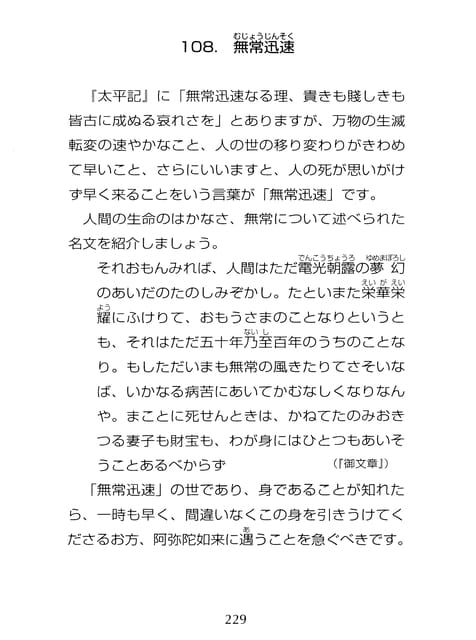
Page 230
むじようじんそく108.無常迅速『太平記』に「無常迅速なる理、貴きも賎しきも皆古に成ぬる哀れさを」とありますが、万物の生滅転変の速やかなこと、人の世の移り変わりがきわめて早いこと、さらにいいますと、人の死が思いがけず早く来ることをいう言葉が「無常迅速」です。人間の生命のはかなさ、無常について述べられた名文を紹介しましょう。でんこうちょうろゆめまぼろしそれおもんみれば、人間はただ電光朝露の夢幻のあいだのたのしみぞかし。たといまた栄華栄えいがえいよう耀にふけりて、おもうさまのことなりというとないしも、それはただ五十年乃至百年のうちのことなり。もしただいまも無常の風きたりてさそいなば、いかなる病苦にあいてかむなしくなりなんや。まことに死せんときは、かねてたのみおきつる妻子も財宝も、わが身にはひとつもあいそうことあるべからず(r御文章』)「無常迅速」の世であり、身であることが知れたら、一時も早く、間違いなくこの身を引きうけてくあださるお方、阿弥陀如来に遇うことを急ぐべきです。229
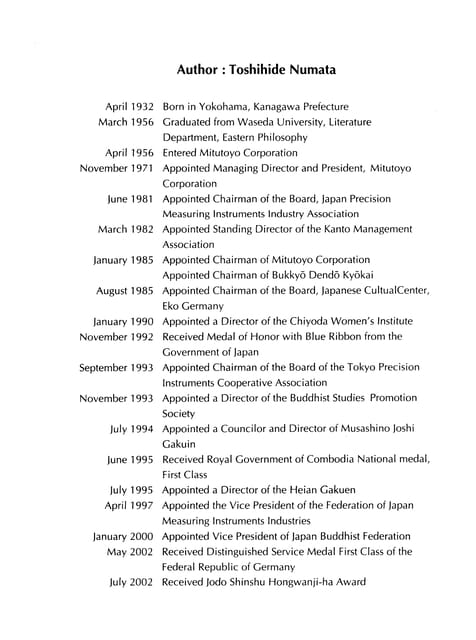
Page 231
Author:ToshihideNumataApril1932March1956April1956November1971iune1981March1982january1985August1985january1990November1992September1993November1993July1994iune1995july1995April1997january2000May2002july2002BorninYokohama,KanagawaPrefectureGraduatedfromWasedaUniversity,LiteratureDepartment,EasternPhilosophyEnteredMitutoyoCorporationAppointedManagingDirectorandPresident,MitutoyoCorporationAppointedChairmanoftheBoard,JapanPrecisionMeasuringInstrumentsIndustryAssociationAppointedStandingDirectoroftheKantoManagementAssociationAppointedChairmanofMitutoyoCorporationAppointedChairmanofBukky6Dend~Ky5kaiAppointedChairmanoftheBoard,iapaneseCultualCenter,EkoGermanyAppointedaDirectoroftheChiyodaWomen'sInstituteReceivedMedalofHonorwithBlueRibbonfromtheGovernmentofjapanAppointedChairmanoftheBoardoftheTokyoPrecisionInstrumentsCooperativeAssociationAppointedaDirectoroftheBuddhistStudiesPromotionSocietyAppointedaCouncilorandDirectorofMusashinoJoshiGakuinReceivedRoyalGovernmentofCombodiaNationalmedal,FirstClassAppointedaDirectoroftheHeianGakuenAppointedtheVicePresidentoftheFederationofJapanMeasuringInstrumentsIndustriesAppointedVicePresidentofJapanBuddhistFederationReceivedDistinguishedServiceMedalFirstClassoftheFederalRepublicofGermanyReceivediodoShinshuHongwanji-haAward